Tag

Heap Overflow

All articles tagged with #heap overflow

Erlang OTP Flaw CVE-2026-116293 Allows Remote VM Crash via Malformed Binary Decoding
technology1 hour ago

Erlang OTP Flaw CVE-2026-116293 Allows Remote VM Crash via Malformed Binary Decoding

A high-severity vulnerability in Erlang OTP allows attackers to crash the entire Erlang VM by sending a malformed binary term. The flaw, CVE-2026-116293, stems from improper validation of reference lengths in the external term decoder, leading to out-of-bounds writes. Patches are available for OTP 27.3.4.20, 28.5.0.9, and 29.1.3.


ASUSTOR ADM Wi-Fi Handler Flaw Allows Authenticated Users to Crash Services
cybersecurity6 hours ago

ASUSTOR ADM Wi-Fi Handler Flaw Allows Authenticated Users to Crash Services

A medium-severity heap-based buffer overflow vulnerability, identified as CVE-2026-120939, has been disclosed in ASUSTOR’s ADM network management software. The flaw exists in the Wi-Fi connection handler and allows an authenticated administrator to corrupt heap memory by submitting an oversized pre-shared key. This action terminates the affected CGI request, resulting in a denial of service for that specific service. The vulnerability affects ADM versions 4.1.0 through 4.3.3.RY62 and 5.0.0 through 5.1.4.RM62. ASUSTOR has released a security advisory to address the issue. The CVSS 4.0 score is 5.1, reflecting low availability impact but high privilege requirements.

ASUSTOR ADM Network Settings Flaw Allows Authenticated Admins to Crash System
cybersecurity6 hours ago

ASUSTOR ADM Network Settings Flaw Allows Authenticated Admins to Crash System

A medium-severity heap-based buffer overflow vulnerability, CVE-2026-120938, affects ASUSTOR ADM software versions 4.1.0 through 4.3.3.RY62 and 5.0.0 through 5.1.4.RM62. The flaw exists in the Link Aggregation handler within Network Settings, where insufficient bounds checks allow an authenticated administrator to submit excessive interface tokens. This action can corrupt memory and terminate the privileged CGI process, causing a denial of service. The vulnerability carries a CVSS 4.0 score of 5.1, reflecting its medium severity and the requirement for high privileges to exploit.

FFmpeg 9.1 Release Addresses Heap Out-of-Bounds Read in Curves Filter
cybersecurity11 hours ago

FFmpeg 9.1 Release Addresses Heap Out-of-Bounds Read in Curves Filter

FFmpeg has released version 9.1 to patch a medium-severity heap out-of-bounds read vulnerability identified as CVE-2026-135745. The flaw exists in the curves filter within libavfilter/vf_curves.c and affects all versions prior to 9.1. Attackers can exploit this by crafting video files containing unmasked gbrp9 to gbrp14 samples processed through the rawvideo decoder, allowing them to read past lookup tables. This can result in application crashes or the leakage of heap contents into output video. The vulnerability is classified as CWE-125, with a CVSS 3.1 score of 6.1 and a CVSS 4.0 score of 6.9, both rated as Medium severity. Exploitation requires local access and user interaction, but no special privileges are needed.

FFmpeg 9.1 Patch Resolves Heap Corruption in EIA-608 Filter
technology11 hours ago

FFmpeg 9.1 Patch Resolves Heap Corruption in EIA-608 Filter

A high-severity vulnerability in FFmpeg versions prior to 9.1 allows attackers to corrupt heap memory through crafted video files. The flaw exists in the readeia608 filter, where the build_histogram function fails to clamp high bit-depth luma samples. Exploitation requires local access and user interaction but can lead to crashes or code execution.

Patch Released for NGINX Two-Pass Overflow That Could Enable Remote Code Execution
technology4 months ago

Patch Released for NGINX Two-Pass Overflow That Could Enable Remote Code Execution

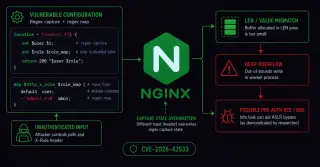
F5 issued fixes for a critical NGINX flaw (CVE-2026-42533) that lets a remote, unauthenticated attacker trigger a heap buffer overflow in the script engine via a specific two-pass evaluation of regex-based maps, potentially causing a crash or remote code execution if ASLR is disabled. All versions up to 1.31.2 are affected; upgrade to nginx 1.30.4 (stable), 1.31.3 (mainline), or NGINX Plus 37.0.3.1. As a temporary mitigation, switch affected regex maps to named captures, though full remediation requires upgrading; exposure depends on configuration, not just version.