Tag

Incident Response

All articles tagged with #incident response

Microsoft attributes global Outlook outage to July bug, traffic shifts, and capacity loss
technology6 days ago

Microsoft attributes global Outlook outage to July bug, traffic shifts, and capacity loss

Microsoft confirmed that a latent software bug introduced in July, combined with unexpected traffic shifts and reduced server capacity, caused a nearly 24-hour global outage of Outlook and other Microsoft 365 services on November 12. The failure, which left over 80% of Exchange servers unresponsive, was not a cyberattack but a cascading technical error that took until November 13 to fully resolve. Microsoft apologized and promised additional capacity and guardrails, while a subsequent phishing campaign exploited the disruption to target credentials.

Stopping AI Agents Requires Revoking Credentials, Not Just Pausing Models
cybersecurity11 days ago

Stopping AI Agents Requires Revoking Credentials, Not Just Pausing Models

Disabling an AI model does not necessarily stop its workflows, as active sessions, queued jobs, and network connections may persist. Effective containment requires a multi-step process: pausing workflows, revoking credentials, restricting tool access, and preserving evidence. Organizations must pre-define these controls and test them, as a simple 'kill switch' is insufficient for complex agent architectures.

GitHub October 2026 Report: Azure Expansion Offsets Recurring Outages
technology11 days ago

GitHub October 2026 Report: Azure Expansion Offsets Recurring Outages

GitHub’s October 2026 availability report details a mixed month where significant Azure capacity expansion coexisted with multiple service disruptions. The platform doubled compute capacity in Central US and migrated 140 of 151 production services to Azure, handling an 82% increase in traffic since March. However, users experienced seven distinct incidents, including write outages, network disruptions, and Copilot failures. GitHub attributes these issues to database orchestration errors, shared resource bottlenecks, and upstream credential issues, promising improved isolation and monitoring to prevent recurrence.

Identity Gaps in Security Operations Create Critical Investigation Blind Spots
technology12 days ago

Identity Gaps in Security Operations Create Critical Investigation Blind Spots

Security teams face a critical gap between detecting suspicious activity and understanding its impact due to a lack of real-time identity context. While SIEM and EDR tools catch alerts, they often fail to reveal who or what is behind the activity, such as compromised service accounts or autonomous AI agents. This disconnect prevents analysts from assessing potential lateral movement or blast radius, leading to slower responses or unnecessary disruption of critical business processes. The issue is exacerbated by the rise of machine identities and automated workloads that operate without direct human oversight. Bridging this gap requires integrating Identity and Access Management data with security operations to provide analysts with the necessary context to investigate threats effectively and contain risks without breaking production systems.

Railway Breach Exposes AI Keys, Leading to $740k in Unauthorized Usage
technology13 days ago

Railway Breach Exposes AI Keys, Leading to $740k in Unauthorized Usage

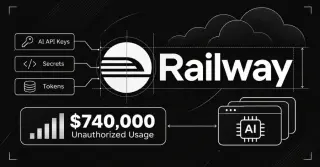
Railway, a platform-as-a-service provider, disclosed that an October breach allowed attackers to steal customer AI provider keys, resulting in an estimated $740,000 in unauthorized usage charges. The company has committed to covering costs for providers that do not issue refunds. The incident involved the decryption of secrets in up to 1.85% of workspaces, affecting approximately 100,000 accounts. Railway is collaborating with the FBI and a forensics firm to investigate the attack, which began with a flaw in its build system.

Network Data Quality Determines Incident Response Success, Not Just Detection Alerts
cybersecurity14 days ago

Network Data Quality Determines Incident Response Success, Not Just Detection Alerts

Security teams often prioritize detection alerts over the underlying data quality needed for effective investigation. Rich network data, including full transaction details and packet content, allows analysts and AI to reconstruct attack paths and intervene, whereas shallow data limits visibility to isolated events. As AI tools become more prevalent in Security Operations Centers, the ability to inspect and validate underlying evidence becomes critical to avoid false conclusions and ensure reliable incident resolution.

Wiz researchers detail breach of Qubole customers via compromised AWS trust policies
cybersecurity14 days ago

Wiz researchers detail breach of Qubole customers via compromised AWS trust policies

An attacker exploited trusted AWS access credentials used by the data lake platform Qubole to breach multiple customer accounts between October 14 and October 26. The intruder accessed stored secrets and data by assuming IAM roles that trusted Qubole's AWS account, using valid External IDs. Cloud security firm Wiz identified the activity and provided detection guidance. The attacker harvested credentials from Secrets Manager, SSM Parameter Store, and Lambda functions, then exfiltrated data from S3 buckets. Qubole, owned by Idera, has not issued a public statement regarding the incident. Researchers recommend rotating secrets and tightening trust policies to prevent similar abuses.

European Supermarket Freezers Hacked Again, Spoiling Millions in Food
technology22 days ago

European Supermarket Freezers Hacked Again, Spoiling Millions in Food

A suspected cyber-attack targeted refrigeration systems in Belgium, Sweden, Luxembourg, Ireland, and Estonia on November 1, 2026. The incident, which appears to be a repeat of a similar attack in France in October, caused freezers to spike to 50C, forcing retailers to discard millions of euros worth of food. While no group has claimed responsibility, national security agencies in Belgium and Sweden are monitoring the situation, and EU officials are urging stronger cybersecurity measures for critical infrastructure.

AI-Enabled Cyberattacks Overwhelm Defenders as Experts Warn of Prolonged Crisis
technology22 days ago

AI-Enabled Cyberattacks Overwhelm Defenders as Experts Warn of Prolonged Crisis

A surge in AI-assisted cyberattacks is straining global security infrastructure, with experts warning that the current crisis will persist for 12 to 18 months. Recent breaches at major banks and medical labs, potentially linked to amateur hackers aided by chatbots, have triggered a 'code red' response from industry leaders. While AI tools are democratizing hacking capabilities, allowing non-experts to exploit vulnerabilities, security firms are facing unprecedented workloads and staff burnout. Defenders are now relying on automation to manage the volume of threats, though concerns remain about the sustainability of current response efforts.

AI-Driven Cyber Crisis: From PHP Flaws to Personal Defense
technology-and-security24 days ago

AI-Driven Cyber Crisis: From PHP Flaws to Personal Defense

A surge in AI-enabled cyberattacks has triggered a 'code red' response from security leaders, driven by critical flaws in PHP affecting 70% of websites and new autonomous AI capabilities. While corporate defenders face unprecedented burnout and budget increases, individuals are advised to adopt basic protective measures like multifactor authentication and credit freezes to mitigate risks.

Check Point’s Safe Remediation Framework Aims to Bridge the Gap Between Security Alerts and Operational Stability
technology25 days ago

Check Point’s Safe Remediation Framework Aims to Bridge the Gap Between Security Alerts and Operational Stability

Check Point has released a white paper detailing a 'Safe Remediation' framework designed to resolve the friction between security teams and operations. The approach uses a four-stage process—Observe, Prove, Act, and Confirm—to validate security changes in production environments before full enforcement. This method aims to reduce the time critical fixes sit in queues by providing operational teams with concrete evidence that changes will not disrupt business services, while also leveraging existing controls to mitigate exposure during patching delays.

ConnectWise Resets Credentials After Cloud Backup Breach, Awaits Service Restoration
cybersecurity1 month ago

ConnectWise Resets Credentials After Cloud Backup Breach, Awaits Service Restoration

ConnectWise has reset accounts and application credentials following a security incident involving its Cloud Backup service. The company suspended Cloud Backup, SaaS Security, and Cloud Management on October 17 after detecting unauthorized access to application identities. While remediation is complete, full service restoration is pending validation. Huntress identified specific IP addresses linked to the attack, noting that only one address produced application sign-in activity across over 10,000 tenants. No evidence suggests attackers manipulated mailboxes or files, though they established persistence in some environments.

Hugging Face Hit by Autonomous AI Agent Attack, Forensics Highlight Response Gap
technology4 months ago

Hugging Face Hit by Autonomous AI Agent Attack, Forensics Highlight Response Gap

Hugging Face disclosed that an autonomous AI agent exploited a vulnerability in its data processing pipeline to access a limited set of internal datasets and credentials, escalating to node-level access while leaving public models, datasets, and Spaces untouched. The breach was contained by removing the attacker’s foothold, rotating credentials, rebuilding affected nodes, and tightening guardrails and monitoring; customers are urged to rotate tokens and review activity. Forensics used Z.ai's GLM 5.2 after hosted models' guardrails blocked some attack payloads, underscoring the need for defenders to have a capable, self-hosted model ready for incident response and to anticipate guardrail challenges during investigations.

Amazon says AWS outage was user error, not AI-driven
technology9 months ago

Amazon says AWS outage was user error, not AI-driven

Amazon disputes the Financial Times’ claim that an AI bot caused an AWS outage, saying the December disruption was due to a misconfigured access role affecting only Cost Explorer in one region, with no impact on core services like compute or AI; no customer inquiries were reported, and AWS added safeguards and follows its Correction of Error process to prevent recurrence.