Tag

Lab Automation

All articles tagged with #lab automation

Anthropic Puts Guardrails on AI’s First Steps in the Physical World
technology1 day ago

Anthropic Puts Guardrails on AI’s First Steps in the Physical World

Anthropic unveiled Model Hardware Standard, a rules-based framework guiding how AI agents interact with physical hardware (microscopes, robots, manufacturing gear, quantum devices) to speed up science and manufacturing while embedding safeguards. The goal is to let AI automate experimental workflows with safety guardrails and to validate the approach with trusted partners before broad release, addressing concerns about potential misuse and rogue behavior as AI moves into the physical world.

AI agent teams accelerate scientific discovery
technology3 months ago

AI agent teams accelerate scientific discovery

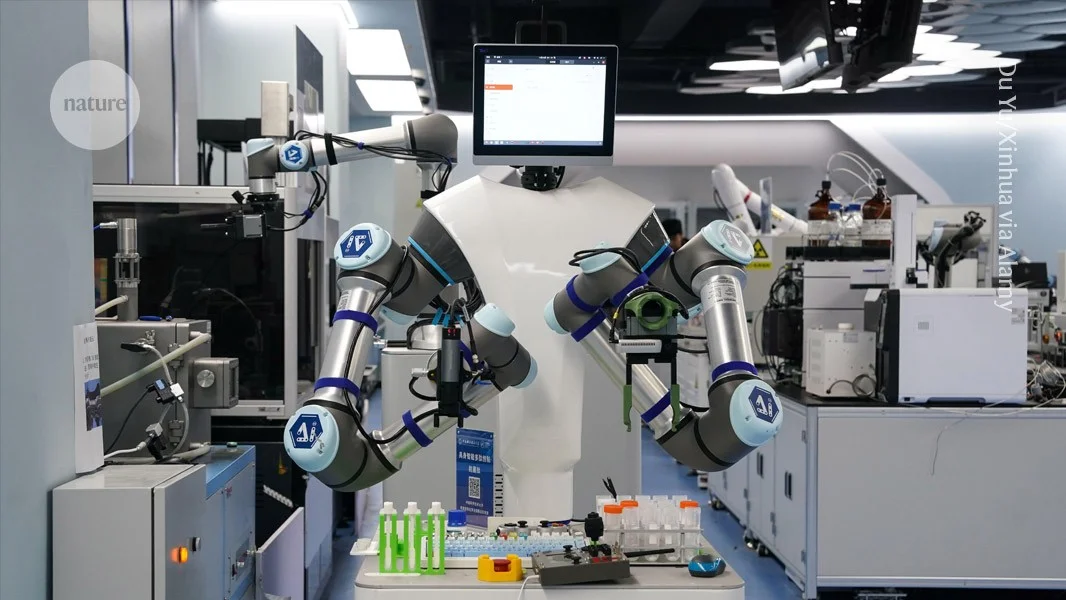
Two AI-agent systems described in Nature—Google DeepMind's Co-Scientist and FutureHouse's Robin—use teams of AI to generate hypotheses, pick experiments, and analyze data to speed up early drug-discovery work. In initial tests they proposed plausible repurposing candidates for AML and dry AMD, with humans carrying out the experiments and validating results; while promising, most candidates require further validation in broader use.

AI-powered robot labs slash protein-synthesis costs, but humans still needed
technology6 months ago

AI-powered robot labs slash protein-synthesis costs, but humans still needed

A collaboration between OpenAI and Ginkgo Bioworks used a GPT-5–driven autonomous lab to optimize cell-free protein synthesis, achieving a 40% further cost reduction beyond a human-led record and testing more than 30,000 conditions in six months. While the approach shows promise, current robots still lack dexterity for bespoke or tissue-related experiments, meaning human biologists’ expertise remains essential for future breakthroughs.

Exploring Bacterial Metabolism through Gaming.
microbiology3 years ago

Exploring Bacterial Metabolism through Gaming.

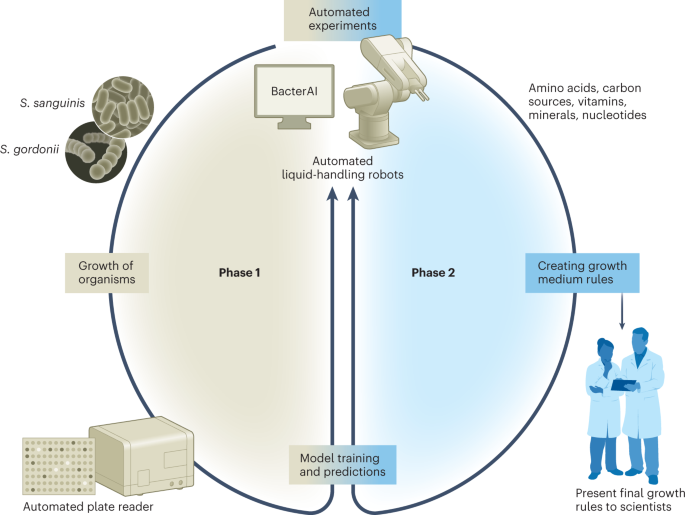
BacterAI, an integrated lab automation and machine learning platform, could help overcome the challenges of culturing understudied microorganisms by learning appropriate culture conditions as a game. Currently, fewer than 2% of all microbial species are culturable due to a lack of knowledge about growth requirements and the tedious, labour-intensive experiments that stand in the way of this essential knowledge. BacterAI could be the future of studying microbial diversity and discovering novel bioactive molecules such as antibiotics.