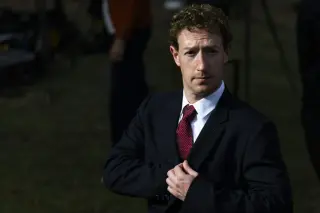
Meta founder Mark Zuckerberg’s 387-foot megayacht Launchpad anchored in Seattle’s Lake Union drew crowds along the shore and on the water, sparking social-media buzz and questions about wealth amid Meta’s latest Washington layoffs.
Mark Zuckerberg’s LaunchPad, a $300 million, 387-foot yacht, docked on Seattle’s Lake Union near Meta’s offices as Meta cuts about 1,400 Seattle-area jobs; crew say Zuckerberg wasn’t aboard, and local marina staff note mega yachts often visit for provisioning.
Kotaku reports leaked audio in which Mark Zuckerberg says Meta's AI is trained by watching ‘really smart people’ at the company as about 8,000 employees are laid off (10% of the workforce) and thousands more reassigned to AI initiatives, amid criticism over employee device tracking and Meta’s ongoing AI pivot.
Meta cut about 8,000 jobs (roughly 10% of staff) in three waves, with 7,000 reassigned to AI projects and roughly 6,000 roles scrapped. In an email to remaining employees, Mark Zuckerberg promised there would be no further company-wide layoffs this year and acknowledged that Meta’s communications during the layoffs had been poor. The company is pouring money into AI-related infrastructure and research, and severance for those let go includes 16 weeks’ pay plus 2 weeks per year worked, plus 18 months of COBRA coverage, as the corporate rethink continues for what survives—about 70,000 employees.
Meta CEO Mark Zuckerberg sent an internal email promising fewer or no companywide layoffs in 2026, thanking the roughly 8,000 laid-off employees, and stressing stability for those remaining while acknowledging communication missteps. The note marks a shift from the firm’s hard-charging, cost-cutting posture under the “Year of Efficiency” to a more empathetic tone as Meta reorganizes about 7,000 staff to focus on AI. Analysts say the reassurance could reduce productivity-harming layoff anxiety, but the ultimate impact depends on how well the company executes its AI-driven strategy and ongoing restructuring.
Meta has cut 10% of its workforce today, but CEO Mark Zuckerberg says there will be no further company-wide layoffs this year, though targeted reductions in divisions like Reality Labs could occur. He emphasizes AI as a strategic focus while trying to balance staff stability with faster, less-bureaucratic teams and greater ownership.
Meta CEO Mark Zuckerberg has moved his desk into the AI lab to code alongside researchers, reinforcing hands-on involvement as Meta expands its Superintelligence Labs and pushes new AI models like Muse Spark.
Meta is reportedly developing a photorealistic AI avatar of Mark Zuckerberg, trained on his mannerisms and public statements, to interact with employees. The move underscores Meta’s push into lifelike AI characters and wearables, but civil rights groups warn that adding facial recognition to smart glasses could empower predators and are calling for more transparency about any talks with authorities.
Meta is reportedly training an AI version of Mark Zuckerberg to respond to employee queries, using his voice and likeness to boost internal engagement, as part of a broader push to embed AI in Meta’s operations, including a CEO agent to speed up access to internal information.
At CinemaCon, Aaron Sorkin’s sequel The Social Reckoning got its first look, with Jeremy Strong playing Mark Zuckerberg opposite Mikey Madison’s Frances Haugen and WSJ reporter Jeff Horwitz in tow. The trailer hints at a David-versus-Goliath whistleblower tale about Facebook’s harms and misinformation, as Sorkin frames a high-stakes confrontation that could shape awards Momentum, ahead of its wide Oct. 9 release.
Meta is developing photorealistic, AI-powered 3D versions of Mark Zuckerberg to interact with employees, with Zuckerberg personally involved in training; if successful, the avatar could let staff converse with the founder in real time and even enable others to build their own AI versions, though some staff fear it could signal job cuts.
Meta is reportedly training an AI avatar of Mark Zuckerberg—based on his image, voice, and mannerisms—to interact with employees and provide feedback, a move that could let creators later make AI versions of themselves if the experiment succeeds; Zuckerberg is involved and also dedicates several hours weekly to other Meta AI projects, with related reporting from the Financial Times and The Wall Street Journal.
President Trump named 13 members to the President's Council of Advisors on Science and Technology (PCAST), making the panel heavily tech‑industry dominated with 12 technology executives and a lone academic, John Martinis of UC Santa Barbara. The lineup features Mark Zuckerberg, Larry Ellison, Sergey Brin, Jensen Huang, Lisa Su, and Michael Dell, among others, with two MIT‑educated leaders in nuclear-energy startups noted. Critics lament the absence of biologists and university researchers, arguing biotech balance is lacking, though Trump could add up to 11 more members under a 2025 order. PCAST advises the White House on science policy and reviews cross‑agency programs.
Mark Zuckerberg and Priscilla Chan sat front row at Prada’s Milan show, dressed in head-to-toe Prada, amid chatter about a possible Meta collaboration on smart glasses; the moment circulated online and drew mixed reactions from fashion insiders.
Meta CEO Mark Zuckerberg testified in a high‑profile Los Angeles bellwether case accusing Facebook and Instagram of being designed to be addictive and targeting teens. He offered guarded, rehearsed answers and insisted the platforms provide value rather than pursuing excessive engagement, while plaintiffs cited internal documents suggesting goals to maximize usage and minutes spent. A large Instagram post tarp used as evidence underscored the stakes as the trial—one of roughly 1,600 similar suits—could influence liability standards for tech platforms and debates over content moderation and youth safety.