FFmpeg versions prior to 9.1 contain a high-severity out-of-bounds write vulnerability in the Ogg encoder. The flaw, triggered by failed memory allocation, allows heap corruption and crashes when writing Ogg output. Patches are available via recent commits.
A high-severity double-free vulnerability, CVE-2026-135723, has been identified in FFmpeg versions prior to 9.1. The flaw exists in the fill_marker() function within the IMF CPL parser, where a Marker label is freed without clearing the pointer if default scope allocation fails. Attackers can exploit this by supplying a crafted Composition Playlist with a Marker Label lacking a scope attribute, triggering a second free under memory pressure. This can lead to memory corruption or application crashes. The issue was patched in FFmpeg 9.1.
A double-free vulnerability in libical versions prior to 4.0.7 allows attackers to crash applications by supplying truncated iCalendar input. The flaw, identified as CVE-2026-134761, occurs in the icalparser_clean function when a component is freed twice due to missing END lines. Rated 5.8 Medium, the issue requires local access and user interaction but poses a high risk to availability. A patch is available in version 4.0.7.
The GnuPG project has released urgent updates for GPGME, a core library used by mail clients, Samba, and other applications, to fix a critical memory flaw. The bug, identified as CVE-2026-129975, allows attackers to potentially steal data or execute code by sending malicious OpenPGP keys with unusually long user IDs. The vulnerability stems from a double-free error in how the library processes status lines and key listings. While no active exploitation has been reported, the project warns that remote code execution cannot be ruled out. Fixed versions, including GPGME 2.3.1 and Gpg4win 5.1.2, are now available, though statically linked applications require specific rebuilds to patch the issue.
A critical out-of-bounds write vulnerability in Google’s Brotli decoder, identified as CVE-2026-111497, affects a wide range of software beyond Node.js. The flaw, which allows unauthenticated attackers to corrupt memory or execute code, has been confirmed in .NET, FFmpeg, ClickHouse, Apache Arrow, and Python packages. While Node.js and several other platforms have released patches, some distributions and applications remain unpatched, requiring immediate remediation or temporary workarounds to prevent exploitation.
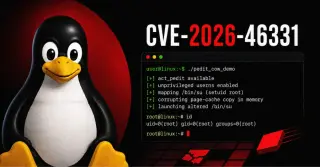
A Linux kernel flaw in the traffic-control pedit action (CVE-2026-46331, 'pedit COW') lets a local unprivileged user corrupt the in-memory page cache and inject a root payload into a cached setuid binary, yielding root access without touching disk. The exploit requires unprivileged user namespaces with CAP_NET_ADMIN and has been demonstrated on RHEL 10 and Debian 13; Ubuntu variants show mixed susceptibility due to AppArmor defaults. Patches have been released by vendors; recommended actions are patching and rebooting, or mitigating by disabling the act_pedit module or turning off unprivileged user namespaces. Because the overwrite hits memory, file-integrity scans may miss it, and a compromised host should be treated as such.
Researchers analyze CVE-2026-32746, a pre-auth RCE in GNU inetutils Telnetd via a LINEMODE SLC buffer overflow. The issue stems from overflowing a small slcbuf when processing SLC triplets during LINEMODE negotiation, with exploitation heavily dependent on OS and architecture (64-bit vs 32-bit); while a reliable full RCE wasn't achieved across tested targets, a heap leak and an arbitrary-free primitive were demonstrated, potentially enabling code execution under favorable libc conditions. The vulnerability affects inetutils Telnetd and many forks across major distros (Ubuntu, Debian, FreeBSD, NetBSD, macOS, etc.), and patches have not been widely released at publication time. Detection strategies include probing for LINEMODE support and non-invasive overflow checks; watchTowr provides a detection artifact generator. Patch urgently, but note there is no universal fixed version yet; users should build from fixed commits or apply vendor mitigations.
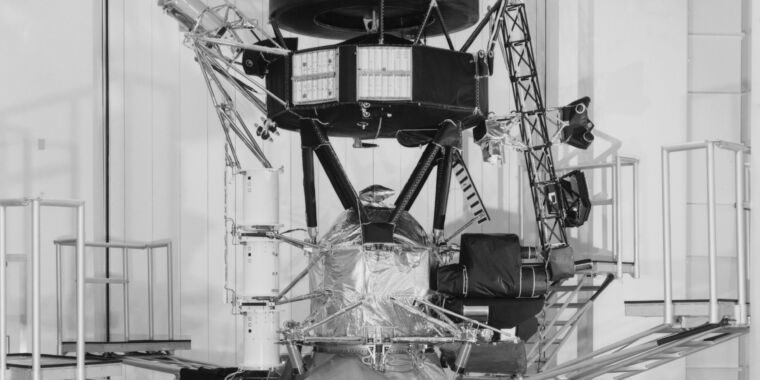
NASA engineers have identified corrupted memory as the cause of Voyager 1's data transmission issues and are working on a remote fix for the hardware problem from 15 billion miles away. The corrupted memory, likely caused by either wear and tear or energetic particles, is hindering the spacecraft's Flight Data System (FDS) from operating normally. Despite being out of physical reach, engineers are optimistic about finding a software solution to enable Voyager 1 to resume sending science and engineering data back to Earth.
NASA engineers have identified a small portion of corrupted memory as the cause of Voyager 1's transmission issues, preventing the Flight Data System (FDS) from operating normally. The spacecraft, located 15 billion miles from Earth, has been beaming unreadable data for nearly five months. Despite the challenges posed by its distance and communication delays, engineers are optimistic about finding a way for the FDS to operate without the unusable memory hardware, allowing Voyager 1 to resume transmitting science and engineering data.