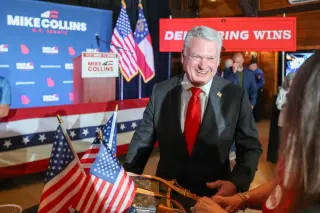
Republican leadership is deprioritizing North Carolina and Georgia Senate races as polls show deficits for nominees Michael Whatley and Mike Collins. While the NRSC redirects funds to defend red states and flip competitive seats, party leaders publicly deny abandoning the states, citing late-breaking potential and high costs in other races.
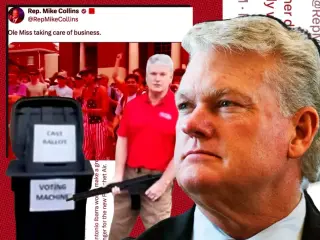
A TPM investigation details how Georgia Rep. Mike Collins’ 2026 Senate bid is increasingly defined by ties to fringe figures: a former intern posted KKK imagery and a swastika, a campaign aide linked to white supremacists, a chief of staff who helped a known Holocaust denier, and a son-in-law who has promoted white nationalism. Collins has publicly denounced antisemitism in some instances, but his social-media history and ongoing associations have drawn renewed scrutiny as opponent Jon Ossoff leads in polls.
A former staffer for Rep. Mike Collins (R-Georgia) posted a swastika image and a photo of himself in Ku Klux Klan robes on X in June and July, highlighting ongoing controversy around Collins’ associates as he campaigns for the Senate against Jon Ossoff.
A Fox News poll of 1,002 Georgia registered voters shows Democrat Jon Ossoff leading Republican Mike Collins 56% to 43%, helped by broad Democratic loyalty and cross-ethnic appeal (Black voters 87%, under-30 68%, independents 68%, moderates 66%, women under 45 66%). Collins leads with White evangelicals, White men without college degrees, and rural voters. Among Collins supporters, 89% are Republicans but only 56% say their vote is for Collins (44% say against Ossoff). Nearly a quarter of non-MAGA Republicans back Ossoff, while about 4% of MAGA supporters do. Ossoff’s favorability is 58% to 44% for Collins; inflation (40%) is the top issue, with Ossoff stronger on inflation, healthcare, and political divisions, and Collins stronger on immigration. The poll also notes some cross-ticket voting and a Georgia governor race where Bottoms leads 52-47. Margin of error ±3 percentage points.
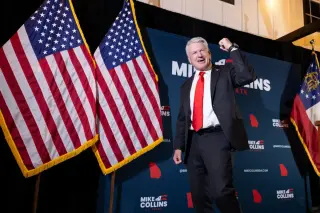
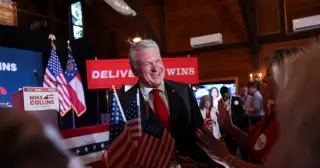
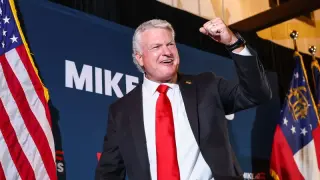
Rep. Mike Collins won Georgia’s Republican Senate runoff and will face incumbent Sen. Jon Ossoff in November; Collins, a businessman and former chair of a major Georgia credit union, ran on a conservative record, while Ossoff criticized him in response to the result.
Georgia Republicans finally named Mike Collins as their Senate nominee, but Jon Ossoff holds a massive fundraising edge (Ossoff about $60 million raised and $32 million cash on hand vs Collins’s $4.9 million raised and $1.2 million cash), leaving Collins with a steep path to victory. Democrats plan about $20 million in support, and GOP groups are scrambling to mobilize outside money after Collins’ win. The race will test GOP unity post‑primary, Trump’s endorsement momentum, and the battle to keep/flip Georgia in a pivotal 2026 contest.
Trump’s late endorsement helped Rep. Mike Collins defeat Kemp-backed Derek Dooley in the Georgia GOP Senate runoff, setting up a fall race against Democrat Jon Ossoff; in the governor’s contest, Rick Jackson—backed by both Trump and Kemp—defeated Jones. The results underscore Trump’s continued sway in GOP primaries but also show mixed outcomes for his nominees elsewhere, with Ossoff remaining a strong fundraiser in a competitive state and 2028 chatter already percolating as the 2026 cycle unfolds.
Trump unexpectedly endorsed Rep. Mike Collins for Georgia’s U.S. Senate race after private talks about Collins’s abortion stance, a late move that could shift the runoff against Derek Dooley as voters weigh electability.
President Trump’s endorsement of Rep. Mike Collins in Georgia’s GOP Senate runoff has sparked intra-party anxiety that Collins’ baggage and hardline abortion stance could cost Republicans the seat in a battleground state, even as Ossoff holds a fundraising edge; with Gov. Kemp backing Derek Dooley, the race underscores Georgia’s shift toward competitiveness and the need for the GOP to rebuild its base to win in November.
Trump endorsed Rep. Mike Collins in Georgia’s GOP Senate runoff against Derek Dooley, praising Collins’ MAGA alignment and criticizing Dooley’s refusal to promote 2020 election conspiracy theories. Collins remains the frontrunner despite a string of controversy over social posts and staffers tied to far-right groups, with the winner facing Democrat Jon Ossoff in the general election.
President Donald Trump endorsed Rep. Mike Collins for Georgia’s Republican Senate runoff against Derek Dooley, boosting Collins as he aims to face Democrat Jon Ossoff in November. Collins led Dooley by double digits in the primary, and the race could determine Senate control; Trump’s endorsement comes as Kemp backs Dooley, highlighting a high-stakes contest where Collins could benefit from the president’s backing and Dooley’s campaign faces scrutiny over voting history and alignment with Trump’s circle.
Former President Donald Trump endorsed Rep. Mike Collins in the Georgia Republican Senate runoff, boosting Collins as he faces Derek Dooley after Collins led the May 19 primary with 40% to Dooley’s 30%. Governor Kemp backs Dooley, while Collins emphasizes Trump support and has hired top Trump aides; the runoff winner will face Democrat Jon Ossoff in the general election.
President Donald Trump endorsed Republican Mike Collins in Georgia's Senate runoff, continuing his MAGA-backed push in GOP primaries as Democrats aim to defend Sen. Jon Ossoff's seat.
President Donald Trump endorsed Rep. Mike Collins in Georgia’s Republican Senate runoff, a move that spots Collins with Trump’s MAGA backing in the final days before Tuesday’s vote and sets up a proxy clash with Gov. Brian Kemp. The endorsement comes after Collins led in the first round and follows months of behind-the-scenes jockeying; its ultimate impact on the race remains uncertain as Georgia Republicans weigh Trump’s influence against Kemp’s power in a must-win battleground state.
Georgia’s Republican Senate primary is headed to a runoff on June 16 after Rep. Mike Collins and ex-football coach Derek Dooley emerge as the top two contenders to face Democrat Jon Ossoff. Collins led the initial vote; Dooley edged Buddy Carter for second. Kemp has campaigned for Dooley, arguing he can win moderates and independents, while Dooley supporters tout electability and opponents highlight ethics scrutiny surrounding Collins. The outcome could shape party control of the Senate in a pivotal race for 2026.