
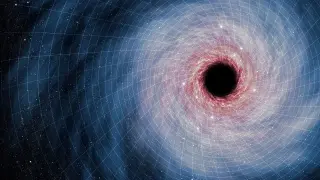
Space-time crystals as seeds for naked singularities and micro black holes, new theory suggests
A new theoretical study argues that a repeating pattern in space-time, called a space-time crystal, could mathematically give rise to naked singularities and microscopic black holes when general relativity is explored in higher dimensions. Using pen-and-paper methods and perturbation theory, the researchers derive analytic self-similar solutions that work in the limit of many dimensions, but in realistic finite dimensions the expressions require extra terms. Current numerical work only reaches up to about 14 dimensions, leaving a gap to fully connect the analytic results to a physical universe. The work shows mathematical possibility, not proof that such objects exist, revisiting Hawking’s historical debate about naked singularities and outlining future steps to bridge theory and numerics.