Tag

General Relativity

All articles tagged with #general relativity

Ancient Moon Mirrors Still Test Gravity With Millimeter Precision
space3 days ago

Ancient Moon Mirrors Still Test Gravity With Millimeter Precision

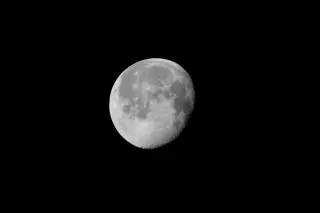
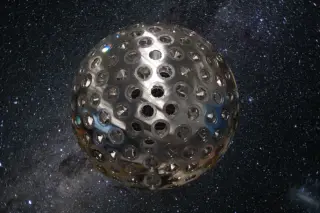
Apollo-era lunar retroreflectors remain functional, allowing Earth-based lasers to measure the Earth–Moon distance to millimeter precision. The Moon is slowly drifting away at about 3.8 cm/year due to tidal friction, enabling stringent tests of general relativity, with next-generation reflectors and DLLR aiming to improve measurements further.

Gravity Makes Time Local: Atomic Clocks Detect Millimeter-Scale Time Differences
science6 days ago

Gravity Makes Time Local: Atomic Clocks Detect Millimeter-Scale Time Differences

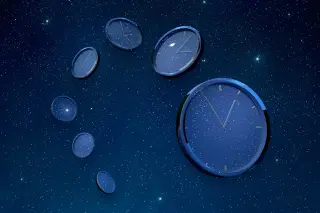
The most precise optical atomic clocks can now detect gravitational time dilation over a mere millimeter in a lab: clocks at the bottom run slightly slower than those at the top, enabling direct tests of general relativity at human scales. With precision around one part in 10^21—roughly one second in 30 billion years—this landmark achievement opens practical avenues for gravimetry, geophysics, and possibly redefining the second, signaling that time is locally shaped by gravity rather than universally uniform.

Cosmic Gravity Holds Its Ground Across Galaxy Clusters
astronomy1 month ago

Cosmic Gravity Holds Its Ground Across Galaxy Clusters

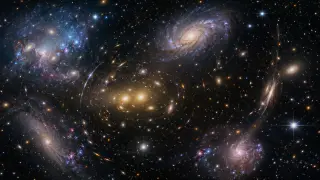
Using data from the Atacama Cosmology Telescope and the kinematic Sunyaev–Zeldovich effect, researchers tracked hundreds of thousands of galaxy clusters across hundreds of millions of light-years and found gravity obeys the inverse-square law on cosmological scales, aligning with Newtonian and Einsteinian gravity, reinforcing dark matter as the source of extra gravitational effects and challenging alternative gravity theories like MOND.

Black Holes May Carry Fermionic Hair, Defying Zero Tidal Response
space1 month ago

Black Holes May Carry Fermionic Hair, Defying Zero Tidal Response

New research using fermionic (Dirac) fields on rotating Kerr black holes suggests the traditional zero tidal Love number for black holes can be violated by fermionic perturbations, hinting at a possible fermionic hair and expanding how we probe black-hole structure—without overturning general relativity, but adding a new layer to black-hole phenomenology.

Relativity Could Explain Why Circumbinary Planets Are So Rare
astronomy1 month ago

Relativity Could Explain Why Circumbinary Planets Are So Rare

Astronomers expected hundreds of planets orbiting binary stars, but only 14 have been found. New work in The Astrophysical Journal Letters suggests Einstein’s general relativity drives precession of the stars’ orbits that resonates with a planet’s orbit, destabilizing it. In tight binaries, this leads to a large instability zone and an “80% survival gap” in which planets are likely ejected or swallowed by the stars. As a result, there’s a desert of circumbinary planets for systems with orbital periods under about seven days, and most observed planets sit just outside the unstable region—likely formed farther out and migrated inward to the stability edge.

Birth of a Magnetar Captured Inside a Brilliant Supernova
space2 months ago

Birth of a Magnetar Captured Inside a Brilliant Supernova

Astronomers have for the first time witnessed the birth of a magnetar—an ultra-strongly magnetized neutron star—at the heart of a rare, superluminous supernova (SN 2024afav). The event’s peculiar light curve, including four diminishing “chirps” caused by a Lense–Thirring precession of a disk around the newborn magnetar, provides the first observational link between such births and magnetar-powered superluminous explosions, with the object estimated to spin ~4.2 milliseconds and harbor a magnetic field about 300 trillion times Earth's.

Magnetar birth confirmed inside colossal supernova
astronomy2 months ago

Magnetar birth confirmed inside colossal supernova

Astronomers have confirmed the births of a magnetar—a highly magnetized, rapidly spinning neutron star—within a rapidly bright supernova, SN 2024afav. Analysis of the 200‑day light curve revealed four chirps caused by a wobbling accretion disk around the newborn magnetar, with general relativity’s frame‑dragging explaining the timing. The magnetar spins about 238 times per second and possesses a magnetic field hundreds of trillions of times stronger than Earth's, providing definitive evidence for the magnetar–superluminous supernova connection.

New Gravitational-Wave Catalog Expands the Testing Ground for Einstein’s Gravity
science2 months ago

New Gravitational-Wave Catalog Expands the Testing Ground for Einstein’s Gravity

A newly released, expanded catalog of gravitational-wave detections from LIGO, Virgo, and KAGRA more than doubles the known events, revealing a broader population of black holes and neutron-star mergers and enabling stringent tests of Einstein’s general relativity as gravity’s effects on spacetime are probed through mass, spin, and merger dynamics. The dataset deepens our understanding of spacetime warping and paves the way for real-time data releases from the collaboration.

Milky Way’s Core May Hide an Ultra-Magnetized Pulsar
astronomy3 months ago

Milky Way’s Core May Hide an Ultra-Magnetized Pulsar

Scientists suspect a rapidly spinning, highly magnetic neutron star (a pulsar) sits near the Milky Way’s center. A Breakthrough Listen radio survey with the Green Bank Telescope (2021–2023) found a single pulsar candidate, BLPSR, around 122 rotations per second. If confirmed, such a pulsar orbiting Sagittarius A* could serve as a precise cosmic clock to test general relativity in the extreme gravity near the galaxy’s supermassive black hole, though the Galactic Center is notoriously hard to survey. Future facilities like ngVLA and SKA could help determine how many pulsars truly populate the core.

Crystal-Clear Gravitational Wave Confirms Einstein’s General Relativity
science3 months ago

Crystal-Clear Gravitational Wave Confirms Einstein’s General Relativity

A record-high-quality gravitational wave signal from a binary black hole merger (GW250114) produced multiple ringdown tones that independently yield the same black-hole mass and spin, providing a precise test of general relativity that passes, while underscoring the ongoing pursuit of quantum gravity and related gaps in our understanding.

Record-Breaking Gravitational Wave Reaffirms Einstein’s Relativity
science3 months ago

Record-Breaking Gravitational Wave Reaffirms Einstein’s Relativity

Scientists detected the loudest gravitational wave signal to date, GW250114, from a black-hole merger roughly 1.3 billion light-years away. The exceptionally clear signal lets researchers test Einstein’s general relativity with unprecedented precision, including the ringdown phase and multiple vibration tones, reinforcing GR and propelling future gravitational-wave astronomy with next‑generation detectors like LISA.

Record-Breaking Gravitational Wave Tests Gravity — and Finds Einstein Right Again
science3 months ago

Record-Breaking Gravitational Wave Tests Gravity — and Finds Einstein Right Again

Scientists detected GW250114, the loudest gravitational-wave event yet, from a pair of about 30-solar-mass black holes merging around 1.3 billion light-years away, recorded by LIGO with unprecedented clarity thanks to detector upgrades. The signal allowed detailed tests of general relativity, including two primary ringdown tones and a newly identified overtone, all matching GR predictions and Hawking’s area theorem. This strengthens GR’s validity at extreme gravity and points to future tests with next‑generation detectors (Einstein Telescope, Cosmic Explorer) and space-based LISA.