Tag

Black Holes

All articles tagged with #black holes

Seven-Hour Gamma-Ray Burst Captured by Webb Defies Known Physics
science11 days ago

Seven-Hour Gamma-Ray Burst Captured by Webb Defies Known Physics

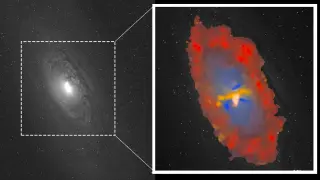
Using the James Webb Space Telescope and a global network of observatories, scientists detected GRB 250702B, a gamma-ray burst that lasted about seven hours—the longest on record and far longer than typical bursts. The event, occurring in a dusty galaxy about 8 billion light-years away, could arise from an extreme gamma-ray burst, a tidal disruption event, or a black-hole–star merger, but a definitive explanation remains elusive. The multi-wavelength observations highlight extreme physics in stellar death and black-hole interactions and offer a rare window into such phenomena.

From Frenzy to Freeze: Chandra Maps a 10-Billion-Year Slowdown in Black Hole Growth
science16 days ago

From Frenzy to Freeze: Chandra Maps a 10-Billion-Year Slowdown in Black Hole Growth

NASA’s Chandra X-ray Observatory shows that supermassive black holes grew rapidly in the early universe but have slowed dramatically over more than ten billion years, likely due to dwindling cold gas, fewer galaxy mergers, and feedback processes; the study combines multiple X-ray datasets to provide a comprehensive view of this long-term decline and its implications for how galaxies evolve.

Webb telescope spots mysterious red dots that baffle scientists
science23 days ago

Webb telescope spots mysterious red dots that baffle scientists

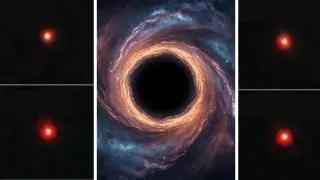
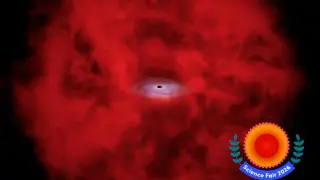
NASA’s James Webb Space Telescope images reveal hundreds of faint red dots dubbed little red dots (LRDs). While many researchers suspect they are powered by growing black holes in the early universe, their exact nature remains unclear, with hypotheses ranging from dust-enshrouded black holes to emission from dense hydrogen gas, and even a possible new class of objects called black-hole stars or quasi-stars, exemplified by the enigmatic feature “The Cliff.” The findings could reshape ideas about black-hole formation, but there is no consensus yet.

Black Hole Merger in Galactic Nucleus May Have Lit Up the Sky
science24 days ago

Black Hole Merger in Galactic Nucleus May Have Lit Up the Sky

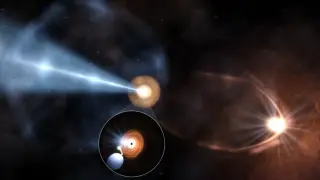
Astronomers connecting the November 2024 gravitational-wave event S241125n with a brief gamma-ray and X-ray flash propose the merger happened inside the accretion disk of a supermassive black hole at the center of a galaxy. If true, the environment would feed rapid accretion and jets, producing light from an event usually expected to be dark, offering a new scenario for how black hole mergers in galactic nuclei might be observed. Further observations and modeling are needed to confirm this explanation.

Webb telescope uncovers mysterious red dots, leaving scientists guessing
science24 days ago

Webb telescope uncovers mysterious red dots, leaving scientists guessing

NASA's James Webb Space Telescope has detected hundreds of tiny red points—dubbed little red dots (LRDs)—in deep-field images. Their nature remains uncertain, with leading ideas ranging from growing black holes shrouded by gas or dust to exotic 'black hole star' or quasi-star scenarios, and even hints from discoveries like 'The Cliff' that a new kind of cosmic object may exist; researchers hope closer local LRDs and continued Webb observations will reveal how these objects fit into black hole formation and galaxy evolution.

Webb’s Little Red Dots Spark New Theories on Black Hole Birth
space25 days ago

Webb’s Little Red Dots Spark New Theories on Black Hole Birth

The James Webb Space Telescope has captured hundreds of tiny red dots in deep-field images whose nature remains mysterious; early ideas centered on distant galaxies or dust-enshrouded black holes, but current thinking leans toward growing black holes surrounded by dense hydrogen gas, or even a new class called black hole stars (quasi-stars). A notable case nicknamed “The Cliff” challenges previous explanations and hints at exotic physics, but most LRDs are extremely distant and consensus awaits more nearby examples and data to settle their origins.

Radio Sky Census Unveils 13.7 Million Hidden Objects
science29 days ago

Radio Sky Census Unveils 13.7 Million Hidden Objects

Scientists released the LOFAR DR3 dataset—the largest radio sky survey to date—mapping about 13.7 million radio-emitting objects across 88% of the northern sky, drawn from 18.6 petabytes of data processed with Europe’s supercomputers; the survey reveals extreme phenomena like black-hole jets and distant active galaxies, and demonstrates the massive data-handling required to stitch signals from 70,000 antennas, setting the stage for future SKA projects and widespread follow-up studies.

Mixed black hole–neutron star mergers reveal eccentric orbits and hidden formation paths
astronomy1 month ago

Mixed black hole–neutron star mergers reveal eccentric orbits and hidden formation paths

Astronomers analyzing the GW200105 gravitational-wave signal found an eccentric, precession-lacking orbit for a black hole–neutron star binary just before merger, suggesting it was shaped by gravitational interactions with a third body and not by a quiet, isolated inspiral. Using a new model from Birmingham’s Institute of Gravitational Wave Astronomy, the team says there are likely multiple formation channels for such mixed mergers, and the event revised prior mass estimates (BH ~13 solar masses, NS ~2). The finding expands our understanding of how extreme binaries form and evolve and challenges the assumption of circular, isolated mergers.

128 New Gravitational-Wave Signals Redefine Black Hole Demographics
science1 month ago

128 New Gravitational-Wave Signals Redefine Black Hole Demographics

The LVK collaboration released Gravitational-Wave Transient Catalog 4.0 (GWTC-4), adding 128 new gravitational-wave candidates detected from 2015–2024, more than doubling the catalog. The expanded set reveals a wider variety of black-hole binaries, including very massive and rapidly spinning systems, enabling tests of general relativity and new measurements of the universe’s expansion (via the Hubble constant). This growth pushes gravitational-wave astronomy into new regions of parameter space and promises deeper insights into black-hole formation and cosmic evolution.

Gravitational‑wave catalog GWTC-4 doubles the event tally to 128
astronomy1 month ago

Gravitational‑wave catalog GWTC-4 doubles the event tally to 128

The LVK collaboration’s GWTC-4 catalog adds 128 distant gravitational‑wave sources detected from 2023–2024, expanding beyond the previous 90; the data include heavier, faster black‑hole mergers, some lopsided in mass, and two mixed black hole–neutron star mergers, with detections up to 10 billion light‑years away, underscoring general relativity under extreme conditions and expanding our view of black‑hole populations.

New Gravitational-Wave Catalog Expands the Testing Ground for Einstein’s Gravity
science1 month ago

New Gravitational-Wave Catalog Expands the Testing Ground for Einstein’s Gravity

A newly released, expanded catalog of gravitational-wave detections from LIGO, Virgo, and KAGRA more than doubles the known events, revealing a broader population of black holes and neutron-star mergers and enabling stringent tests of Einstein’s general relativity as gravity’s effects on spacetime are probed through mass, spin, and merger dynamics. The dataset deepens our understanding of spacetime warping and paves the way for real-time data releases from the collaboration.

Cosmic hum from black hole mergers could refine the universe’s expansion
science1 month ago

Cosmic hum from black hole mergers could refine the universe’s expansion

Physicists propose using the faint, unresolved gravitational-wave background from countless distant black-hole mergers as an independent way to measure the expansion rate of the universe (the Hubble constant), potentially helping resolve the Hubble tension. Even without directly detecting this background, current data already place bounds on H0; upcoming detector upgrades could turn this into a precise measurement, offering a new tool for cosmology while highlighting limitations tied to population models and large uncertainties.

Could JWST’s Tiny Dots Hint at the Universe’s First Monster Stars
science1 month ago

Could JWST’s Tiny Dots Hint at the Universe’s First Monster Stars

A study linked to the James Webb Space Telescope’s “little red dots” proposes they could be the first generation of supermassive stars (Population III) rather than powered black holes. The team modeled metal-free supermassive stars approaching a million solar masses and found their brightness and spectral features match two observed dots, MoM-BH*-1 and The Cliff, suggesting these stars might eventually collapse into the universe’s first supermassive black holes. If correct, these stars would live only a very short time (around 10,000 years at such masses), limiting how often we might see them; lack of X-ray signals could fit the star scenario, though accreting black holes remain an alternative. Future radio observations could decisively test the idea by detecting emission that would escape if black holes power the dots.

Hawking’s Tiny 1974 Paper: Black Holes That Could Explode
science1 month ago

Hawking’s Tiny 1974 Paper: Black Holes That Could Explode

In 1974 Stephen Hawking published a short Nature paper proposing that tiny primordial black holes, formed in the early universe, could evaporate and explode via Hawking radiation, flipping the view that black holes only grow. The idea, which connects quantum mechanics to gravity, later sparked the black hole information paradox as it suggested information might be lost; Hawking and collaborators’ later work proposed mechanisms for information escape, including wormholes, though direct evidence remains elusive. Ongoing research, including gravitational waves and James Webb observations, continues to investigate primordial black holes and their potential cosmological signatures.

Radio Echo Unveils Hidden Gamma-Ray Burst in Distant Galaxy
science1 month ago

Radio Echo Unveils Hidden Gamma-Ray Burst in Distant Galaxy

Astronomers using the Australian SKA Pathfinder (ASKAP) detected the long‑lived radio afterglow of a powerful gamma‑ray burst that emitted little or no high‑energy light, revealing an orphan afterglow (ASKAP J005512-255834). The radio source brightened to about 10^32 watts of energy and faded over about 1,000 days, and lies in a distant, star‑forming galaxy ~1.7 billion light‑years away. This finding provides a clearer example of hidden GRB events and could help map the full gamma‑ray burst population, though an alternative explanation — a star torn apart by an intermediate‑mass black hole — remains possible.