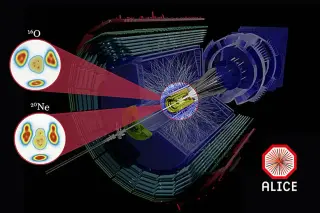
Europe builds a tiny Big Bang with light nuclei to study the universe’s dawn
European researchers produced a miniature quark-gluon plasma by colliding light nuclei, specifically Oxygen-16 and Neon-20, to create a tiny 'little Big Bang' that helps study the universe’s first moments; they observed rounded particle sprays for O-16 and bowling-pin shapes for Ne-20, providing new insights into atomic nuclei and the early state of matter, with results published in Physical Review Letters.