Brain's modular toolkit enables flexible cognition in mice and artificial networks
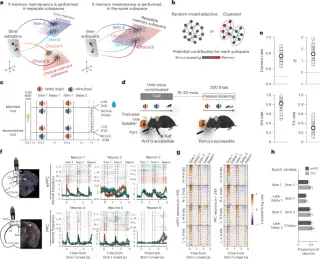
A Nature Neuroscience study shows mice performing a delayed match-to-sample task reuse separate neural subspaces for stimulus processing and memory maintenance, each supported by distinct neuron clusters in the medial prefrontal and posterior parietal cortices. These subspaces are largely orthogonal and are repurposed across inputs and memories within the same task. Analyses of data-constrained recurrent networks reveal that silencing the corresponding clusters causes modular, task-specific deficits, providing evidence for a brain-wide reusable architecture of cognitive components that parallels modular ideas in artificial networks.