
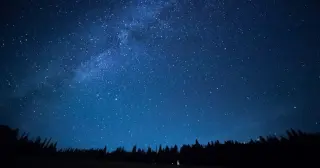
Brighter Skies, Shorter Distances: The Night Sky of the First Life
Imagine life arising 1–2 billion years after the Big Bang: the night sky would be busier and bluer, with denser star formation and brighter, closer nebulae in smaller, gas-rich galaxies. An observer 1 Gyr after the Big Bang would see about 5,000–8,000 stars at once and 10,000–15,000 over a full night; at 2 Gyr, roughly 15,000–30,000 at once and 30,000–60,000 over a night—like using binoculars instead of the naked eye. The cosmic microwave background would be hotter (11–18 K), and the universe would be smaller and denser, shortening distances to galaxies and making extragalactic observations easier but more foreground-laden. Dark matter would dominate and dark energy would be minor; whether intelligent life would arise remains uncertain, and no alien civilizations are detected today.