Google is launching its first experimental orbital data center, dubbed MVP, on October 1. The refrigerator-sized satellite, built by Planet Labs, carries four TPUs to test if AI hardware can survive space conditions. It will run for only 15 minutes at a time due to cooling limits, marking the first step toward a future constellation of orbital AI centers.
GOOGL shares slid about 5% in premarket trading after a breakout week as Ming‑Chi Kuo said Google is developing an upgraded TPU v9 AI chip, codenamed Triggerfish, with MediaTek as exclusive development partner. The new chip would boost memory and inference for next-gen AI workloads, with production expected late 2027 and ramping in 2028, underscoring MediaTek’s growing role in custom AI silicon alongside Nvidia and Microsoft collaborations.
Google backs a $3.2B Lake Mariner AI data center in western New York, financing a facility whose compute will be leased to Anthropic via thousands of Google TPUs, a move to rival Nvidia GPUs and diversify revenue while pressuring Amazon, Microsoft, and Meta to pursue proprietary AI chips.
Intel shares jumped after The Information reported Google will rely on Intel to manufacture more than 3 million tensor processing units (TPUs) for AI workloads by 2028, signaling stronger demand for Intel’s foundry services as TSMC capacity constraints bite. The story notes the potential upside for Intel’s turnaround, though the impact on its still-loss-making manufacturing business is limited in the near term, with Nvidia remaining the GPU leader and it’s unclear how much Google will depend on Intel versus its packaging business.
Google I/O 2026 opens with a heavy focus on Gemini AI, showcasing fast in-house silicon demos (TPU 8t/8i), a projected $180–$190 billion AI infrastructure push, and Gemini-powered features like Docs Live, Ask YouTube, and Maps, while Android updates are noted but not the main draw. The keynote frames AI-first scaling from infrastructure to products, with Sundar Pichai steering the vision.
Blackstone and Google are forming a US-based joint venture to offer TPU-based compute-as-a-service, starting with a $5 billion equity commitment to deploy 500 MW of capacity by 2027 and scale up over time, with Google providing TPUs and tech and Blackstone handling data-center infrastructure and energy.
Google and Amazon are moving to sell their own AI chips (TPU and Trainium) directly to customers, challenging Nvidia's dominance. Google plans select data-center sales this year with broader revenue by 2027, while Amazon aims to offer full chip racks beyond its cloud in the coming years. Analysts say the shift is irreversible but won’t be easy due to Nvidia’s ecosystem and bespoke deployments, and Nvidia remains a major supplier as AI workloads diversify.
Google is in talks with Marvell Technology to co-develop two new AI chips aimed at running models more efficiently: a memory processing unit designed to work alongside Google’s Tensor Processing Unit and a new TPU built specifically for inference, underscoring rising demand for accelerators that speed up AI workloads.
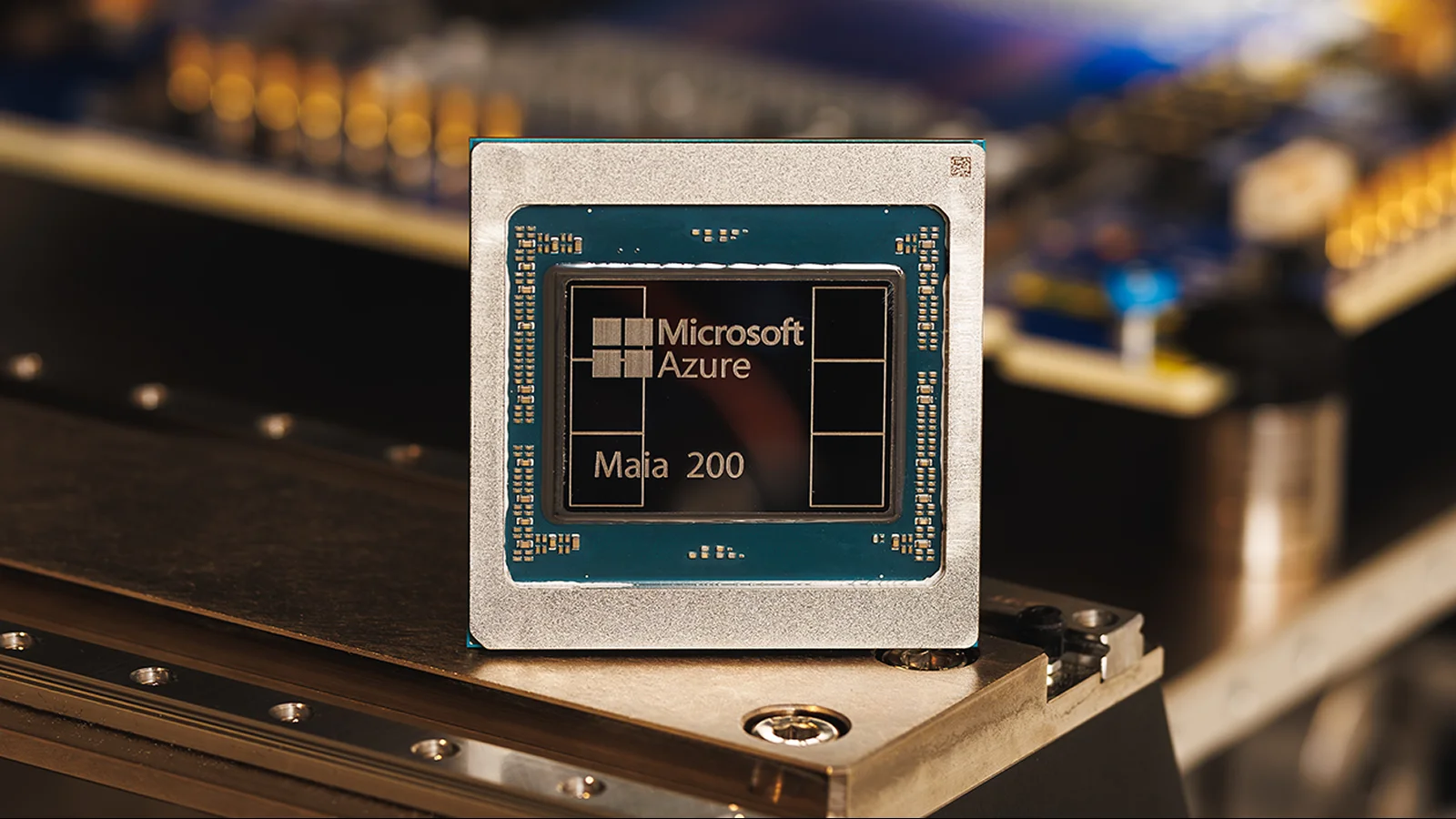
Microsoft unveiled Maia 200, an AI inference accelerator for Azure, claiming it delivers over 10 petaflops at FP4 and 5 PFLOPS at FP8, with 3x FP4 performance versus Amazon’s Trainium Gen3 and FP8 performance above Google’s TPU Gen7. Built on TSMC’s 3-nanometer process with about 100 billion transistors, Maia 200 is designed for data-center inference to speed Copilot and Azure OpenAI workloads, featuring a memory system to keep model weights local and is currently deployed in a US data center with broader Azure availability planned in the future.
Google is set to launch its seventh-generation Tensor Processing Unit, named Ironwood, in the coming weeks, aiming to enhance its AI hardware capabilities and challenge Nvidia in the market.
Google unveiled a new version of its data center artificial intelligence chips, called TPU v5p, and announced an Arm-based central processor named Axion, which offers superior performance to x86 chips. The company plans to offer Axion via Google Cloud and aims to power services such as YouTube Ads in Google Cloud "soon." The TPU v5p chip is built to run in pods of 8,960 chips and can achieve twice the raw performance as the prior generation of TPUs. This move positions Google to compete with other cloud operators and provides developers with an alternative to Nvidia's AI chips.
Google has made its top-of-the-line artificial intelligence program, Gemini Pro, available as a preview version in its AI Studio programming tool and Vertex AI for enterprise users. Gemini is part of Google's AI hyper-computing infrastructure and utilizes the Tensor Processing Unit (TPU) for enhanced performance. The AI Studio allows individuals and small teams to build applications using natural-language prompting, while Vertex AI is designed for enterprise use with access to corporate data sources. Google Cloud also announced the availability of TPU v5p, which offers four times the performance of the previous version. Gemini Pro is one of three versions, with Ultra in private preview and Nano set for release on mobile devices. Additionally, Google introduced Imagen 2, an enhanced text-to-image neural network, available in the Vertex AI feature called Model Garden.
Google has revealed that its custom-designed Tensor Processing Unit (TPU) supercomputer is faster and more power-efficient than comparable systems from Nvidia. The TPU is now in its fourth generation and is used for over 90% of Google's work on artificial intelligence training. Google has strung more than 4,000 of the chips together into a supercomputer using its own custom-developed optical switches to help connect individual machines. The company's largest publicly disclosed language model to date was trained by splitting it across two of the 4,000-chip supercomputers over 50 days. Google hinted that it might be working on a new TPU that would compete with the Nvidia H100 but provided no details.
Google has revealed that its custom-designed Tensor Processing Unit (TPU) is faster and more power-efficient than Nvidia's A100 chip. The TPU is used for over 90% of Google's artificial intelligence training, and the company has strung over 4,000 of the chips together into a supercomputer using its own custom-developed optical switches. Google's PaLM model, its largest publicly disclosed language model to date, was trained by splitting it across two of the 4,000-chip supercomputers over 50 days. Google hinted that it might be working on a new TPU that would compete with Nvidia's H100 chip but provided no details.
Google has revealed that its custom-designed Tensor Processing Unit (TPU) supercomputer is faster and more power-efficient than comparable systems from Nvidia. The TPU is now in its fourth generation and is used for over 90% of Google's work on artificial intelligence training. Google has strung more than 4,000 of the chips together into a supercomputer using its own custom-developed optical switches to help connect individual machines. The company said its chips are up to 1.7 times faster and 1.9 times more power-efficient than a system based on Nvidia's A100 chip that was on the market at the same time as the fourth-generation TPU.