innovation7.635 min read
South Korean Researchers Create Ultra-Thin Film That Blocks 99.9999999% of Radar Waves
16 days ago•Source: interestingengineering.com

The latest innovation stories, each synthesized from multiple sources with added background and context.
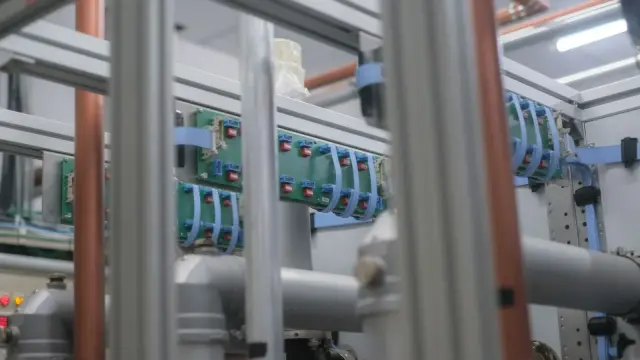
HKUST researchers unveiled the world’s first zero-degradation elastocaloric cooling device, using a fatigue-resistant TiNiCuCo shape memory alloy and a redesigned refrigerant structure to deliver a constant 400W cooling power and a 41°C temperature span over one million cycles; accelerated tests show no degradation up to 100 million cycles, and real-world use is expected to exceed a decade, marking a green alternative to conventional refrigeration and advancing toward market-ready elastocaloric cooling for air conditioning.
Interesting Engineering•1 month ago
Interesting Engineering•1 month ago

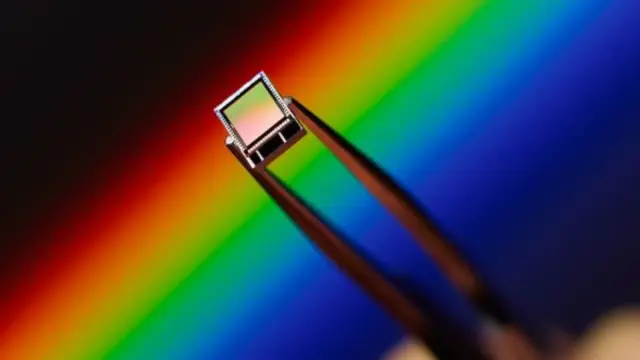
Researchers combined gallium arsenide/aluminum gallium arsenide multi-quantum-well layers with a nanoscale metasurface to amplify light’s nonlinear frequency conversion by up to 1,000 times, enabling smaller, scalable photonic devices for telecom and quantum technologies. The approach engineers both the material and the optical structure, yielding strong light–matter interactions at near-infrared wavelengths and compatibility with existing semiconductor manufacturing, with potential applications including quantum communication and entangled-photon sources.
Researchers at Pohang University of Science and Technology (POSTECH) have developed MiPAL, a low-cost single-element speaker that uses a front acoustic metasurface lens and rear elastic meta-units to focus sound to a single listener, suppressing lateral leakage. Covering 500 Hz to 10 kHz (over four octaves) and designed for easy 3D-printed customization, the device promises headphone-free, personalized audio in public spaces like trains, planes, and museums without creating noise pollution.
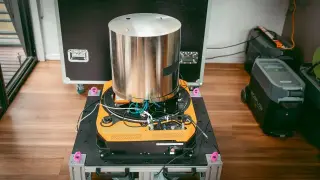
Q-CTRL demonstrated GPS-free navigation at sea using quantum sensors stabilized by AI, achieving one nautical mile accuracy and about 10x the performance of GNSS. GravNav measures gravity changes to determine position, runs autonomously aboard a ship cabin, and is resilient to GPS spoofing/jamming, signaling a defense-ready alternative when satellite signals are unavailable.
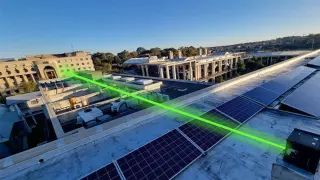
Researchers demonstrated a world-first method to transmit optical data through open air without distortion-correction hardware by encoding information in the light's topology using skyrmions. In real-world tests over hundreds of meters, the topologically encoded beams retained data with ~98% fidelity under normal conditions and about 86% under extreme turbulence, suggesting cheaper, more robust long-distance optical links and potential applications in space, satellite downlinks, and bridging the digital divide.

A University of Michigan team designed memory-centric SRAM architectures for future space telescopes, cutting computing power from about 3,000 watts to 51 watts (roughly 59× less) and reducing spacecraft mass from about 2,425 pounds to 425 pounds by co-locating memory and processing to minimize data movement; the design could lower mission costs (about $430 million savings over 25 years) and is moving from simulation to lab testing with chiplet fabrication planned next.

Ferrari's first EV, the Luce, designed with Jony Ive, faced online ridicule yet is on track to meet its 2026 target of 500 units (out of 2,500 by 2030) with strong orders and a raised full-year forecast; Q2 revenue reached 1.94 billion euros, and the company remains focused on attracting wealthy buyers in China and Silicon Valley, even as U.S. EV sales soften.
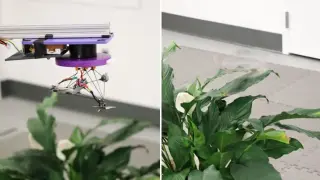
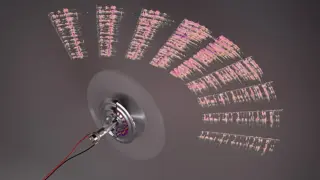
Northwestern University researchers unveil the Phantom Twist, a drone whose entire frame spins up to 25 Hz to create motion blur that makes it appear as a semi-transparent disc, about ten times harder to see than a standard quadcopter. An AI-driven design pipeline evaluated 20,000 configurations to ensure stability and non-overlapping components while spinning. The approach could aid wildlife and industrial surveys by reducing disturbance, but the drone is not perfectly invisible yet—sound remains audible and faint outlines can appear—with future work aiming for full transparency and acoustic dampening; findings were presented at RSS 2026 in Sydney.
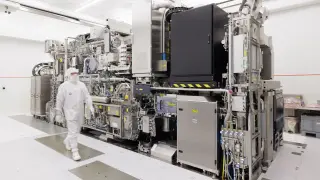
MIT's FUTUR-IC program unveils advances in electronically-photonic integration to push data transmission toward and beyond one petabit per second with lower energy use, including evanescent and GRIN optical couplers plus a third previously developed one—optical 'solder bumps' linking photonic devices. These approaches can be manufactured with existing semiconductor equipment, and Earthster models environmental impact while the initiative trains a workforce for semiconductor efficiency. The aim is to separate computation (electronics) from communication (photonic) to reduce data-center energy as AI and cloud services scale.
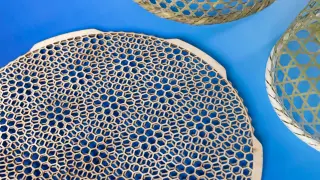
Researchers using machine-learning pre-screening paired with quantum-physics calculations identified two previously unknown superconductors, YRu3B2 and LuRu3B2, in a kagome lattice—demonstrating a faster path to billions of material candidates and edging closer to a room-temperature superconductor.

Chinese researchers demonstrated the world’s first field trial of a hollow-core fiber transmission system capable of 1.2 Tb/s per wavelength, achieving a total of 51.3 Tb/s over roughly 128 miles without repeaters. The advance uses adaptive per-wavelength rate control, flexible channel power allocation, and a cascaded high-power amplifier design with up to 33.5 dBm output, along with safeguards to monitor stability and prevent failures, underscoring hollow-core fiber’s potential for faster, lower-latency backbone networks.