
Global EV Sales Hit Record Highs as Oil Crisis Drives Demand
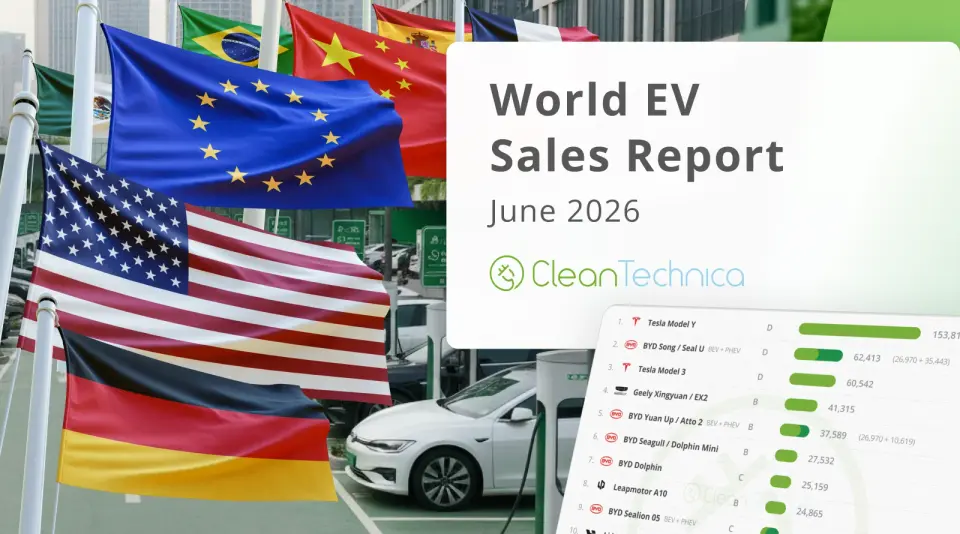
Global plug-in vehicle registrations reached approximately 2 million units in June 2026, marking an 8% year-over-year increase. Battery electric vehicles (BEVs) surged 21%, while plug-in hybrids declined 14%. Excluding the US and China, global EV sales jumped 52% year-over-year. The Tesla Model Y remained the world's best-selling EV, followed by the BYD Song and Tesla Model 3. Leapmotor surpassed Geely to become the third-largest manufacturer by volume. The International Energy Agency attributes the surge to oil price spikes from the US-Iran conflict, noting that electrified vehicles now account for 29% of global car sales.
Key points
- June 2026 global plug-in vehicle registrations reached approximately 2 million units, up 8% year-over-year.
- Battery electric vehicles grew 21% year-over-year, while plug-in hybrids fell 14%, shifting the BEV share of plug-in sales to 72%.
- The Tesla Model Y led global sales with 153,813 units, followed by the BYD Song (62,000 units) and Tesla Model 3 (60,000 units).
- Leapmotor became the third-largest manufacturer by volume, surpassing Geely, with 93,376 units sold in June.
- The International Energy Agency reports that 50 countries hit quarterly EV sales records in Q2 2026, driven by oil price spikes.
- China's EV export share rose to over 45% in the first half of 2026, though approximately one million unsold EVs remain in inventory.
Background
This surge follows a period of volatility in the US market, where federal tax credit eliminations and weakened fuel economy rules initially suppressed EV demand. However, Q2 2026 saw a recovery, with Tesla clearing its delivery backlog and exceeding forecasts. In the UK, BEV registrations rose 38% in June, driven by higher fuel prices and the ZEV Mandate. These developments align with broader trends where consumers in India, Brazil, Australia, and Korea are also hitting new EV sales highs, indicating a global shift toward electrification despite mixed performance in major markets like the US and China.
How outlets are covering it
CleanTechnica emphasizes the structural shift in the market, highlighting the divergence between BEVs and plug-in hybrids, and notes the dominance of Chinese manufacturers like BYD and Leapmotor. It points out that excluding the US and China, global EV sales are booming, suggesting strong organic demand elsewhere. Engadget, citing the International Energy Agency, frames the surge as a direct response to the oil crisis, noting that road vehicles account for nearly half of global oil use. While CleanTechnica focuses on model-specific performance and manufacturer rankings, Engadget highlights the macroeconomic drivers, such as fuel price spikes and supply chain advantages for Chinese manufacturers, which have production costs 35% lower than in advanced economies. Both sources agree on the overall growth but differ in emphasis: CleanTechnica on market dynamics and specific models, Engadget on geopolitical and economic factors driving the transition.
Why it matters
The sustained growth in EV sales, despite challenges in major markets like the US and China, indicates a resilient global demand for electrified vehicles. The shift toward BEVs over plug-in hybrids suggests a long-term trend toward full electrification. The dominance of Chinese manufacturers and their export growth poses competitive challenges for legacy automakers in Europe and the US. Additionally, the correlation between oil prices and EV sales underscores the vulnerability of the traditional auto industry to energy market fluctuations. Policymakers and manufacturers must address supply chain dependencies and infrastructure gaps to sustain this growth, particularly as China faces inventory overhang and other nations seek to close the cost gap in battery production.
What to watch
Analysts expect BEVs to potentially exceed 75% of plug-in sales by the end of 2026, their highest share since 2012. Tesla's Model Y is likely to maintain its lead, while BYD's Song may regain the second spot as new generations ramp up. Leapmotor's continued growth could challenge Geely's position in 2027. In the US, the recovery in Q2 suggests a potential rebound in EV demand, though the impact of policy changes remains uncertain. China may face continued inventory challenges, while other nations will need coordinated efforts to close the cost gap in battery production. The IEA expects electrified vehicles to maintain their 29% share of global car sales in 2026, with further growth driven by fuel price volatility and environmental regulations.
- Top Selling Electric Vehicles in the World — June 2026 CleanTechnica
- Electric Car Markets in a Time of Uncertainty – Analysis IEA – International Energy Agency
- ‘Largest Supply Disruption In History’: High Oil Prices Drove Record EV Sales In 50 Countries insideevs.com
- Surprise: The Global Oil Crisis Is Pushing People Toward Buying Electrified Cars Engadget
- Opinion: Rising fuel prices drive consumers to EVs. Make necessary policy changes. AJC.com
Want the full story? Read the original reporting
Read on CleanTechnica