
Meta's $825B AI Commitments Spark Credit Crisis Fears
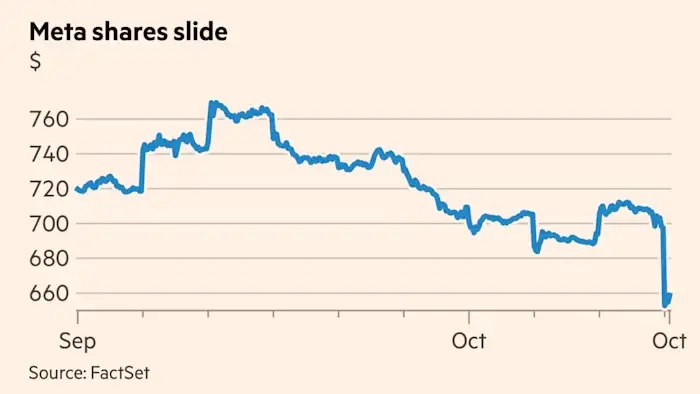
Meta Platforms faces heightened investor scrutiny as its future spending commitments for AI infrastructure surge to $825 billion, driving credit default swap costs to record highs and turning free cash flow negative.
Key points
- Meta’s future spending commitments on leases and contracts, largely tied to AI computing and infrastructure, have risen to approximately $825 billion, up from nearly $700 billion in July.
- The company raised the lower end of its 2026 capital expenditure outlook to $135 billion from $130 billion, while maintaining the upper limit at $145 billion.
- Meta’s free cash flow turned negative at $2.12 billion in the third quarter, a sharp decline from positive figures of $784 million in the previous quarter and $10.63 billion a year earlier.
- Five-year credit default swaps for Meta reached an intraday high of 119.3 basis points, the highest level since trading began roughly a year ago.
- The risk premium on Meta’s 5.25% notes due 2036 widened by 6 basis points to 1.2 percentage points relative to U.S. Treasuries.
- Meta shares fell 5.8% to $655.45 following the disclosure, reflecting investor concerns over the company’s debt financing strategy.
Background
Meta has been aggressively expanding its AI infrastructure, a trend that has raised questions about the sustainability of such spending across the tech sector. Previous reports indicated future commitments of nearly $700 billion in July, signaling a rapid acceleration in capital outlays. The company recently introduced a new class of nonvoting stock, potentially to facilitate future acquisitions or expenses, amidst broader market anxieties about how major tech firms will finance their AI expansions.
How outlets are covering it
Seeking Alpha emphasizes the immediate market reaction, highlighting the spike in credit default swaps and the negative free cash flow as indicators of rising credit risk. It notes that similar credit risk indicators have risen for Oracle, Microsoft, and Broadcom, suggesting a sector-wide concern. Yahoo Finance, citing Bloomberg, focuses on the sheer scale of the financial commitments, detailing the breakdown of $355.7 billion in operating and finance leases and $454.5 billion in non-cancellable contracts, many related to cloud computing and energy. While both sources agree on the $825 billion figure, Seeking Alpha frames it as a credit crisis trigger, whereas Yahoo Finance presents it as a factual disclosure of future obligations. The Financial Times primary source was inaccessible due to a paywall, so its specific analysis could not be synthesized.
Why it matters
The surge in Meta’s credit risk metrics signals a potential shift in investor sentiment regarding the financial sustainability of massive AI infrastructure investments. If other tech giants face similar credit tightening, it could impact broader market valuations and the pace of AI deployment. The negative free cash flow and rising debt costs may force a reassessment of the return on investment for these capital-intensive projects.
What to watch
Investors will likely monitor Meta’s subsequent earnings reports for any changes in capital expenditure guidance or further deterioration in free cash flow. The market may also watch for similar credit risk spikes in other major tech companies like Oracle and Microsoft. Meta’s ability to manage its $825 billion in future commitments without further increasing debt costs will be a key indicator of its financial health.
- Meta sell-off drags US tech stocks lower as AI spending fears flare up Financial Times
- Meta's credit risk indicator jumps to record high after results Reuters
- Meta Shares Slide 6% on Spending Commitments WSJ
- Meta’s AI spending push sends credit risk to fresh highs (META:NASDAQ) Seeking Alpha
- Meta Reports $825 Billion in Future Spending Commitments Yahoo Finance
Want the full story? Read the original reporting
Read on Financial Times