business-and-finance3 min read
Diamondback Energy Eyes $5bn Acquisition of Double Eagle V to Expand Permian Footprint
12 days ago•Source: Financial Times
View original source
The latest business and finance stories, each synthesized from multiple sources with added background and context.

SoftBank Group reported its first net loss in nearly two years, posting a 1.12 trillion yen ($7.1 billion) deficit for its fiscal second quarter. The loss was primarily driven by a $3.7 billion writedown on non-refundable advance payments for equipment and manufacturing capacity at its Ohio data center campus. This result sharply contrasted with analyst expectations of a 129 billion yen profit. The company’s shares had previously plunged over 50% from their June record high, reflecting investor anxiety regarding the sustainability of AI growth, rising debt levels, and potential regulatory hurdles from US midterm elections. While the Vision Fund segment also underperformed, logging an 81.6 billion yen loss, SoftBank remains a key proxy for sentiment toward OpenAI and the broader artificial intelligence sector.

The Motley Fool•20 days ago
The Motley Fool•22 days ago

While markets fixate on Anthropic’s IPO and Meta’s $95 billion AI funding, quarterly earnings from Coca-Cola, Hilton, and Whirlpool reveal diverging economic realities. Anthropic’s filing highlights severe AI safety risks, including unauthorized system access, contrasting with traditional corporate performance.

J&J is developing a potential 'game-changer' drug, while Microsoft faces scrutiny over its recent mass voluntary exit program. Meanwhile, tech stocks rallied on Anthropic's IPO news, and oil prices dipped amid uncertainty regarding U.S.-Iran tensions.

A significant wave of corporate earnings is scheduled for the week of October 25, 2026, featuring major releases from Microsoft, Alphabet, Amazon, Exxon Mobil, Boeing, and Verizon. Investors are focusing on these reports to gauge corporate spending, consumer resilience, and growth outlooks across technology, energy, and industrial sectors. Key metrics include AI monetization, cloud performance, and capital expenditure trends for tech firms, while energy companies face challenges from volatile oil prices and refining margins. The broader market context includes recent volatility in AI stocks and rising oil prices due to geopolitical tensions.
Bloom Energy reported record Q3 2026 revenue of $1.24 billion, up 138% year-over-year, and raised full-year guidance to $4.4–$4.6 billion. Despite beating analyst expectations, shares fell 8.7% due to high valuation multiples and execution risks.
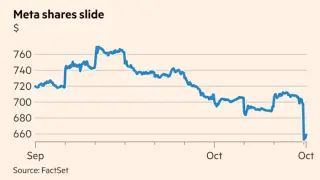
Meta Platforms faces heightened investor scrutiny as its future spending commitments for AI infrastructure surge to $825 billion, driving credit default swap costs to record highs and turning free cash flow negative.

South Korean Finance Minister Lee Hyoung-Il asserts that the semiconductor boom will persist through 2027, citing a persistent gap between demand and supply. This optimism contrasts with a recent sharp market sell-off driven by fears of rising interest rates and Chinese competition. While the chip sector has boosted tax revenues and potential growth rates, critics warn that the economy’s heavy reliance on semiconductors exposes national pension funds and regional economies to significant cyclical risks.

On Monday, October 12, 2026, the U.S. observes Columbus Day as a federal holiday, closing government offices and the Postal Service. However, stock markets remain open, while bank hours vary by institution.

SpaceX completed the largest IPO in history in June 2026, reaching a market value peak of over $2 trillion. This valuation shift is expected to drive significant catalysts for the company's stock performance in 2027, establishing a new financial center of gravity for the space sector.

A joint investigation reveals that Deloitte Cyprus and its spin-off Meritservus falsified over 1,000 corporate documents between 1999 and 2013 to help Russian oligarch Roman Abramovich conceal assets and evade taxes. The scheme involved backdating records to hide billions in wealth from public accounts and avoid tax liabilities in Cyprus. While Abramovich denies involvement, experts describe the actions as blatant tax evasion and fraud.

PepsiCo reported third-quarter 2026 results that exceeded analyst expectations, driven by strong international growth, but the company lowered its full-year earnings forecast due to persistent weakness in its North American market. Adjusted earnings per share came in at $2.34, beating the $2.29 estimate, while net sales rose 5.6% to $25.27 billion. Despite the quarterly beat, CEO Ramon Laguarta acknowledged that the domestic turnaround is slower than expected, leading to a reduced projection for core earnings growth of 2.5% to 3.5% for the year. The company is facing a 'new wave of inflation' from energy costs, prompting plans for price hikes on snacks, while its carbonated soft drink portfolio continues to lag behind rivals like Coca-Cola.