
China’s Trade Surplus Tops $1.04 Trillion as AI Demand Masks Domestic Slump
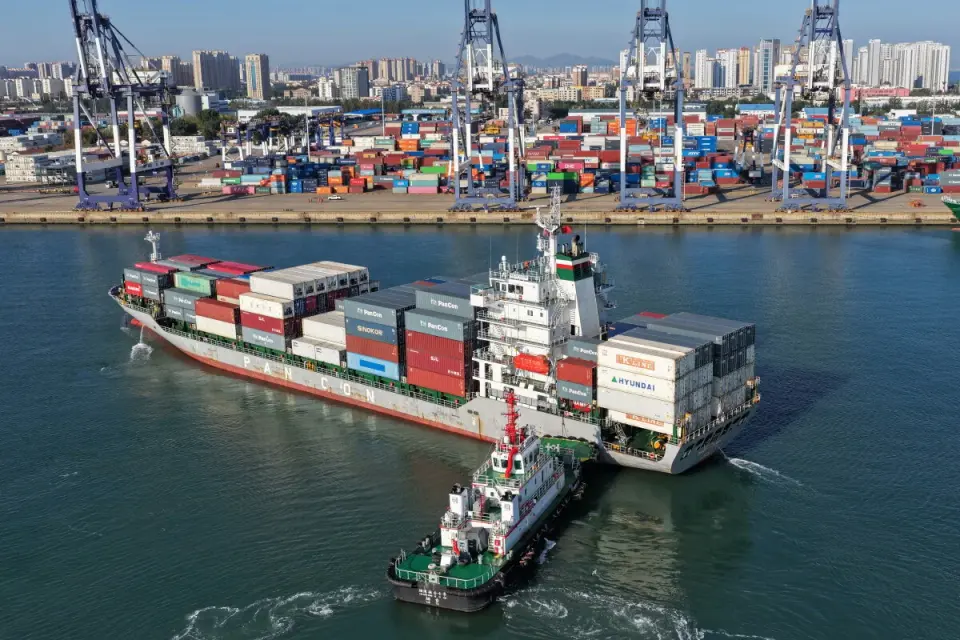
China’s trade surplus exceeded $1.04 trillion in the first ten months of 2026, marking the second consecutive year of over $1 trillion in surplus. Exports surged 35.2% year-on-year in October, driven by high-tech goods like semiconductors and autos, while imports rose 41.6%. This external strength offsets weak domestic consumption and a property slump, though it risks deepening trade frictions with the U.S. and EU.
Key points
- China’s trade surplus reached $1.04 trillion in January-October 2026, surpassing the $1 trillion mark a month earlier than in 2025.
- October exports grew 35.2% year-on-year, with semiconductor exports jumping 137.1% and auto exports rising 37.6%.
- Imports increased 41.6% in October, partly due to a recovery in crude oil shipments from the Persian Gulf.
- The trade surplus narrowed slightly in October to $105.3 billion from $133.5 billion in September as imports accelerated.
- China’s economy is on track to meet its 4.5% to 5% annual growth target, despite sluggish domestic demand.
- Trade tensions are rising with the EU, which has agreed to limit Chinese hybrid vehicle exports, and the U.S., where a two-month trade truce extension has provided temporary relief.
Background
China’s trade surplus has been a growing concern for trading partners, with the EU recording a roughly $410 billion trade deficit with China in 2025. Previous coverage noted that China’s Q3 growth hit 4.5% amid an export boom, masking a domestic slump with fixed-asset investment contracting 7.2% and property investment plunging over 20%. The current surplus is seen as a result of structural imbalances, including overcapacity and excess domestic savings, which push goods abroad as domestic demand weakens.
How outlets are covering it
AP News highlights the sustainability concerns, with economist Alicia García-Herrero noting that overcapacity and weak domestic demand make the current situation unsustainable. CNN emphasizes the role of the global AI investment boom in buoying high-tech sales, while also warning that this reliance on overseas demand could deepen domestic imbalances. Both sources agree that the surplus is offsetting weak domestic consumption, but CNN notes that the AI boom is expected to keep demand strong into 2027, while AP cites concerns about a potential AI correction hitting exports hard. The EU’s trade measures are seen as a risk by AP, but CNN notes that factories may bring forward shipments before new curbs take effect.
Why it matters
China’s record trade surplus underscores its growing reliance on external demand to support an economy weakened by a property slump and subdued consumption. This imbalance risks escalating trade tensions with major partners like the U.S. and EU, who are implementing protective measures. The sustainability of this surplus is questionable, as it depends on the global AI boom, which could face corrections, and on continued weak domestic demand, which may not resolve without deeper structural reforms.
What to watch
Trade is expected to be a key topic at the APEC summit in Shenzhen next week, where U.S. President Donald Trump and Chinese leader Xi Jinping are set to meet. The two-month extension of the U.S.-China trade truce until January provides temporary relief, but its long-term viability is uncertain. China’s exports may face headwinds if the AI boom slows, and the EU’s new trade measures could impact Chinese hybrid vehicle exports in the coming years.
- China’s trade surplus surpasses $1 trillion for a 2nd straight year, as exports surge 35% AP News
- China’s Trade Surplus Passes $1 Trillion at Record Pace The New York Times
- China set for record trade surplus as AI boom pushes it past $1 trillion in just 10 months CNN
- China's trade surplus soars past $1 trillion as AI boom powers exports Reuters
- Chinese Trade Surplus Tops $1 Trillion for Second Time Ever Bloomberg.com
Want the full story? Read the original reporting
Read on AP News