
Mortgage Rates Dip to 7.56% Amid Persistent Housing Market Gridlock
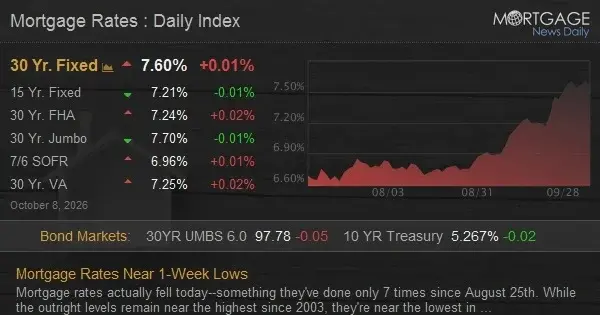
U.S. 30-year fixed mortgage rates fell to 7.56% on October 6, 2026, marking the lowest level in over a week. While this slight decline offers minor relief, rates remain near their highest levels since 2003. The market is currently experiencing a 'double top' pattern, but analysts caution that it is too early to confirm a sustained downward trend. Meanwhile, high borrowing costs continue to suppress buyer demand, leaving sellers stranded in a frozen market.
Key points
- 30-year fixed mortgage rates dropped to 7.56% for top-tier lenders on October 6, 2026, the first decline since August 25.
- Current rates remain near their highest levels since 2003, despite the recent dip.
- The 15-year fixed rate stood at 7.21%, while the 10-year Treasury yield was 5.267%.
- Rates have only fallen seven times since late August, indicating limited volatility.
- High mortgage rates and stubborn home prices are causing buyer demand to plummet, stranding sellers.
Background
Mortgage rates have been on a volatile upward trajectory since late August 2026. In September, the 30-year fixed rate climbed from 6.66% to over 7.0%, with some periods seeing rates approach 7.6%. This rise pushed many borrowers toward adjustable-rate mortgages and reduced overall application volume. The recent dip to 7.56% follows a period of sustained high rates, which had previously peaked around 7.61% on September 30.
How outlets are covering it
Mortgage News Daily focuses on the technical market movement, noting that the recent drop to 7.56% is a rare occurrence in the current cycle. They describe the rate behavior as a potential 'double top' after hitting 7.61% in late September, but caution that it is too early to declare a momentum shift. In contrast, NBC News emphasizes the macroeconomic impact, highlighting that high rates are not just a financial metric but a barrier to entry that is 'stranding' home sellers. While MND looks at the rate chart, NBC points out that buyer demand has plummeted, creating a mismatch between supply and demand that keeps prices high despite the slight rate dip.
Why it matters
The slight decline in mortgage rates offers a brief window of potential relief for buyers, but the overall market remains constrained. With rates still near historic highs, the housing market faces a structural imbalance: sellers are unable to move because buyers cannot afford the high borrowing costs. This gridlock could lead to further price stagnation or a slow decline in home values if rates do not drop significantly in the coming months. For policymakers, the persistence of high rates despite minor dips suggests that inflation or other macroeconomic factors may still be anchoring interest rates at elevated levels.
What to watch
Watch for the 30-year fixed rate to break below 7.5% in the coming weeks, which would signal a more sustained downward trend. Monitor the 10-year Treasury yield, which is currently at 5.267%, as it is a key driver of mortgage rates. Additionally, track home sales data to see if the current buyer demand slump leads to price reductions or if sellers continue to hold out, potentially prolonging the market gridlock.
- Mortgage Rates Near 1-Week Lows Mortgage News Daily
- Here's the latest sticker shock: Borrowing for a mortgage — or a car NPR
- How rising mortgage rates are hitting the housing market hard The Hill
- High mortgage rates strand home sellers as buyer demand plummets NBC News
- Mortgage rates are increasing, raising questions about where the Seattle housing market is heading KING5.com
Want the full story? Read the original reporting
Read on Mortgage News Daily