U.S. existing-home sales rose 1.5% month-over-month in September but fell 2.2% year-over-year, marking the slowest pace of 2026. Rising mortgage rates, now near 7.3%, and high prices are suppressing demand, while inventory reaches its highest level since 2020.
U.S. existing-home sales rose 1.5% month-over-month in September but fell 2.2% year-over-year, marking the slowest months of 2026. Rising mortgage rates and high prices have stalled demand, while inventory reached its highest level since 2020.
U.S. mortgage rates have surged to a three-year high, reaching approximately 7.5%, driven by rising bond yields, geopolitical tensions, and strong economic growth. This spike is suppressing home sales and refinancing activity, with experts warning that rates could climb to 8% if inflation remains elevated.
The average 30-year fixed mortgage rate has climbed to 7.4%, marking the highest level in nearly three years. This surge is freezing the housing market, with existing home sales slowing to their lowest pace in over a year and mortgage applications dropping for the fifth consecutive week. The rise in rates is attributed to persistent inflation and geopolitical tensions, including the war in Iran, which have pushed Treasury yields higher. Consequently, refinance applications have fallen to their lowest levels since January 2025, while potential buyers are delaying purchases due to unaffordable costs.
The average 30-year fixed mortgage rate reached 7.4%, the highest level since late 2023, significantly dampening buyer demand and refinance activity. This surge, driven by rising oil prices following the Iran conflict, has left millions of Americans priced out of the market while home prices continue to climb.
US housing markets are experiencing a sharp correction as mortgage rates surge to 2023 highs, driven by inflationary pressures from the Iran conflict. While sellers in Florida, Texas, and California have been cutting prices for years, New York State has recently joined the downtrend, with listing prices dropping 6.8% year-over-year. This price adjustment is accompanied by a 14% year-over-year decline in mortgage applications, as buyers face significantly higher monthly payments. Although sellers are offering more concessions, the high cost of borrowing continues to limit buyer demand, creating a market where affordability remains a central constraint despite increased negotiating leverage.
The average 30-year fixed mortgage rate has climbed to its highest level in nearly three years, reaching 7.49% in the week ending October 7, 2026. This surge has significantly dampened refinancing activity, with total mortgage applications dropping 4.2% weekly. Refinance applications fell by 8%, now less than half of last year's volume, while purchase applications declined by 2%. Borrowers are increasingly shifting toward adjustable-rate mortgages (ARMs) to secure lower initial payments, with ARM applications remaining steady at 10.3%.
The average 30-year fixed mortgage rate rose to 7.49% last week, reaching its highest level in nearly three years. This surge caused total mortgage applications to drop 4.2% weekly, with refinance applications falling 8% and reaching less than half of last year's volume. Purchase applications declined 2%, while adjustable-rate mortgage (ARM) applications remained steady at 10.3% as borrowers sought lower initial payments.
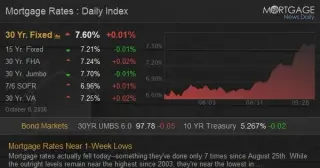
Soaring mortgage rates and elevated home prices have created a stalemate in the U.S. housing market. While buyer demand has plummeted to multi-year lows, supply remains constrained, leaving sellers unable to close deals. Recent data shows 30-year fixed rates hovering near 7.6%, a level that has stalled transactions for millions of potential homeowners.
U.S. 30-year fixed mortgage rates fell to 7.56% on October 6, 2026, marking the lowest level in over a week. While this slight decline offers minor relief, rates remain near their highest levels since 2003. The market is currently experiencing a 'double top' pattern, but analysts caution that it is too early to confirm a sustained downward trend. Meanwhile, high borrowing costs continue to suppress buyer demand, leaving sellers stranded in a frozen market.
The gap between what first-time home buyers earn and what they need to afford a starter home is widening in the US. National data shows a median income of $72,100 for first-time buyers, while the required income to afford a typical starter home is now $103,584. This disparity is driven by rising mortgage rates and high rental costs that hinder savings, with affordability indices remaining below 100 since 2021.
A new analysis indicates that US home prices would need to fall by 32% to make current mortgage payments comparable to those of existing homeowners. The median US home price reached $429,100 in August 2026, but at current mortgage rates of approximately 7.3%, a new buyer would face monthly payments of $2,353, which is 47% higher than the $1,597 paid by the typical existing mortgage holder. This significant disparity is driven by the 'lock-in effect,' where millions of homeowners who secured low rates during the pandemic are reluctant to sell, contributing to a persistent shortage of available homes. Experts suggest that a crash of this magnitude is unlikely, with affordability expected to improve gradually through rising incomes and slower price growth rather than a sudden market collapse.
A new report projects that 13.9 million homes will enter the U.S. market between 2026 and 2036 as older generations age. However, this influx consists primarily of large family homes, offering little relief for the acute shortage of starter homes. While this may ease prices for move-up buyers, it could exacerbate affordability issues for first-time buyers and potentially weaken overall demand as household formation slows.
The gap between what first-time home buyers earn and what they need to afford a starter home is widening in the US. National data shows a median income of $72,100 for first-time buyers, while the required income to afford a typical starter home is now $103,584. This disparity is driven by rising mortgage rates and high rental costs that hinder savings, with affordability indices remaining below 100 since 2021.
The average interest rate for new five-year fixed mortgages in the UK has reached 6%, marking the first time it has hit this level in three years. This spike, driven by rising government bond yields and global economic uncertainty, has caused a 99% collapse in the number of deals priced below 5%. While the Bank of England’s base rate remains unchanged, lenders are raising prices due to increased wholesale funding costs, significantly impacting home buyers and those renewing fixed deals.