
US Retail Sales Slow to 0.2% in October as Consumers Curb Discretionary Spending
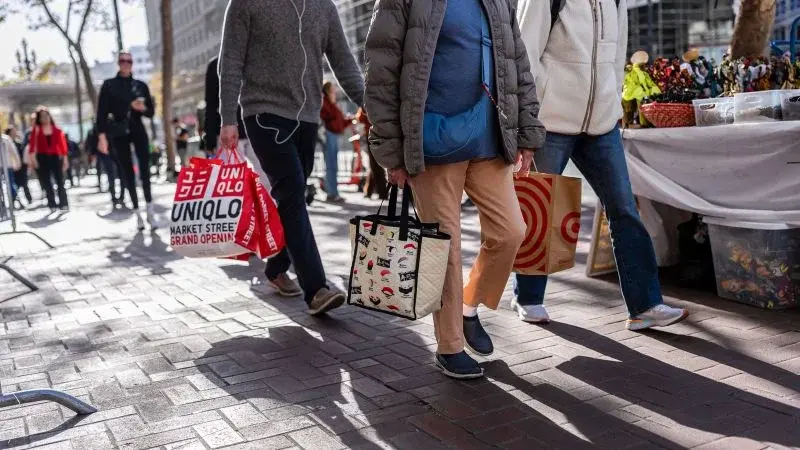
US retail sales rose 0.2% in October, a significant slowdown from September’s 0.8% gain, driven by declines in auto and furniture sales. Core retail sales, excluding volatile categories, rose 0.6%, indicating underlying consumer resilience. Economists suggest households are delaying discretionary purchases to save for holiday deals, while high-income consumers continue to drive spending despite inflation pressures on middle and lower-income groups.
Key points
- US retail sales increased 0.2% in October, down from a 0.8% rise in September, according to Commerce Department data.
- Core retail sales, which exclude auto, gas, building materials, and restaurants, rose 0.6%, exceeding expectations of 0.4%.
- Sales at motor vehicle and parts dealers dropped 1.6%, reversing a 1.3% increase in September, while gas station sales rose 1.5% after a 30.3% spike in September.
- Spending declined in furniture, home furnishings, and apparel, but rose in miscellaneous stores (4.7%) and online retailers (1.2%).
- Credit card balances reached $1.17 trillion, up 5.1% year-over-year, but delinquency rates remained stable, suggesting disciplined borrowing.
Background
This data follows earlier reports indicating that rising inflation and travel costs are pushing consumers toward physical gifts rather than experiences this holiday season. Previous coverage noted that while projected retail sales are rising 4.5% year-over-year, real growth is modest at 1.1% due to inflation. Additionally, stricter regulations on Buy Now Pay Later services in the UK have prompted consumers to reduce non-essential spending, a trend that may parallel US consumer caution.
How outlets are covering it
CNN and AP News both highlight the slowdown in overall retail sales, attributing it to high gas prices and cost-of-living concerns. CNN emphasizes that the decline in discretionary categories like furniture and sporting goods may reflect consumers saving for holiday sales, while AP News notes that excluding gas stations, retail sales rose only 0.1%, signaling broader caution. Kitco focuses on the market reaction, noting that gold prices dropped to $3,848/oz after the data, as core retail sales exceeded expectations, suggesting underlying consumer strength. Economists cited by CNN and AP, such as Elizabeth Renter and Carl B. Weinberg, describe the report as mixed, with some consumers trading down due to high prices and interest rates, while others remain in a spending mood due to solid fundamentals. ING’s James Knightley points to a bifurcation in household finances, with high-income households driving consumption while middle and lower-income groups face squeezed spending power.
Why it matters
The slowdown in retail sales signals potential strain on consumer spending heading into the holiday season, which could impact corporate earnings for major retailers like Target and Walmart. The divergence between headline and core retail sales suggests that while overall spending is softening, underlying consumer demand remains resilient, particularly among higher-income households. This bifurcation may influence Federal Reserve policy decisions, as inflation continues to weigh on middle and lower-income consumers, potentially affecting economic growth and employment trends in the coming months.
What to watch
Target and Walmart are scheduled to release their earnings reports on Wednesday and Thursday, respectively, providing further insight into consumer spending trends. Retailers are heavily advertising holiday deals, with Target offering over 8,000 new gifts, most priced at $20 or less, to attract cost-conscious shoppers. Credit experts will monitor delinquency rates as consumers rely on credit cards to finance spending, with outstanding balances already at $1.17 trillion. Future retail sales data will be crucial in determining whether the current slowdown is a temporary pause or a sign of deeper economic weakness.
- American shoppers are showing signs of strain heading into the holiday season CNN
- Shoppers slowed spending in October with high prices leading to caution AP News
- Gold price drops to $3,848/oz after September retail sales rise 0.2%, core rises 0.6% Kitco
- US Retail Sales Rise 0.2% Amid Mixed Demand for Merchandise Bloomberg.com
- US retail sales increase moderately in October Reuters
Want the full story? Read the original reporting
Read on CNN