
Oracle’s Credit Default Swaps Spike as AI Debt Concerns Test Investment-Grade Status
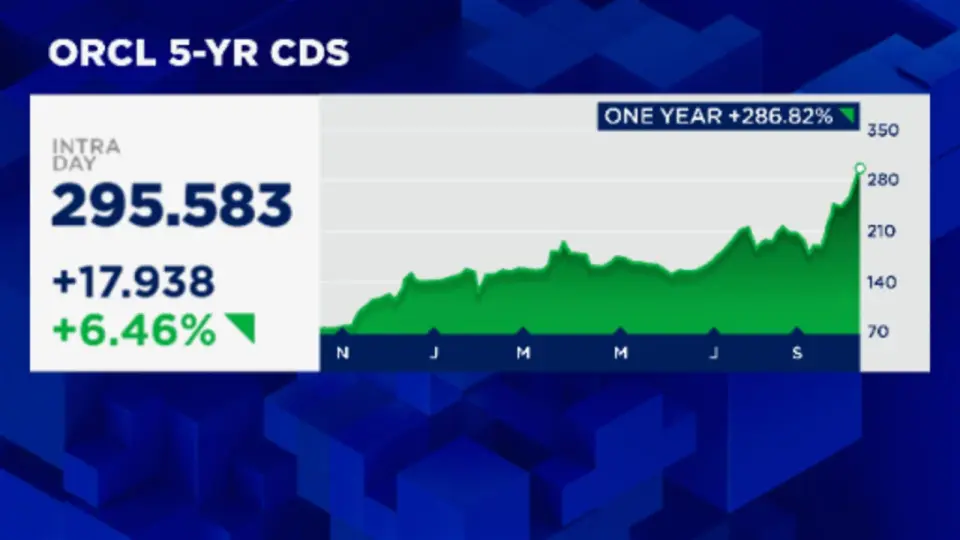
Oracle’s five-year credit default swap spreads have surged 287% in a year to 295 basis points, nearing high-yield levels. This spike reflects market anxiety over the company’s massive AI infrastructure debt, which includes $118 billion in long-term debt and a $300 billion OpenAI deal. While Oracle remains investment-grade, analysts warn that a downgrade to junk status could trigger forced sales and higher borrowing costs, potentially destabilizing the broader AI financing ecosystem.
Key points
- Oracle’s five-year credit default swap spread reached 295 basis points, up 287% in one year, approaching high-yield territory.
- The company has issued $118 billion in long-term debt and faces $39 billion in capital and lease obligations to fund AI data centers.
- S&P Global downgraded Oracle to BBB- in July, citing rising credit risk from its expanding infrastructure business and weaker expected operating cash flow in 2027.
- Analysts estimate Oracle’s free cash flow will be negative $23.7 billion this year and negative $36 billion in 2027.
- A potential downgrade to junk status could force investment-grade-only investors to sell Oracle debt, disrupting the AI financing ecosystem.
Background
This development follows a broader AI debt crisis highlighted in recent weeks, where bond yields spiked and credit default swap costs hit record highs for infrastructure firms. Previous coverage noted that AI providers face a massive funding gap, with projected infrastructure spending of $7 trillion through 2030 versus expected revenue of only $3.6 trillion. CoreWeave, a neocloud company, has already faced severe credit distress with spreads past 1,000 basis points, serving as a warning for other AI-heavy firms like Oracle.
How outlets are covering it
CNBC emphasizes the risk of Oracle’s credit rating slipping into junk territory, which could have cascading effects on the AI financing ecosystem. It highlights the fragility of sentiment in AI-related names, noting that Oracle’s CDS spreads now resemble high-yield credit. In contrast, Yahoo Finance focuses on the equity market’s resilience, noting that despite Oracle’s stock falling 54%, 80% of analysts still maintain a 'Buy' rating. This divergence suggests that while bond markets are pricing in significant risk, equity analysts remain optimistic about Oracle’s long-term revenue ramp and earnings potential. Some fixed-income investors, like those at Vanguard and Laffer Tengler, argue that Oracle’s balance sheet remains healthy and that the current stress is a 'financing test' rather than a sign of insolvency.
Why it matters
Oracle serves as a bellwether for the AI industry’s financial health. A downgrade to junk status would not only increase borrowing costs for Oracle but could also trigger forced sales by investment-grade-only funds, potentially destabilizing the broader AI infrastructure market. The company’s ability to maintain its investment-grade rating is crucial for sustaining its massive capital expenditure plans, including its $300 billion OpenAI deal, without facing a liquidity crisis.
What to watch
Investors will closely monitor Oracle’s free cash flow trajectory and any further movements in its credit default swap spreads. S&P Global has outlined specific triggers for a potential downgrade, including sustained leverage exceeding 4x or a failure to generate positive free operating cash flow by fiscal 2029. Oracle has stated that maintaining its investment-grade rating is its top priority and expects strong free cash flows once its AI projects ramp up. The coming months will test whether the company can bridge the gap between its massive debt obligations and its AI revenue generation.
- Credit stress is threatening to unwind the AI bull. All eyes are on Oracle to hold the line CNBC
- Oracle (ORCL) Has Fallen 54% and 80% of Analysts Still Say Buy. Why? Yahoo Finance
- Why Oracle's debt load could be your problem : The Indicator from Planet Money NPR
- AI Skepticism Is Shaking Markets. Will an Oracle Downgrade Be the Next Shoe to Drop? Barron's
- Prediction: Oracle Stock Trails the S&P 500 Through 2030 The Motley Fool
Want the full story? Read the original reporting
Read on CNBC