
GPN-Star and AlphaGenome Atlas Advance Genome-Wide Variant Prediction
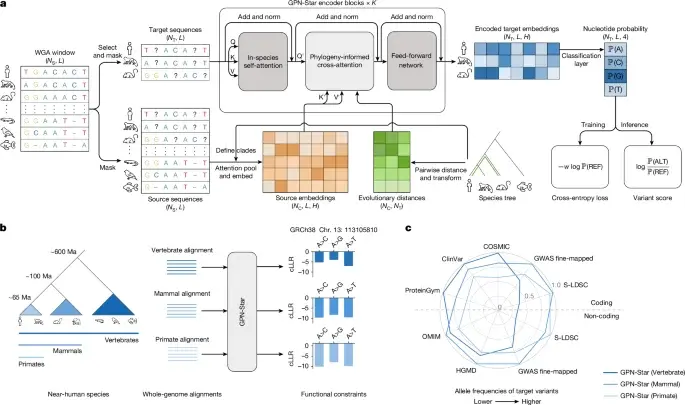
Two major new tools for interpreting genetic variants have emerged: GPN-Star, a phylogeny-aware model that outperforms previous methods in predicting functional constraints across species, and AlphaGenome Atlas, a 1-petabyte database mapping the molecular impact of all 9 billion possible single-nucleotide changes in the human genome.
Key points
- GPN-Star achieves state-of-the-art performance in predicting variant effects in both coding and non-coding human regions by leveraging whole-genome alignments and species trees.
- The model demonstrates superior performance in prioritizing pathogenic variants and enriching complex trait heritability compared to classical evolutionary models like PhyloP and PhastCons.
- GPN-Star has been successfully applied to five model organisms, including mouse, chicken, fruit fly, worm, and Arabidopsis, showing robust generalizability.
- Google DeepMind’s AlphaGenome Atlas provides precomputed predictions for every possible single-nucleotide variant in the human genome, totaling 9 billion variants.
- The Atlas introduces the AVI score, a single metric combining coding and non-coding impact predictions to help researchers rapidly rank variants for disease and trait research.
Background
Recent large-scale genome-wide association studies have identified thousands of variants linked to complex traits, such as personality, but interpreting the functional impact of non-coding variants remains a significant challenge. Previous genomic language models often required massive computational resources and still underperformed compared to classical evolutionary models in certain tasks. These new tools aim to bridge that gap by integrating explicit evolutionary data or precomputing massive datasets for accessibility.
How outlets are covering it
Nature highlights GPN-Star’s efficiency, noting it achieves superior constraint prediction with a much smaller resource footprint than single-sequence models like Evo 2 by explicitly using alignment data. Google DeepMind emphasizes the scale and accessibility of AlphaGenome Atlas, framing it as a democratizing tool that allows researchers without coding skills to query 9 billion variants via a web portal. While GPN-Star focuses on the biological mechanism of evolutionary constraint across species, AlphaGenome Atlas focuses on comprehensive precomputation for human-specific variant prioritization, including a unified AVI score for both coding and non-coding regions.
Why it matters
These advancements significantly accelerate the identification of causal variants for diseases and complex traits. By improving the accuracy of variant effect prediction, particularly in difficult non-coding regions, these tools can enhance rare disease diagnosis, polygenic risk prediction, and the understanding of genetic architecture for common conditions, potentially leading to new therapeutic targets and personalized medicine approaches.
What to watch
Researchers are expected to integrate these tools into existing genomic workflows to improve fine-mapping and association testing. Google DeepMind plans to make AlphaGenome Atlas available for commercial use on Google Cloud, while GPN-Star’s developers anticipate future work on human-specific adaptations and integrating functional genomics data into multimodal models.
- Predicting genome-wide functional constraints with GPN-Star Nature
- A Quieter Kind of AI Breakthrough WSJ
- AlphaGenome Atlas: Molecular predictions for 9 Billion human DNA variants Google DeepMind
- Google DeepMind publishes AI-powered predictions for effect of all 9B mutations to human DNA Fortune
- AlphaGenome Atlas: a high-resolution map of human DNA blog.google
Want the full story? Read the original reporting
Read on Nature