Tag

Bioinformatics

All articles tagged with #bioinformatics

AlphaFold’s database adds protein pairs to map how molecules work together
technology25 days ago

AlphaFold’s database adds protein pairs to map how molecules work together

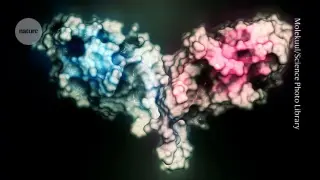
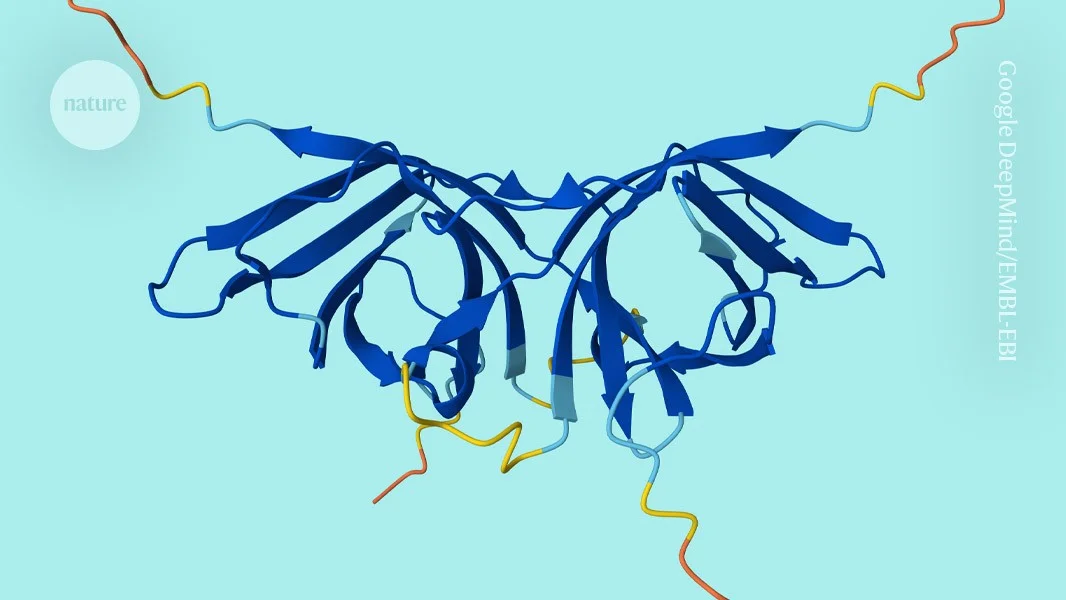
AlphaFold’s database now includes 1.7 million predicted homodimer protein complexes, expanding its 200 million monomer structures to show how two copies of the same protein interact. The complex predictions were produced by a international consortium and are freely accessible via EMBL-EBI, broadening the resource’s biological and medical relevance across 20 studied species.

Evo 2: An Open-Source AI for Genome-Scale Prediction and Design Across Life
science1 month ago

Evo 2: An Open-Source AI for Genome-Scale Prediction and Design Across Life

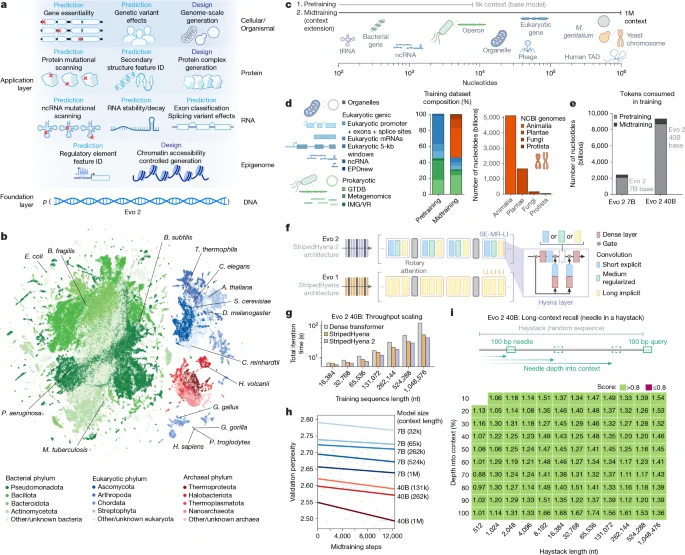
Evo 2 is a large, open biological foundation model trained on 9 trillion base pairs across all life, with a 1‑million‑token context, available in 7B and 40B sizes. It predicts mutational effects on DNA, RNA and proteins without task-specific fine-tuning, can generate genome-scale sequences and chromatin-accessibility designs, and supports exon–intron annotation and variant-effect prediction across diverse species. The model and data (OpenGenome2) are fully open-source, with training/inference code and tools (Evo Designer, Evo Mech Interp), plus safety safeguards such as virus-data exclusions to mitigate misuse.

Evo: The AI Revolutionizing Genetic Prediction and Design
science-and-technology1 year ago

Evo: The AI Revolutionizing Genetic Prediction and Design

Scientists have developed Evo, a machine learning model that predicts the effects of genetic mutations and generates new DNA sequences with high accuracy. Unlike traditional large language models, Evo is trained on microbial genomes, using base pairs as "words" to analyze genetic patterns. While Evo shows promise in understanding DNA and RNA functions, it currently lacks the ability to predict human genetic mutations. The researchers emphasize the importance of ethical guidelines to prevent misuse as the technology advances.

"New Atlas Reveals Gene Functions in Early Embryo Development"
science1 year ago

"New Atlas Reveals Gene Functions in Early Embryo Development"

Researchers at UC San Diego have developed a "genetic atlas" using the model organism C. elegans to profile the function of nearly 500 genes during embryonic development. By blocking each gene one at a time and using time-lapse 4D imaging and computer vision, they tracked how these genes influence tissue formation and cell identity. This study, published in Cell, provides new insights into gene functions and their roles in development, with implications for understanding human developmental disorders. The data is now available through an online resource called PhenoBank.

"Next-Generation CRISPR: Advancements in Precision Gene Editing"
science-and-technology2 years ago

"Next-Generation CRISPR: Advancements in Precision Gene Editing"

The recent development of CRISPR-COPIES by the Center for Advanced Bioenergy and Bioproducts Innovation (CABBI) represents a significant advancement in genetic engineering, streamlining the identification of optimal genetic integration sites and accelerating the pace of scientific discovery and innovation. This high-tech upgrade to the CRISPR/Cas system offers a powerful and accessible tool for precision genome editing, with applications spanning agriculture, biofuel production, and gene therapy, promising to drive forward the boundaries of what’s possible in genetic engineering.

"Revolutionizing R&D: AI Unlocks Unknown Protein Functions"
science-and-technology2 years ago

"Revolutionizing R&D: AI Unlocks Unknown Protein Functions"

Researchers at KAUST have developed an innovative AI tool, DeepGO-SE, that excels in predicting the functions of unknown proteins, outperforming existing methods and ranking in the top 20 of over 1,600 algorithms in an international competition. Leveraging large language models and logical entailment, this tool can deduce molecular functions even for proteins without existing database matches, offering a groundbreaking approach to understanding cellular mechanisms. The team aims to apply this tool to explore proteins in extreme environments, opening new doors for biotechnological advancements.

"AI Predicts Functions of Unknown Proteins with New Tool"
science-and-technology2 years ago

"AI Predicts Functions of Unknown Proteins with New Tool"

A new AI tool called DeepGO-SE has been developed to predict the function of unknown proteins, outperforming existing methods and even analyzing proteins with no clear matches in existing datasets. Developed by KAUST bioinformatics researcher Maxat Kulmanov and colleagues, the tool employs logical entailment to draw meaningful conclusions about molecular functions based on general biological principles. It has been successful in predicting the functions of poorly understood proteins and is being used to investigate enigmatic proteins in plants thriving in extreme environments, with potential applications in drug discovery, disease associations, and more.

"ChatGPT: Revolutionizing Medicine Design with AI Coding"
science-and-technology2 years ago

"ChatGPT: Revolutionizing Medicine Design with AI Coding"

Scientists at Chapman University have developed a GenAI model called drugAI, which utilizes advanced AI techniques to design new drug compounds with the right properties and characteristics, promising to accelerate the process of identifying viable drug candidates for various diseases at a fraction of the cost. The model has been tested and validated, showing magnificent results and generating potential drugs that have never been conceived of before. It has also demonstrated a high validity rate, drug-likeness, and strong binding affinities to respective targets, making it a promising tool for future drug design and development.