
Billion-dollar coalition launches AI 'virtual cell' to accelerate biological discovery
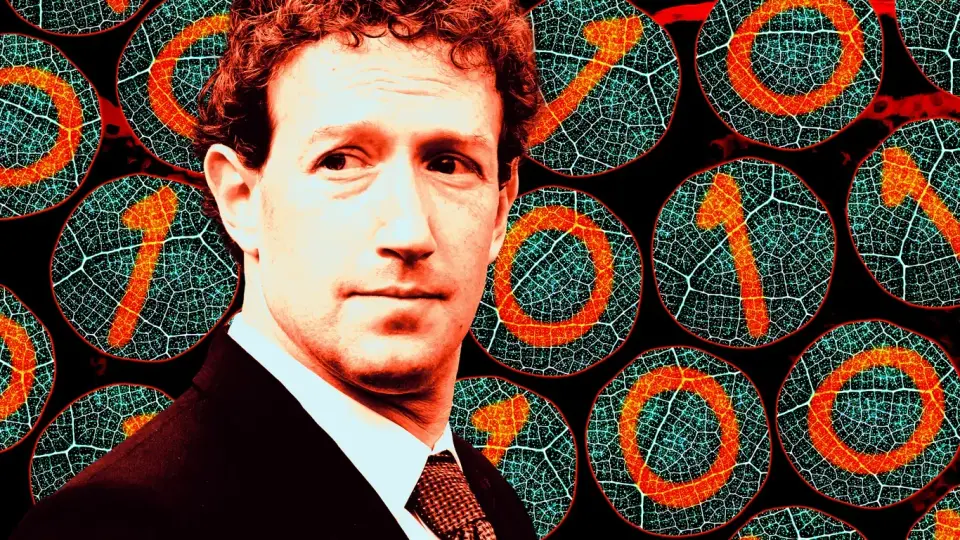
Mark Zuckerberg’s Biohub has joined forces with Google, the U.S. Department of Energy, and the National Institutes of Health in a $1.8 billion initiative to create a 'universal virtual cell.' The project aims to generate massive biological datasets that allow AI to simulate cellular behavior, enabling scientists to test hypotheses digitally before conducting expensive physical experiments. While commercial partners receive a one-year exclusive data window, the ultimate goal is to open these resources to the public to accelerate medical breakthroughs.
Key points
- The 'Virtual Biology' initiative secures $1.8 billion in total funding, including $500 million from the Department of Energy over five years and $300 million from Google DeepMind, Meta, and Isomorphic Labs.
- The primary objective is to build AI models that can predict cellular responses, reducing the need for costly and time-consuming laboratory experiments.
- Commercial partners will have a one-year exclusive access period to the newly generated data before it is released to the public scientific community.
- Biohub head of science Alex Rives emphasizes that biological AI requires 'empirical' data to bridge the gap between digital computation and physical reality.
- The project builds on Biohub’s earlier $500 million commitment, with NIH contributing existing datasets from previous federal investments.
Background
Biohub, founded in 2016 by Mark Zuckerberg and Priscilla Chan, has long focused on using technology to cure diseases. In April 2026, the organization announced an initial $500 million effort to explore whether cellular biology follows the same 'scaling laws' seen in other AI fields. This new announcement expands that vision into a broader, multi-sector collaboration, moving from initial exploration to a large-scale data generation phase.
How outlets are covering it
Axios highlights the strategic importance of the 'empirical AI' approach, noting that biology requires physical data to validate digital models. The Verge emphasizes the commercial investment aspect, framing the $300 million contribution from tech giants as a major push for digital disease combat. Newswise focuses on the international and cross-sector nature of the collaboration, stressing the nearly $2 billion commitment as a foundational step for future AI-driven medical treatments. All sources agree on the core goal of creating a predictive model for cells, but they differ in emphasis: Axios focuses on the scientific methodology, The Verge on the corporate funding, and Newswise on the global scientific impact.
Why it matters
This initiative could fundamentally change how biological research is conducted by allowing scientists to run virtual experiments. By identifying the most promising hypotheses through AI simulation, researchers can save time and resources, potentially accelerating the discovery of treatments for complex diseases like Alzheimer's and understanding fundamental processes like aging.
What to watch
The first phase of the project will focus on creating a broad map of cellular biology. Within one year, researchers expect to have enough data to train initial models and determine which additional biological data points improve accuracy. The commercial partners will have exclusive access to this data for one year before it becomes publicly available.
- "The beginning of a new scientific paradigm": Zuckerberg's Biohub, U.S. and Google build virtual cell Axios
- Zuckerberg’s Biohub Partners With DOE, NIH to Invest $1.8 Billion in Biological Data for AI Models WSJ
- US government, Google join Zuckerberg-backed Biohub in $1.8 billion push for AI biology data Reuters
- Google invests millions in Mark Zuckerberg’s efforts to create a ‘virtual cell’ The Verge
- International, Cross-Sector Collaboration Commits Nearly $2 Billion to Build Foundational Data for AI Models to Predict and Treat Disease Newswise
Want the full story? Read the original reporting
Read on Axios