Tag

Google Deepmind

All articles tagged with #google deepmind

Google's Gemini 4 Neon Targets Mid-Tier Market with 3x Speed and Lower Costs
technology3 days ago

Google's Gemini 4 Neon Targets Mid-Tier Market with 3x Speed and Lower Costs

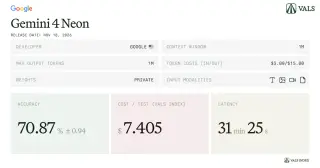
Google released Gemini 4 Neon on November 18, 2026, positioning it as a mid-tier model between its flagship Carbon and lightweight Hydrogen variants. Priced at $3 per million input tokens and $15 per million output tokens, Neon offers a 1 million-token context window and supports multimodal inputs. The model ranks second on the Vals Index and first on specific legal and finance benchmarks, claiming 3x faster performance than Carbon at 60% lower cost per task. It is available in the Gemini API, Google Antigravity, and for paid subscribers, with cybersecurity features rolling out to vetted defenders.
Google DeepMind warns AI could reach superintelligence within a decade via cognitive industrialization
technology3 days ago

Google DeepMind warns AI could reach superintelligence within a decade via cognitive industrialization

Google DeepMind researcher Tim Genewein argues that AI is approaching artificial general intelligence (AGI) and could soon advance to artificial general superintelligence (ASI). He attributes this potential shift to 'cognitive industrialization,' where hardware efficiency, algorithmic improvements, and massive investment increase effective AI compute by tenfold annually. This trajectory could enable AI to outperform human experts across nearly all tasks within ten years, necessitating urgent interdisciplinary governance and measurement frameworks.

Google DeepMind Launches Gemini 4 Neon: A Mid-Tier Model for Coding and Enterprise Work
technology4 days ago

Google DeepMind Launches Gemini 4 Neon: A Mid-Tier Model for Coding and Enterprise Work

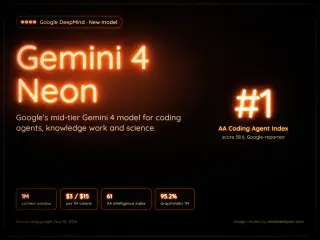
Google DeepMind has released Gemini 4 Neon, a new reasoning model positioned between its flagship Carbon and lightweight Hydrogen variants. Priced at $3 per million input tokens and $15 per million output tokens, Neon targets complex software engineering, scientific analysis, and enterprise knowledge work. The model features a 1 million-token context window and claims to deliver near-frontier performance at a lower cost per task than larger models. It is available via the Gemini API, Google Antigravity, and for paid subscribers in the Gemini app, with specific cybersecurity features rolling out to vetted defenders.

DeepMind’s AlphaGenome 2 maps genetic variant effects across specific cell types
science12 days ago

DeepMind’s AlphaGenome 2 maps genetic variant effects across specific cell types

Google DeepMind has released AlphaGenome 2, an advanced AI model designed to predict how genetic variants affect specific cell types and states, rather than broad tissue averages. Trained on over 100 million individual cell profiles across 68 tissues, the model identifies nearly twice as many variants that alter gene expression compared to its predecessor, AlphaGenome. By shifting from parallel bulk-tissue predictions to a conditional architecture, AlphaGenome 2 can resolve subtle differences in gene activity within specialized cells, such as heart muscle or immune cells. This granularity allows researchers to link genetic variations to disease mechanisms at the cellular level, potentially uncovering overlooked therapeutic targets. The model is available for non-commercial research via the AlphaGenome API, with a limited private preview for commercial partners. While it offers superior precision, it requires significantly more computational power than its predecessor and is not intended for clinical diagnosis.

Google DeepMind’s AI agents mathematically verify Signal’s encryption in four weeks
technology13 days ago

Google DeepMind’s AI agents mathematically verify Signal’s encryption in four weeks

Google DeepMind used its new AlphaProof Code AI framework to formally verify the security of Signal’s encryption protocol in just four weeks. The project proved that the post-quantum handshake and Triple Ratchet mechanisms function as intended at the machine-code level, marking a significant milestone for AI-assisted software security. While the verification did not uncover new vulnerabilities, it demonstrated that AI can drastically reduce the time and cost associated with traditional formal verification, which previously required years of human effort. The team emphasized that the process remains human-guided, with AI agents generating proofs that are checked against rigorous mathematical specifications.

Google DeepMind’s AlphaProof Code formally verifies Signal’s encryption in four weeks
technology13 days ago

Google DeepMind’s AlphaProof Code formally verifies Signal’s encryption in four weeks

Google DeepMind researchers used a new AI framework called AlphaProof Code to mathematically verify key security guarantees of the Signal protocol in just four weeks. The work validates the post-quantum handshake and Triple Ratchet but does not cover the entire app. While the project found no new vulnerabilities, it highlights the potential for AI to scale formal verification, a process previously too costly for widespread use.

Google DeepMind Employees Challenge Contractual Ban on Public AI Criticism

Google DeepMind Employees Challenge Contractual Ban on Public AI Criticism

Google DeepMind researchers are contesting employment clauses that prohibit them from publicly criticizing the company, arguing these restrictions prevent them from warning the public about potential AI risks. Current employees state that these contractual barriers suppress dissent and hinder transparency regarding the safety and societal impact of advanced artificial intelligence systems.

Google's Gemini 4 Carbon and Genie 4 Push AI Into Autonomous Engineering and Real-Time Simulation
technology23 days ago

Google's Gemini 4 Carbon and Genie 4 Push AI Into Autonomous Engineering and Real-Time Simulation

Google DeepMind has launched Gemini 4 Carbon, a frontier model optimized for long-horizon coding and cybersecurity, alongside Genie 4, a real-time world simulation engine with native audio. Carbon leads key benchmarks in vulnerability detection and secure patching, while Genie 4 allows users to steer interactive environments via natural language. Both models are currently restricted to vetted partners and testers, with broader public access pending.

Google's Gemini 4 Carbon Sets New Benchmarks in Cybersecurity and Secure Coding
technology25 days ago

Google's Gemini 4 Carbon Sets New Benchmarks in Cybersecurity and Secure Coding

Google has released Gemini 4 Carbon, a frontier AI model designed for advanced cybersecurity tasks. The model leads key benchmarks for finding, exploiting, and patching vulnerabilities, while also improving secure code generation. Access is currently restricted to vetted cyber defenders through the Fairwind Program, with broader availability pending.

DeepMind Engineer Quits to Protest Google’s Military AI Expansion
technology-and-ethics1 month ago

DeepMind Engineer Quits to Protest Google’s Military AI Expansion

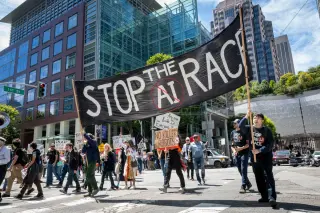
Sofia Liguori, a research engineer at Google DeepMind, resigned this week in protest against the company’s military AI contracts. Liguori, who joined in 2023 to work on grid efficiency, opposed the expansion of AI into warfare, citing the Pentagon’s GenAI.mil contract and Israel’s Project Nimbus. She argued that AI targeting systems dehumanize individuals and facilitate the escalation of war. Her departure follows internal activism, including a February demonstration and unionization efforts, amid concerns that corporate culture suppresses dissent through bureaucratic hurdles and self-censorship.

Google's Gemini 4 Argon Agents Complete Minecraft in 27 Hours
technology1 month ago

Google's Gemini 4 Argon Agents Complete Minecraft in 27 Hours

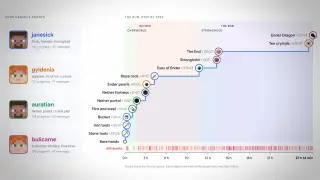
Google DeepMind researchers reported that four Gemini 4 Argon AI agents autonomously defeated the Ender Dragon in Minecraft without human intervention. The agents operated in a sandboxed survival world, writing 2,783 JavaScript programs and exchanging 229 messages over 27 hours and 14 minutes. Despite dying 605 times, the team successfully coordinated tasks, shared resources, and completed the game using only the standard Mineflayer library.