
SpaceX Captures Starship Upper Stage in Historic Midair Landing
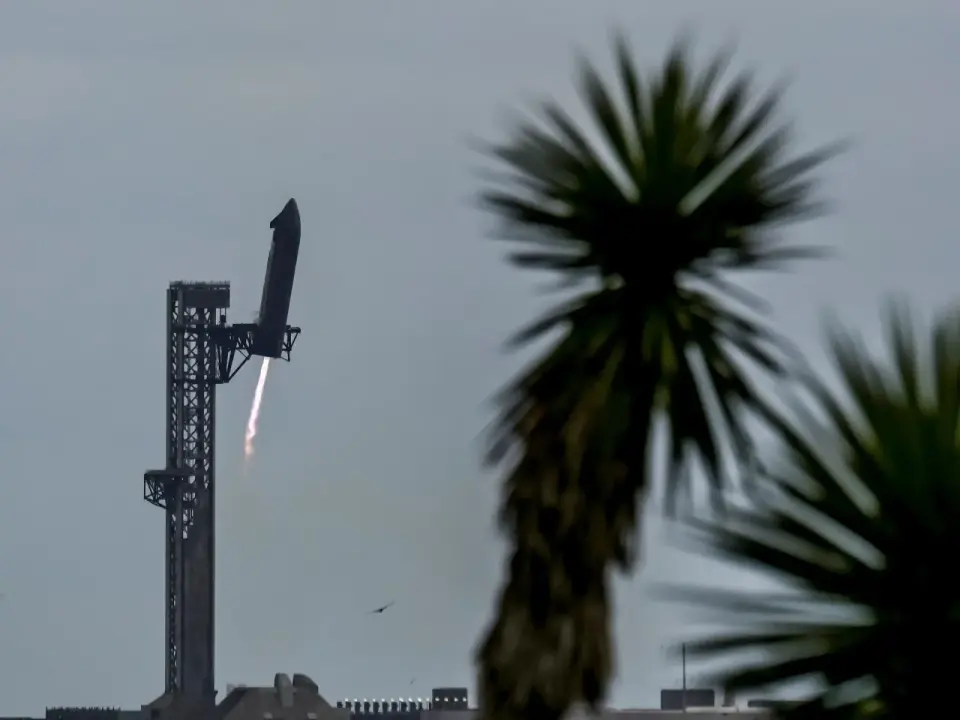
SpaceX achieved a historic milestone on November 14, 2026, by successfully catching its Starship upper stage in midair using the 'Mechazilla' tower's mechanical arms at its Starbase facility in Texas. The 124-meter-tall rocket, designated Ship 42, completed 14 orbits of Earth over 22.5 hours before descending and being secured by the tower's 'chopstick' arms while its engines were still active. This marks the first time the upper stage of a mega-rocket has been captured, a feat previously limited to smaller boosters. While the Super Heavy booster failed to land due to a low-fuel issue, the successful capture of the upper stage signals a major step toward fully reusable launch systems, potentially drastically reducing the cost of space access and enabling rapid deployment of satellite constellations and crewed lunar missions.
Key points
- SpaceX successfully captured the Starship upper stage (Ship 42) in midair on November 14, 2026, at its Starbase facility in Texas.
- The rocket orbited Earth 14 times over 22.5 hours, deploying 26 Starlink V3 satellites before returning to the launch site.
- The 'Mechazilla' tower's mechanical arms caught the 124-meter-tall spacecraft while its engines were still firing, a first for a vehicle of this size.
- The Super Heavy booster failed to land, diverting to a splashdown in the Gulf of Mexico due to a low-fuel alarm, though SpaceX called this a minor anomaly.
- NASA Administrator Jared Isaacman praised the achievement as 'almost magic,' noting its significance for future lunar missions.
- Analysts suggest this milestone validates SpaceX's core business as a rocket builder, potentially making space access more affordable and scalable.
Background
This event follows SpaceX's previous successes in catching its Super Heavy boosters on three separate occasions since October 2024. The company has long pursued full reusability to reduce costs, having already launched its Falcon 9 rocket 700 times since 2010 with a reusable first stage. The current achievement extends this capability to the upper stage, a critical step for the Artemis program, which relies on Starship for crewed lunar landings targeted for 2028. Background from our archive notes that NASA is also accelerating other deep-space missions, such as the SkyFall helicopter deployment to Mars in 2028, highlighting the broader push for advanced space infrastructure.
How outlets are covering it
Outlets varied in their emphasis on the event's implications. Al Jazeera and Space.com focused on the technical achievement and its significance for future space exploration, with SpaceX commentator Dan Huot calling it the 'holy grail of spaceflight.' The Atlantic highlighted the historical and cultural impact, comparing the feat to Jules Verne's fiction and emphasizing the reinvention of rocket technology. Yahoo Finance, however, framed the event through an investment lens, with analysts noting that SpaceX's core value lies in its ability to reduce the cost and increase the frequency of orbital access. They also contrasted SpaceX's success with a recent failure by United Launch Alliance, whose Vulcan rocket lost 40 Amazon satellites, underscoring SpaceX's dominance in reusable launch technology. All sources agreed on the historic nature of the capture, but differed in their focus on technical, cultural, or financial implications.
Why it matters
The successful capture of the Starship upper stage is a pivotal moment for the aerospace industry, demonstrating that fully reusable mega-rockets are feasible. This could dramatically reduce the cost of accessing space, enabling the rapid deployment of massive satellite constellations like Starlink V3 and Starmind AI data centers. It also paves the way for crewed lunar and Mars missions, as reusable vehicles can be quickly refurbished and reflown. For NASA, this achievement is crucial for its Artemis program, which aims to establish a lunar base by 2032. The event also highlights the competitive landscape, with SpaceX's success contrasting sharply with recent failures by competitors like United Launch Alliance, potentially reshaping the future of commercial and government space operations.
What to watch
SpaceX plans to attempt a 'double catch' on its next test flight, where both the Super Heavy booster and the Starship upper stage are recovered. The company is also working on rapid reflight capabilities, aiming to reuse Ship 42 in future missions. Additionally, SpaceX is developing a crew cabin for Starship, with NASA reporting that a full-scale prototype, 'Cabin 1,' is on track for completion by the end of 2026. The company is also planning to test in-orbit refueling, a critical step for deep-space missions, with the first test expected soon. These developments will determine whether SpaceX can meet its ambitious goals, including 10,000 launches per year by 2030 and crewed lunar landings by 2028.
- ‘Almost magic’ as SpaceX craft caught mid-air: Why it matters Al Jazeera
- Awesome The Atlantic
- SpaceX's Starship feat should remind investors that the company at its 'core' is a rocket builder Yahoo Finance
- What's next for SpaceX's Starship after epic Flight 15 chopsticks catch? Space
- SpaceX Makes History With Successful Rocket Catch in Texas The New York Times
Want the full story? Read the original reporting
Read on Al Jazeera