
SpaceX Starship Flight 15 reaches orbit after aborting booster catch
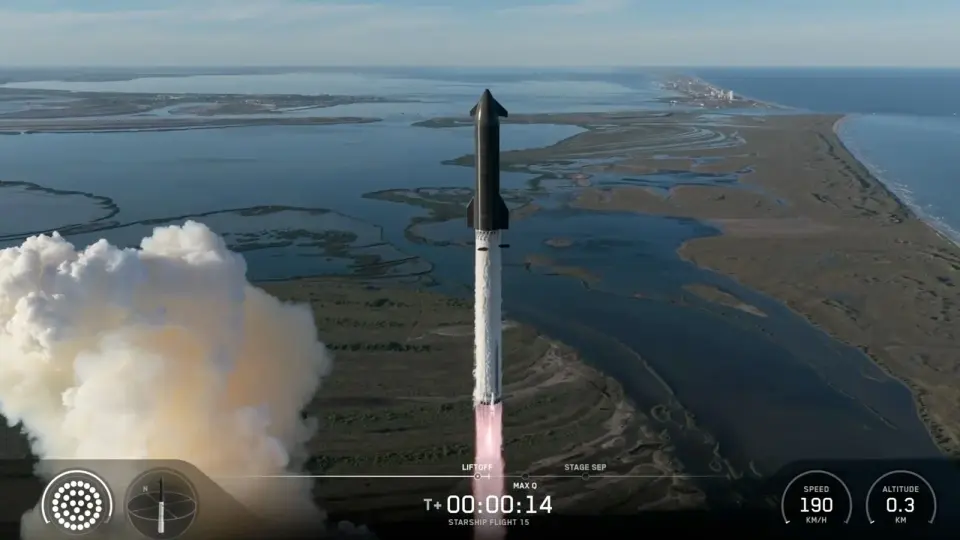
SpaceX’s 15th Starship test flight launched successfully on November 13, 2026, achieving orbital insertion for the upper stage and deploying 26 Starlink V3 satellites. However, the company aborted the planned catch of the Super Heavy booster, which splashed down in the Gulf of Mexico. The upper stage is now orbiting Earth and may attempt a historic landing at the launch site on November 14, marking the first recovery of a Starship upper stage.
Key points
- Launch occurred at 5:47 p.m. ET from Starbase, Texas, with the Super Heavy booster and Ship upper stage separating successfully after 2.5 minutes.
- SpaceX aborted the catch of the Super Heavy booster, which splashed down in the Gulf of Mexico approximately 6.5 minutes after launch; reasons were not immediately disclosed.
- The Ship upper stage reached low Earth orbit at an altitude of 170 miles (275 km) at T+26 minutes and 10 seconds, marking the second time Starship has reached orbit.
- The mission deployed 26 Starlink V3 satellites, adding a terabit of data capacity to the constellation, equivalent to 10 Falcon 9 launches.
- The upper stage is scheduled to orbit Earth 14 times over 22 hours before attempting a landing at Starbase on November 14 at approximately 4:17 p.m. ET.
- SpaceX has three contingency checkpoints to decide whether to attempt the upper stage catch or divert it to a splashdown in the Gulf of Mexico.
Background
This is the 15th test flight of SpaceX’s Starship rocket, which has been in development since 2023. Previous flights have achieved orbital insertion for the upper stage, but none have attempted to catch it. The company has previously recovered three V1 Super Heavy boosters and reused two in later flights. The current flight is part of SpaceX’s efforts to achieve full reusability, which is critical for its plans to launch 10,000 Starship rockets per year by 2030 and support NASA’s Artemis III lunar mission.
How outlets are covering it
Space.com and Ars Technica emphasize the successful orbital insertion and satellite deployment, noting that the primary mission objectives were met. CNN highlights the uncertainty surrounding the booster catch abort and the implications for NASA’s Artemis III mission, which relies on Starship for lunar landings. BBC focuses on the setback of the aborted booster catch and the historic nature of the potential upper stage catch, noting that SpaceX has never attempted to catch the upper stage before. All sources agree that the upper stage’s return is a critical milestone for full reusability, but they differ in their emphasis on the risks and uncertainties involved.
Why it matters
The success of the upper stage catch would be a major milestone for SpaceX, demonstrating the feasibility of full reusability for Starship. This would significantly reduce launch costs and enable SpaceX’s ambitious plans for Starlink satellite deployment and orbital data centers. It would also be critical for NASA’s Artemis III mission, which relies on Starship for lunar landings. The flight’s success or failure will have significant implications for the future of space exploration and commercial spaceflight.
What to watch
SpaceX will monitor the upper stage’s orbit and decide whether to attempt a catch at the launch site on November 14. If the catch is aborted, the upper stage will splash down in the Gulf of Mexico. The company will also analyze data from the flight, including heat shield performance, to inform future missions. NASA and other stakeholders will closely monitor the flight’s progress, as it has implications for the Artemis III mission and other lunar and Mars missions.
- SpaceX launches Starship on ambitious 22-hour Flight 15 test, but aborts booster 'chopsticks' catch (video) Space
- Live updates: SpaceX lifts off, aiming to make history in Starship’s 15th test CNN
- Starship flight 15 powers to orbit—setting up a possible catch on Saturday Ars Technica
- SpaceX Starship Flight 15 live updates: Starship deploys 26 Starlink satellites, coasting on 22-hour trip Space
- First catch aborted in SpaceX Starship rocket double-catch test BBC
Want the full story? Read the original reporting
Read on Space