
Agentic AI Drives CPU Comeback as NVIDIA Vera Reverses Chiplet Trade-offs
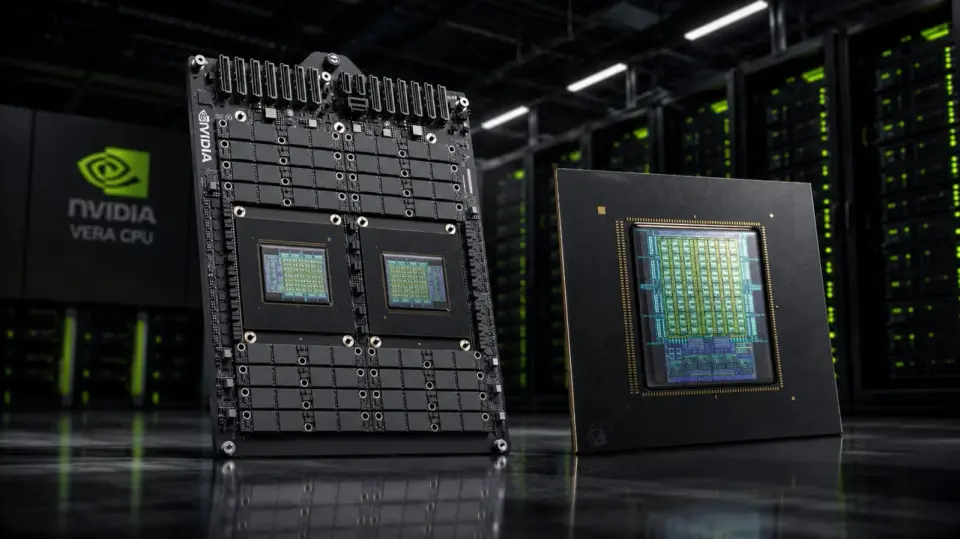
NVIDIA's Vera CPU marks a strategic reversal in data center design, prioritizing single-threaded speed over raw core counts to support agentic AI. By using a monolithic die instead of chiplets, Vera achieves 1.5x higher performance than its predecessor and 2x faster speeds than leading x86 rivals on agent workloads. This shift reflects a broader industry trend where CPUs are becoming critical for orchestrating complex AI tasks, moving the CPU-to-GPU ratio closer to 1:1.
Key points
- NVIDIA's Vera CPU uses a monolithic die to eliminate latency, achieving 3.4 TB/s bisection bandwidth, which is 3x faster than leading x86 chips.
- Vera is 1.5x faster than the Grace CPU and 2x faster than top x86 processors on agentic workloads like Python scripting.
- Agentic AI requires CPUs to handle sequential decision-making, preventing expensive GPUs from sitting idle during multi-step reasoning loops.
- NVIDIA is now selling Vera as a standalone CPU for 'pure racks' dedicated to agent tool calls, rather than just a host node for GPUs.
- Industry estimates suggest the CPU-to-GPU ratio may shift from 1:4 to 1:1 as agentic workloads increase CPU demand.
Background
This development follows recent announcements from AMD, which unveiled its 256-core EPYC Venice processors in September 2026, claiming 2.24x higher throughput than NVIDIA's Vera. Additionally, NVIDIA, Meta, and Google standardized open AI factory designs at the 2026 OCP Summit, focusing on the Vera Rubin platform to support agentic AI deployment.
How outlets are covering it
Wccftech highlights NVIDIA's technical pivot, noting that Vera's monolithic design sacrifices the core density of chiplet architectures to restore single-threaded performance, a trade-off previously made by cloud providers. Semiconductor Engineering emphasizes the broader industry impact, stating that agentic AI is driving CPU prices upward as the CPU-to-GPU ratio shifts toward 1:1. Fierce Network quotes Google Cloud's Mark Lohmeyer, who argues that while GPUs handle inference, CPUs are essential for orchestrating long-running agent workflows, though he cautions that a completely new CPU class may not be necessary yet. Arm's perspective focuses on scaling agentic infrastructure from the CPU level to the rack level, aligning with NVIDIA's push for standalone CPU racks.
Why it matters
The rise of agentic AI is reshaping data center economics by making CPUs a bottleneck rather than a secondary component. As agents require continuous orchestration and decision-making, the demand for high-speed, low-latency CPUs is surging. This shift could lead to higher hardware costs and a re-evaluation of infrastructure design, moving away from pure throughput toward balanced performance and orchestration capabilities.
What to watch
Expect increased competition between NVIDIA and AMD as both companies optimize their CPUs for agentic workloads. NVIDIA's push for standalone Vera CPU racks may face resistance from AMD's 256-core Venice, which claims higher throughput. Additionally, cloud providers like Google Cloud will likely refine their compute services to better handle bursty, long-running agentic workloads, potentially leading to new pricing models for CPU-intensive AI tasks.
- Exclusive: NVIDIA’s Vera Team Says Chiplet Designs Sacrificed Single-Threaded Performance For Core Counts, And Agentic AI Is Now Forcing A Reversal Wccftech
- Agentic AI Alters The CPU-GPU Balance Semiconductor Engineering
- Google Cloud’s Lohmeyer: Agentic AI will kick off a CPU comeback Fierce Network
- Arm at the OCP Global Summit 2026: How Arm AGI CPU is scaling agentic AI infrastructure from CPU to rack Arm Newsroom
- The Inference Era Is Also a CPU Story TrendForce
Want the full story? Read the original reporting
Read on Wccftech