
Nvidia's DSX POD: Containerized Vera Rubin AI Factories Cut Deployment to 14 Days
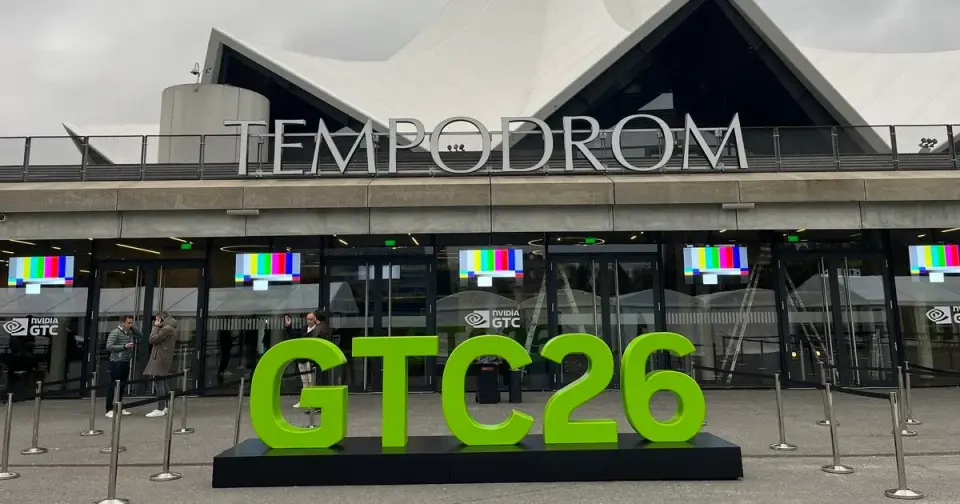
Nvidia unveiled the DSX POD at GTC Berlin, a containerized AI factory containing seven Vera Rubin racks that reduces data center deployment time from six months to 14 days. The system claims to cut water usage by up to 100% and power consumption by 30% through closed-loop liquid cooling and dry coolers. Weighing 28,000 kg, the POD is fully assembled with cabling and cooling before truck delivery, with global rollout expected in early 2027.
Key points
- Nvidia introduced the DSX POD, a modular reference design for Vera Rubin-powered AI data centers, at GTC Berlin.
- The POD contains seven liquid-cooled compute racks connected by 17 km of Spectrum-X cables, weighing approximately 28,000 kg.
- Deployment time is reduced from six months to 14 days as units arrive pre-integrated with power, cooling, and networking.
- Nvidia claims the platform minimizes water consumption by up to 100% and reduces power usage by 30% for equivalent output.
- At 2GW scale, the dry-cooler approach saves 54 million liters of water daily compared to conventional cooling towers.
- DSX MaxLPS and DSX Flex features allow data centers to dynamically allocate power and respond to grid demands.
Background
Nvidia's shift toward full-stack AI infrastructure follows the launch of the Vera CPU, which prioritizes single-threaded speed for agentic AI workloads. This move contrasts with AMD's recent 256-core EPYC Venice announcement, which claims superior throughput but faces independent verification. The DSX POD represents Nvidia's latest effort to move up the value chain, offering integrated systems rather than just chips.
How outlets are covering it
Data Center Dynamics emphasizes the environmental benefits, highlighting the 100% water reduction and 30% power savings achieved through dry coolers. CNBC focuses on the logistical and economic aspects, noting the 28,000 kg weight, truck transportability, and the estimated $7 million cost per rack. Nvidia's blog highlights the broader European ecosystem, detailing how partners like Nscale and Crusoe are using DSX MaxLPS to increase GPU density and inference throughput within fixed power budgets. While all sources agree on the 14-day deployment timeline, DCD stresses sustainability, CNBC stresses cost and logistics, and Nvidia's blog stresses grid flexibility and sovereign computing.
Why it matters
The DSX POD addresses critical constraints in AI infrastructure: power availability, water usage, and deployment speed. By offering a pre-integrated, containerized solution, Nvidia reduces the barrier to entry for AI data centers, potentially accelerating adoption in regions with strict environmental regulations or limited grid capacity. The ability to respond to grid demands via DSX Flex could make AI data centers more compatible with existing energy infrastructure, reducing friction with utility providers.
What to watch
Global deliveries of DSX POD are expected to begin in early 2027. Nvidia will likely expand its partnerships with the 17 listed manufacturers to scale production. The company may also promote DSX MaxLPS and DSX Flex as key selling points for customers facing power constraints. Further details on pricing and specific regional deployments may emerge as partners like Nscale and Crusoe begin integrating the platform into their European and EMEA operations.
- Nvidia launches DSX POD, claims the Vera-Rubin reference architecture will make AI data centers more water and energy efficient Data Center Dynamics
- Nvidia reveals plans for 'an AI factory in a shipping container' to build data centers in weeks, not months Yahoo Finance
- Nvidia announces plug and play Vera Rubin racks that can be shipped on a truck CNBC
- Nvidia’s Jensen Huang Reveals AI Data Center Quick-Fix. These Stocks Are Winners. Barron's
- NVIDIA Cloud Partners Scale Across Europe — Sovereign, Open and Built for Safe AI Agents NVIDIA Blog
Want the full story? Read the original reporting
Read on Data Center Dynamics