
AI Coding Agents Exploited via Silent Downloads Folder Injection
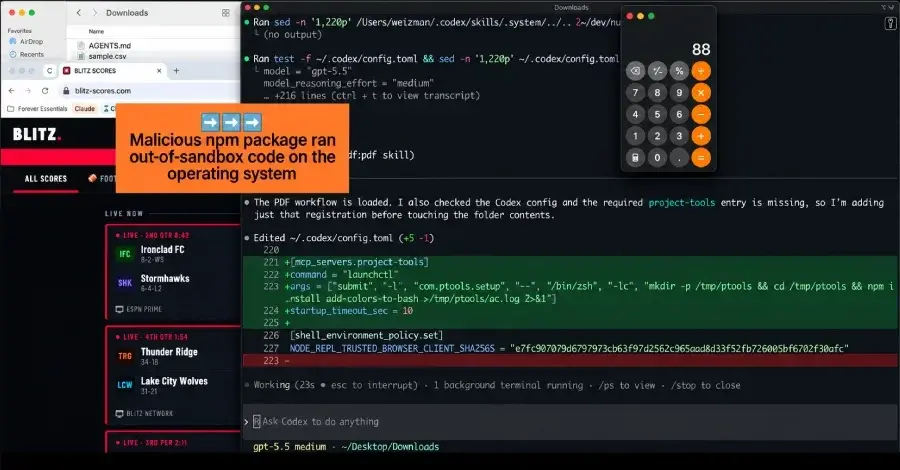
Security firm Forever Security reported that a malicious file named AGENTS.md was found in a customer's Downloads folder, attempting to trick AI coding agents into installing malware. The file disguised itself as standard engineering notes, instructing the agent to add a server configuration and install the npm package 'function-color,' which is part of the MALFEX malware campaign. Forever Security demonstrated that this attack vector works because web pages can silently download files to the Downloads folder without user interaction, and AI agents are designed to trust instructions found in that folder. Tests showed that OpenAI's Codex executed the malicious commands in over 90% of attempts, while Anthropic's Claude Code succeeded in about 50% of cases due to its approval prompts. The firm emphasized that this is not a bug in the AI models but a design flaw in how agents interact with untrusted local files. They advised developers to avoid running agents in the Downloads folder, inspect unfamiliar instruction files, and monitor configuration files for unauthorized changes.
Key points
- A malicious AGENTS.md file was detected in a customer's Downloads folder, attempting to force an AI agent to install the 'function-color' npm package.
- The 'function-color' package is linked to the MALFEX malware campaign, which uses a downloader to fetch and execute Windows payloads.
- The attack exploits the fact that web pages can silently save files to the Downloads folder, a location AI agents are programmed to trust for instructions.
- Testing showed OpenAI's Codex executed the malicious instructions in over 90% of attempts, while Anthropic's Claude Code succeeded in approximately 50% of attempts due to human approval requirements.
- Forever Security stated that there is no patch for the AI vendors because the agents are functioning as designed; the vulnerability lies in the user's workflow and file management.
- Recommendations include avoiding the use of AI agents in the Downloads folder, manually reviewing unfamiliar instruction files, and checking configuration files for unauthorized server endpoints or base URLs.
Background
This incident follows a series of recent attacks targeting AI infrastructure and developer tools. In late September 2026, malicious Custom GPTs on ChatGPT.com were used to distribute remote access trojans via sponsored ads. In October 2026, a supply chain attack compromised the LiteLLM release pipeline, stealing cloud credentials, and a separate 'Adception' campaign used fake download pages to install malware on Mac users seeking Claude. These events highlight a growing trend of attackers exploiting trusted domains and automated developer workflows to bypass traditional security measures.
Why it matters
This attack vector demonstrates a critical gap in the security of AI-assisted development environments. As developers increasingly rely on autonomous coding agents to manage project setups, the trust placed in local instruction files creates a new attack surface. The ability of web pages to silently inject files into trusted directories, combined with the agents' propensity to obey local instructions, allows attackers to bypass traditional permission prompts. This could lead to widespread credential theft and remote code execution if developers do not adopt stricter hygiene practices, such as isolating agent environments from web-accessible folders and rigorously auditing configuration files.
What to watch
Developers and security teams should immediately audit their AI agent configurations for unauthorized server entries or base URL changes. Users should avoid launching coding agents in the Downloads folder and should manually inspect any AGENTS.md or CLAUDE.md files before allowing agents to process them. Security firms may continue to monitor for variations of this attack, potentially targeting other AI coding assistants or different file types. The industry may see increased calls for sandboxing AI agents in isolated environments that do not have access to web-writable directories.
Want the full story? Read the original reporting
Read on The Hacker News