
LiteLLM Breach: Leaked Key Enabled Supply Chain Attack via Malicious v1.107.0
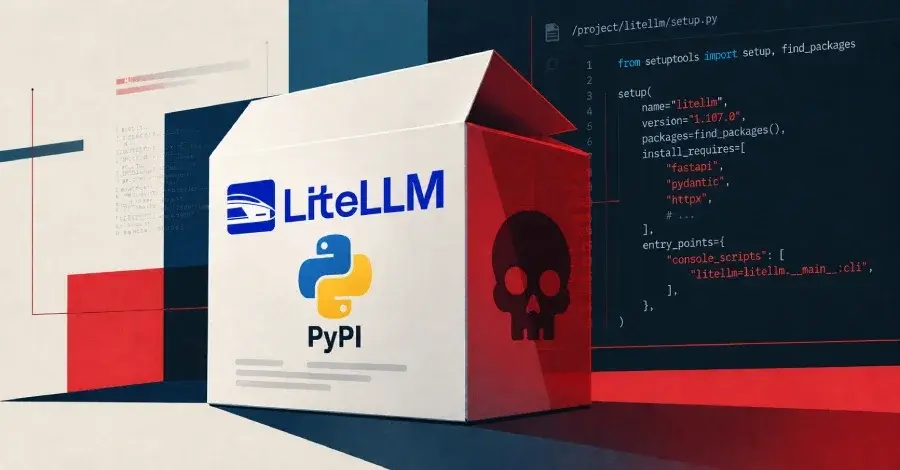
A leaked master key allowed attackers to hijack LiteLLM's release pipeline, publishing a malicious Python package that steals credentials and installs backdoors.
Key points
- A master key for LiteLLM's Agent Platform was accidentally committed to a public repository in May 2026 but was not revoked.
- Attackers used the unrevoked key on October 10, 2026, to extract a GitHub CLI OAuth token with owner-level access.
- The attacker modified the release pipeline to point to a lookalike repository, publishing malicious LiteLLM version 1.107.0 to PyPI and Docker Hub on October 21.
- The malicious package included a credential stealer and a Unix backdoor that executes automatically when Python starts, even if LiteLLM is not imported.
- The malware exfiltrates secrets from developer tools, cloud environments, and browsers to a specific domain, with data sent via HTTP POST requests.
Background
This incident follows a pattern of supply chain attacks targeting open-source software, such as the recent compromise of country-code top-level domains to forge certificates. LiteLLM had previously disclosed the breach on October 22, noting that attackers exploited leaked tokens found in logs to bypass security controls. The current report provides deeper technical details on the attack vector and the specific mechanisms used to exfiltrate data, clarifying that the initial hypothesis about token theft from logs was inaccurate.
Why it matters
The incident highlights critical risks in managing secrets for AI orchestration tools, where a single unrevoked key can lead to full organizational compromise. The malware's ability to execute upon Python startup, independent of the LiteLLM package, expands the attack surface beyond direct users, potentially affecting any environment where Python is active. This underscores the need for strict secret rotation and release pipeline integrity checks in open-source projects.
What to watch
LiteLLM is working to revoke all tokens associated with internal systems and vendor platforms. Users who installed unpinned versions of LiteLLM between 11:39 a.m. and 1:23 p.m. UTC on October 21, 2026, are advised to update immediately and scan for malicious startup components, as removing the application files alone may not eliminate the threat.
Want the full story? Read the original reporting
Read on The Hacker News