
Joyce Carol Oates Condemns Emily Wilson's 'Odyssey' Review as 'Crude' and 'Haughty'
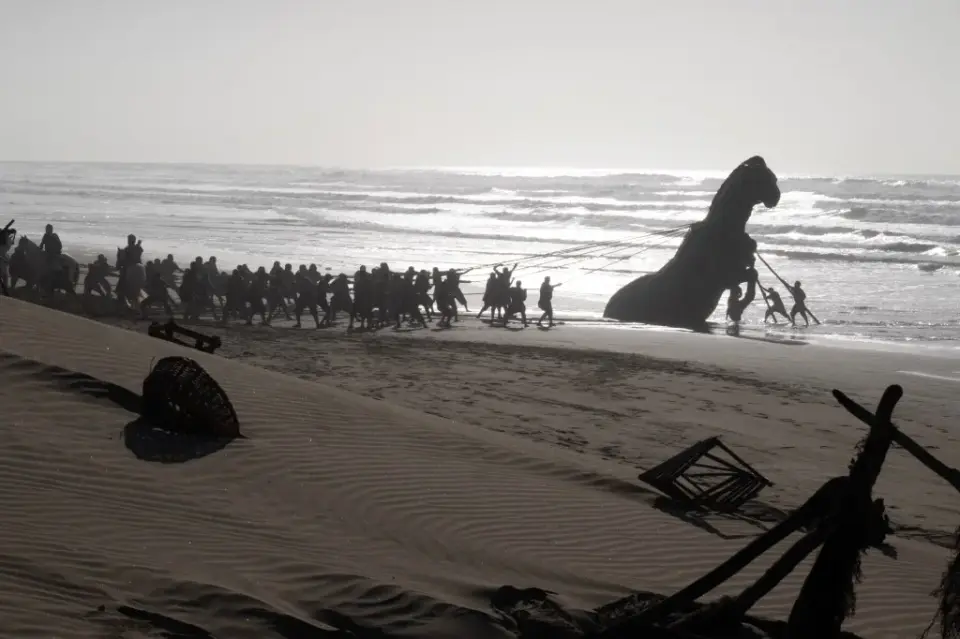
Author Joyce Carol Oates publicly defended Christopher Nolan’s 'The Odyssey' against translator Emily Wilson’s scathing review, criticizing Wilson’s tone as 'haughty' and 'crude.' Oates argued that Nolan has the right to reimagine classical heroes, while Wilson maintained the film lacks emotional depth and ethical nuance. The debate highlights a clash between literary purism and cinematic interpretation, occurring as the film surpasses $727 million at the global box office.
Key points
- Joyce Carol Oates responded to Emily Wilson’s London Review of Books critique via social media, accusing Wilson of 'haughty superiority' and using 'crude language' reminiscent of political partisans.
- Oates defended Nolan’s right to reimagine Homer’s characters, noting that Odysseus is not inherently 'noble' and that Nolan’s version explores conscience rather than just pride.
- Emily Wilson, whose 2017 translation of 'The Odyssey' is widely used, argued the film lacks psychological depth, convincing motivations, and ethical complexity, stating she would be 'ashamed' to have written the script.
- Wilson criticized the film’s depiction of the gods as absent and the portrayal of characters like Penelope as one-dimensional, though she acknowledged the actors’ strong performances.
- Slate’s Theo Nash, a classicist, countered Wilson’s review, arguing she misunderstood Nolan’s thematic focus on the violation of hospitality (xenia) and misinterpreted visual symbolism, such as the depiction of the gods as elemental forces.
- The film has grossed over $727 million globally in 12 days, though it is expected to drop from the top spot with the release of 'Spider-Man: Brand New Day.'
Background
The controversy follows a period of near-unanimous critical acclaim for Nolan’s 'The Odyssey,' which was praised for its IMAX scale and ambition. Earlier debates included Whoopi Goldberg defending Elliot Page’s casting as Sinon, and Nolan dismissing backlash as irrelevant. Wilson’s review, which briefly crashed the London Review of Books website, contrasts with the film’s strong commercial performance and the general critical consensus that it is a bold, modern epic.
How outlets are covering it
Outlets diverge sharply on the validity of Wilson’s critique. Deadline and The Hollywood Reporter present Oates’s defense as a rebuke of Wilson’s tone, emphasizing Oates’s argument that artistic reinterpretation is valid. NPR highlights Wilson’s specific complaints about character motivation and the absence of sex scenes, while acknowledging her belief that the film is still worth seeing. Slate offers a counter-perspective from classicist Theo Nash, who argues Wilson’s review is 'baffling' and that she failed to understand Nolan’s deliberate deviations from the poem, such as the indirect portrayal of the gods and the thematic focus on hospitality violations. While Oates and Nash view Wilson’s critique as intellectually unsound or poorly delivered, Wilson maintains that the film fails to capture the ethical and psychological complexity of Homer’s original work.
Why it matters
The dispute underscores the tension between literary fidelity and cinematic adaptation in high-profile cultural projects. Wilson’s review, despite its harshness, has driven significant public interest in Homer’s works and her own translations. Oates’s intervention signals that the debate has moved beyond academic circles into mainstream cultural discourse, with implications for how audiences and critics evaluate adaptations of classical texts. The film’s continued box office success suggests that commercial appeal may outweigh critical or literary objections in the current market.
What to watch
The film is expected to drop from the number one box office position as 'Spider-Man: Brand New Day' releases. Wilson is working on a new, more expansive translation of 'The Odyssey' and a collection of essays, 'Crossing the Wine-Dark Sea,' due in September. The debate may continue as more critics and scholars weigh in on the film’s interpretation of Homer’s themes.
- Joyce Carol Oates Defends Christopher Nolan & ‘The Odyssey’ Against Emily Wilson, Other Critics Deadline
- 'Odyssey' translator Emily Wilson says Nolan shouldn't have written the movie himself NPR
- As a Classicist, I’ve Defended Emily Wilson’s Odyssey Translation. I Can’t Defend Her Review of Nolan’s Movie. Slate Magazine
- Joyce Carol Oates Defends ‘Odyssey’ Against Translator’s Viral Slam: “Crude Language of MAGA Folks” The Hollywood Reporter
- Joyce Carol Oates goes to battle for 'Odyssey,' takes aim at translator Emily Wilson’s viral review latimes.com
Want the full story? Read the original reporting
Read on Deadline