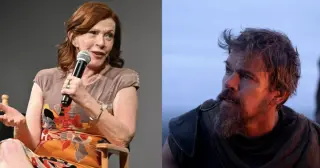
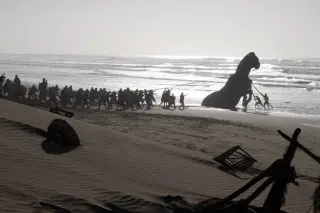
Classicist Emily Wilson is creating a new, complete translation of Homer's 'The Odyssey,' abandoning the strict constraints of her 2017 version. The project follows a viral controversy where Wilson criticized Christopher Nolan's film adaptation, which unexpectedly boosted sales of her original work.
Emily Wilson has announced a complete, ground-up retranslation of Homer's The Odyssey, distinct from a revision of her 2017 edition. This move follows the massive sales surge triggered by Christopher Nolan's film adaptation and Wilson's subsequent public critiques of the movie. While Wilson embraces the controversy as part of her public role, critics like Joyce Carol Oates have condemned her previous remarks as disrespectful to the film's creators.
Emily Wilson is preparing a new edition of her 2017 translation of Homer's 'The Odyssey,' a project accelerated by the intense public debate surrounding Christopher Nolan's recent film adaptation. Wilson's translation has become a central point of contention in the discourse, with the translator now revisiting her work to address the cultural moment. The reissue aims to provide a definitive text for readers engaging with the epic during a period of heightened interest and scholarly disagreement.
Christopher Nolan’s 'The Odyssey' has ignited a fierce academic debate, with translator Emily Wilson calling the film 'emotionally empty' while critics like Joyce Carol Oates defend it. Despite the controversy, the movie has grossed over $900 million worldwide and boosted sales of Homer’s epic by 1,400%.
Christopher Nolan’s adaptation of The Odyssey has ignited a cultural phenomenon, driving record box office receipts and a surge in Homer book sales. While fans scramble for scarce 70mm IMAX tickets, critics debate the film’s artistic merit, with translator Emily Wilson calling it 'emotionally empty.'
Emily Wilson, translator of the 2017 'The Odyssey,' published a second critical essay in The Atlantic, calling Christopher Nolan's film 'emotionally empty.' While the movie remains a box office phenomenon, Wilson argues it lacks the ethical depth of Homer's original. Meanwhile, the film has triggered a massive surge in book sales, with Wilson's translation becoming a bestseller.
Emily Wilson has intensified her criticism of Christopher Nolan’s 'The Odyssey,' calling the film 'emotionally empty' in a new op-ed for The Atlantic. While the movie has grossed over $922 million worldwide, the debate has expanded beyond literary fidelity to include discussions on PTSD, moral injury, and theological interpretations of the source material.
Christopher Nolan’s film adaptation of Homer’s The Odyssey has driven a massive surge in book sales across the US, with print sales up 76% year-to-date. While the film has grossed over $700 million, it faces sharp criticism from classicist Emily Wilson, who argues it lacks the emotional depth of the original poem. Despite the controversy, libraries and bookstores report unprecedented demand, particularly among younger readers.
Christopher Nolan’s 'The Odyssey' has become a cultural lightning rod, generating over $700 million at the box office while sparking fierce debate among classicists and critics. The film’s casting of Matt Damon as Odysseus and race-neutral choices for other roles ignited controversy, leading to a viral feud between translator Emily Wilson and authors Susan Orlean and Joyce Carol Oates. Despite harsh critiques calling the adaptation shallow, the film remains a commercial and critical success, with audiences and many defenders praising its intimate, modern take on Homer’s epic.
Emily Wilson’s scathing review of Christopher Nolan’s 'The Odyssey' ignited a public feud, with authors Susan Orlean and Joyce Carol Oates defending the film while Wilson regretted specific critiques on casting. Despite the controversy, the movie has grossed nearly $700 million, and Wilson’s translation sales surged by over 600% on Audible.
The cultural debate over Christopher Nolan’s 'The Odyssey' has escalated into a high-profile literary feud. Classicist Emily Wilson, whose 2017 translation inspired Nolan, published a harsh 4,200-word review in the London Review of Books, calling the film shallow and lacking in ethical depth. In response, authors Susan Orlean and Joyce Carol Oates publicly defended the film, with Orlean calling Wilson 'a bit of a jerk.' Wilson has since expressed regret over her comments regarding the film's race-neutral casting, while the film continues to dominate box office and cultural discourse.
Joyce Carol Oates publicly criticized Emily Wilson’s review of Christopher Nolan’s The Odyssey, calling her tone 'haughty.' Wilson’s London Review of Books essay argued the film lacks depth and character development, while Slate’s Theo Nash defended Nolan’s interpretation, arguing Wilson misunderstood the film’s themes.
Novelist Joyce Carol Oates has publicly defended Christopher Nolan’s film The Odyssey against sharp criticism from classicist Emily Wilson. Oates criticized Wilson’s tone in a London Review of Books essay, calling it 'crude' and lacking collegiality. While Wilson argued the film lacks emotional depth and character motivation, Oates defended Nolan’s interpretation, noting that Wilson’s own translation inspired the film’s opening line. The dispute has intensified online, with Wilson acknowledging the film’s visual spectacle but maintaining that the script is poorly written. Box office figures show the film has earned $683 million globally, while sales of Wilson’s translation have surged 1,560% in the UK.
Joyce Carol Oates has publicly defended Christopher Nolan’s film adaptation of 'The Odyssey' against a scathing review by translator Emily Wilson. While Wilson criticized the movie for lacking depth and ethical nuance, Oates condemned her tone as dismissive and politically charged. The debate has intensified public interest in Homer’s work, driving a massive surge in sales for Wilson’s translation despite the controversy.
Author Joyce Carol Oates publicly defended Christopher Nolan’s 'The Odyssey' against translator Emily Wilson’s scathing review, criticizing Wilson’s tone as 'haughty' and 'crude.' Oates argued that Nolan has the right to reimagine classical heroes, while Wilson maintained the film lacks emotional depth and ethical nuance. The debate highlights a clash between literary purism and cinematic interpretation, occurring as the film surpasses $727 million at the global box office.