
New Study Suggests Van Gogh’s 'Starry Night' Depicts July 1889 Sky
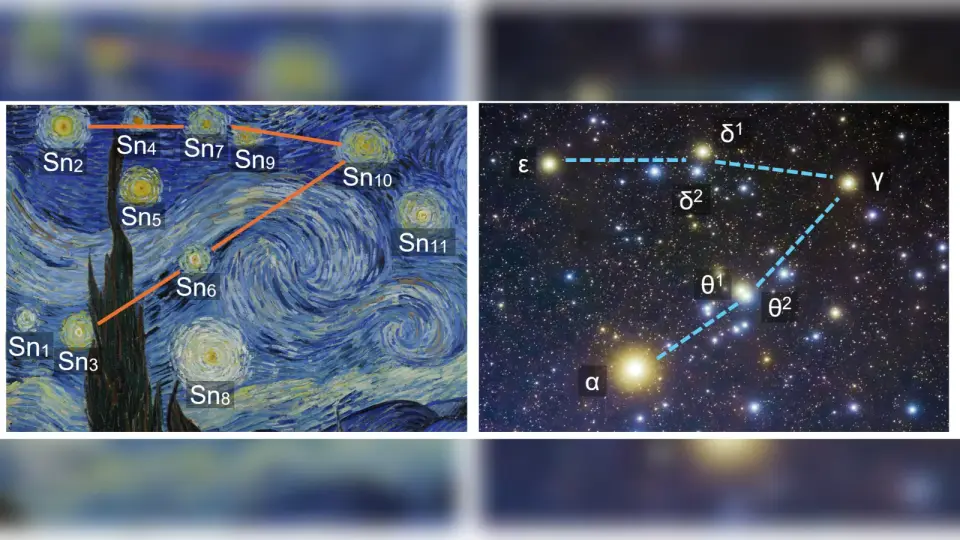
Researchers argue Vincent van Gogh’s 'The Starry Night' depicts the pre-dawn sky of July 22, 1889, not June, using geometric analysis to match the painting’s stars to the Hyades cluster.
Key points
- A study in Scientific Reports proposes that 'The Starry Night' depicts the sky of July 22, 1889, rather than the traditionally accepted June date.
- Researchers used Procrustes analysis to match the painting’s central star cluster to the Hyades in Taurus, finding a close geometric fit.
- The study suggests Van Gogh may have combined observations from multiple days, including a waning crescent moon and Venus, into the final composition.
- Art historians and the Van Gogh Museum dispute the findings, citing a June 1889 letter and a subsequent mental breakdown that likely prevented painting in July.
- The research validates its method by analyzing other night paintings by Van Gogh, Elsheimer, and Millet, confirming the reliability of the geometric approach.
Background
Previous analyses of 'The Starry Night' often treated the sky as a product of imagination or symbolic expression. Earlier astronomical attempts by Albert Boime and Charles Whitney in the 1980s failed to reach a consensus due to qualitative methods. Recent studies have also explored the painting’s depiction of turbulence, but this new research focuses on the specific celestial arrangement and its potential link to a real date.
How outlets are covering it
Space.com and ScienceAlert highlight the quantitative success of the new study, emphasizing the match between the painting’s stars and the Hyades cluster. The Guardian notes the skepticism from the Van Gogh Museum, which maintains the June date based on historical letters and a mental breakdown. Donald Olson, a physics professor, criticizes the study’s assumed narrow field of view as inconsistent with the painting’s wide landscape. The researchers acknowledge that Van Gogh may have combined skies from multiple days, but argue the July 22 date provides the best fit for the celestial arrangement.
Why it matters
This study bridges art history and astronomy, offering a new framework for analyzing historical night paintings. It challenges long-held assumptions about Van Gogh’s creative process and the dating of his iconic work, potentially reshaping our understanding of his timeline and artistic methods.
What to watch
Further research in art history and conservation science may clarify the painting’s completion date. The researchers suggest that similar geometric analyses could be applied to other historical night paintings to determine if they depict real skies or imagined compositions.
- Van Gogh's 'The Starry Night' depicts the sky on July 22, 1889, researchers find Space
- The actual sky of Van Gogh’s Starry Night: a multidisciplinary reconstruction | Scientific Reports Nature
- Astronomers challenge dating of Van Gogh’s Starry Night The Guardian
- Mysterious Star Pattern in Famous Van Gogh Painting Helps Solve a Century-Old Debate ScienceAlert
- New study traces van Gogh's famed 'Starry Night' to an actual night sky from 1889 ABC News - Breaking News, Latest News and Videos
Want the full story? Read the original reporting
Read on Space