
Hunter's Moon Peaks Early, Missing Halloween but Lighting Up Global Skies
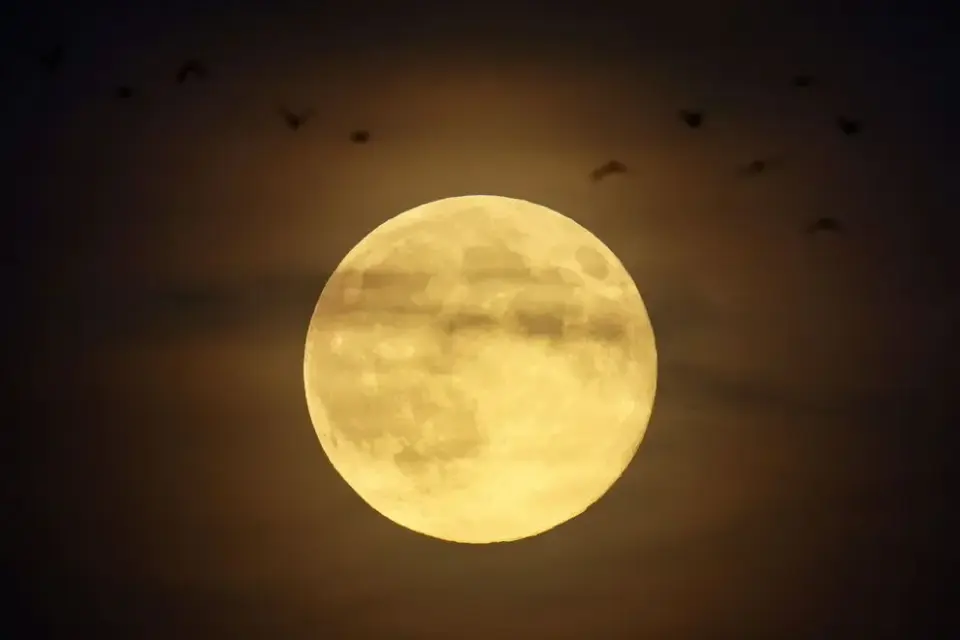
The October 2026 Hunter's Moon reached peak illumination at 12:12 a.m. EDT on Monday, October 26, appearing as a vibrant orange orb in skies worldwide. While it did not coincide with Halloween, it offered a spectacular display for photographers and stargazers, with visibility varying by region due to weather and light pollution.
Key points
- The Hunter's Moon peaked at 12:12 a.m. EDT on October 26, 2026, appearing largest and brightest in Western time zones before midnight on October 25.
- The moon is not a supermoon; it is the first full moon after the Harvest Moon and closest to the autumn equinox.
- The orange hue is caused by the scattering of blue light as the moon passes through a deeper layer of the atmosphere when low on the horizon.
- The full moon will not coincide with Halloween until 2039, as this alignment occurs only once every 18 to 19 years.
- Visibility in Michigan was hampered by clouds, rain, and fog, while other regions enjoyed clear skies for photography.
Background
October 2026 has been a busy month for astronomy, featuring Saturn at opposition on October 4 and the Orionid meteor shower peaking on October 21-22. The Hunter's Moon was the final major celestial event of the month, following the Harvest Moon and preceding the Beaver Moon supermoon in November.
How outlets are covering it
USA Today 10Best emphasized the historical significance of the Hunter's Moon for farmers and hunters, noting its role in signaling the end of harvest and the start of hunting season. BBC and Space.com focused on the global visual spectacle, highlighting stunning photographs from locations like New York, Istanbul, and Italy, and explaining the orange hue as a result of atmospheric scattering. The Detroit Free Press provided a regional perspective for Michigan, noting that clouds and fog likely hindered visibility, and clarified that the moon would not be full on Halloween, shifting to a waning gibbous phase by October 31.
Why it matters
The Hunter's Moon serves as a cultural and historical marker for the transition from farming to hunting in the Northern Hemisphere. Its visibility and appearance offer a shared global experience, connecting people through a common celestial event, and provide a backdrop for seasonal traditions and photography.
What to watch
The next full moon, known as the Beaver Moon, will peak on November 24, 2026, and will be a supermoon, appearing up to 30% brighter and 14% larger than the smallest full moon of the year. The next full moon coinciding with Halloween will not occur until 2039.
- Tonight's Hunter's Moon will glow orange for a spooky October sky USA TODAY 10BEST
- Stunning photos capture October's Hunter's Moon around the world BBC
- October full 'Hunter's Moon' dazzles in spectacular photos from around the world Space
- Will the full moon come on Halloween in Michigan? When to expect peak Detroit Free Press
- Here’s what to know about tonight’s Hunter’s Moon The Boston Globe
Want the full story? Read the original reporting
Read on USA TODAY 10BEST