
AI Model Identifies Hidden Sleep Risks Beyond Standard Apnea Metrics
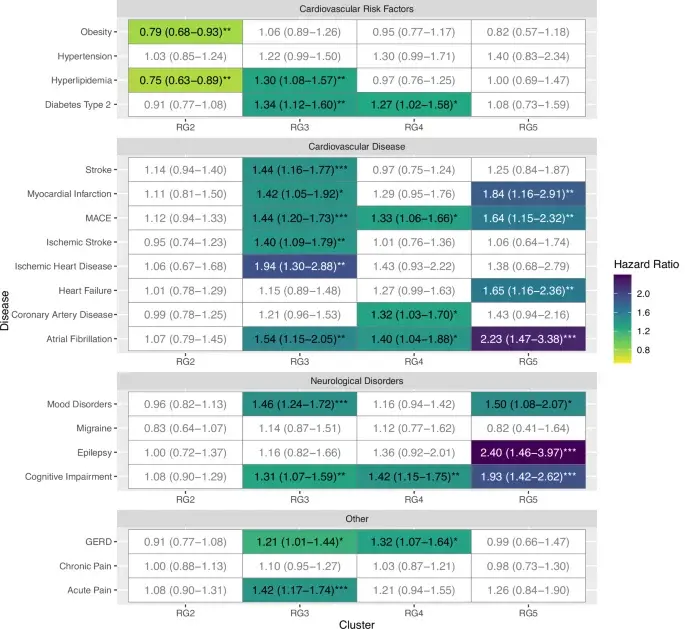
Researchers from Cleveland Clinic and IBM have developed a foundation model that analyzes full-night sleep recordings to predict long-term health risks. The model identifies five distinct patient groups with varying risks for mortality, cardiovascular, and neurological diseases, outperforming traditional metrics like the apnea-hypopnea index (AHI).
Key points
- A transformer-based model trained on 10,000 sleep studies from the Cleveland Clinic STARLIT registry generates high-dimensional embeddings of sleep physiology.
- The model identifies five risk groups; the highest-risk group has more than double the mortality risk of the lowest, a distinction missed by standard AHI severity categories.
- Validation on the independent Sleep Heart Health Study confirmed the model’s ability to distinguish high- and low-risk patients despite lower-resolution data.
- The approach integrates multimodal signals (EEG, ECG, airflow, etc.) with electronic medical records to capture complex physiological patterns invisible to single summary measures.
- The framework aims to enable precision sleep medicine by identifying subpopulations needing targeted interventions, such as cardiovascular monitoring, beyond standard sleep-disordered breathing treatments.
Background
This development follows a trend in medical AI where foundation models are applied to diverse biological data. In August 2026, a pathology foundation model (PRISM2) was introduced to link histology images with diagnostic reasoning. Similarly, in July 2026, researchers at UC San Francisco used machine learning on sleep EEG data to estimate 'brain age' and predict dementia risk, highlighting the growing focus on sleep as a digital biomarker for broader health outcomes.
How outlets are covering it
Nature and Bioengineer.org emphasize the model’s technical innovation and its potential to replace limited metrics like AHI with a comprehensive physiological assessment. Bioengineer.org highlights the scalability of foundation models across fragmented clinical datasets. ScienceDaily, covering a separate but related study, focuses on the clinical application of sleep EEG for dementia risk, noting that traditional sleep metrics fail to capture complex multidimensional physiology. While the primary source focuses on mortality and cardiovascular outcomes, the secondary source from ScienceDaily highlights neurological aging, suggesting a broader consensus that sleep signals contain latent risk information missed by conventional diagnostics.
Why it matters
Current sleep diagnostics rely heavily on the apnea-hypopnea index, which has limited prognostic value. This new model offers a scalable method to stratify patients by actual health risks, potentially improving resource allocation, referral patterns, and early intervention for cardiovascular and neurological diseases. It represents a shift from treating sleep disorders in isolation to using sleep data as a window into overall physiological resilience.
What to watch
The authors acknowledge limitations, including the retrospective design and reliance on supervised training objectives. Future work will explore self-supervised learning and prospective clinical trials to validate whether embedding-based stratification improves patient outcomes. The development of simplified surrogate metrics, such as the spectral sleep fragmentation score, may aid in translating complex embeddings to diverse clinical settings with lower-resolution data.
- A foundation model for sleep-based risk stratification and clinical outcomes Nature
- AI identifies previously unrecognized health insights in routine sleep studies Medical Xpress
- AI can tell if your brain is aging faster than you are sciencedaily.com
- AI model detects hidden health risks using standard sleep study data ThePrint
- Foundation Model Uses Sleep Data to Predict Health Risks and Clinical Outcomes Bioengineer.org
Want the full story? Read the original reporting
Read on Nature