
Levetiracetam May Extend Survival in Diffuse Midline Glioma by Disrupting Tumor-Neuron Connections
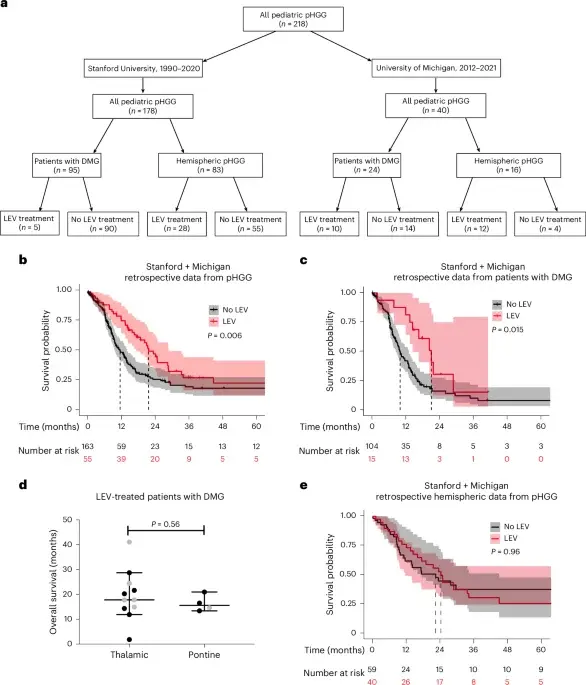
A new study in Nature Medicine suggests that levetiracetam, a common anti-seizure drug, may slow the growth of diffuse midline gliomas (DMG) in children by blocking specific electrical connections between tumor cells and healthy neurons. Retrospective data from four institutions showed that DMG patients taking levetiracetam had a median survival of approximately 21 months compared to 10 months for those not taking it. This benefit was not observed in patients with hemispheric high-grade gliomas. Preclinical mouse models confirmed that the drug reduces tumor proliferation in DMG but not in other glioma types, acting through a mechanism distinct from its standard anti-seizure function. Researchers are now launching clinical trials to validate these findings.
Key points
- Retrospective data from Stanford, Michigan, Hamburg, and UCSF showed DMG patients on levetiracetam had a median overall survival of 20.96 months versus 9.92 months for non-users.
- No survival benefit was observed in patients with hemispheric high-grade gliomas, indicating the drug's effect is specific to the tumor subtype.
- Levetiracetam reduces GABAergic synaptic currents in DMG cells but not in healthy neurons, suggesting a tumor-selective mechanism.
- The drug's anti-tumor effect is independent of its primary anti-seizure mechanism (SV2A interaction), as brivaracetam, which targets SV2A, showed no effect on DMG growth.
- Preclinical models showed reduced tumor burden and prolonged survival in mice with DMG xenografts, but no effect in hemispheric glioma models.
Background
Diffuse midline gliomas (DMG) are aggressive brain tumors affecting 300-400 U.S. children annually, with a five-year survival rate of approximately 1%. Previous studies on anti-seizure medications in glioma patients yielded inconsistent results, often due to confounding factors like tumor subtype and drug class. Recent research in cancer neuroscience has revealed that DMG cells form functional synapses with healthy neurons, using GABAergic signals to promote growth. This study builds on those findings, suggesting that repurposing existing neurological drugs could target these specific tumor-neuron interactions.
How outlets are covering it
Stanford Medicine emphasizes the potential of levetiracetam as a repurposed drug that 'severs' tumor-neuron connections, highlighting its safety profile and the promise of combining it with immunotherapy like CAR-T cells. Cure Today focuses on the statistical significance of the survival data and the limitations of the retrospective design, noting that small sample sizes and potential confounders (such as seizure phenotype) require prospective validation. The Nature Medicine article provides the detailed mechanistic evidence, confirming that the drug's effect is independent of its standard SV2A-mediated anti-seizure action and is specific to GABAergic synapses in DMG. All sources agree on the subtype-specificity of the drug's effect, contrasting DMG with hemispheric gliomas, but differ in emphasis: Stanford highlights the clinical potential and combination therapies, while Cure Today stresses the need for rigorous clinical trials to confirm the retrospective findings.
Why it matters
This research offers a potential new treatment avenue for a devastating childhood cancer with few options. If validated in clinical trials, levetiracetam could be used to slow tumor growth, potentially extending survival and improving outcomes for children with DMG. The finding that the drug acts through a tumor-specific mechanism, sparing healthy neurons, suggests a favorable safety profile for this application. Additionally, the insights into cancer neuroscience may inform the development of other repurposed drugs for brain tumors and metastatic cancers that form similar connections with the nervous system.
What to watch
Researchers are launching a clinical trial to test levetiracetam in patients with DMG. The study will aim to validate the retrospective findings and determine the optimal dosing and combination strategies, potentially alongside CAR-T cell therapy. Further research is needed to elucidate the exact molecular mechanism by which levetiracetam disrupts GABAergic synapses in DMG cells, as this pathway remains unknown. Additionally, the team is investigating whether levetiracetam can slow the growth of other cancers that metastasize to the brain, such as small cell lung cancer.
- Levetiracetam therapeutically targets GABAergic synapses in diffuse midline glioma Nature
- Anti-seizure drug fights aggressive childhood brain tumors, Stanford Medicine-led study shows Stanford Medicine
- Seizure Medication Linked to Longer Survival in Diffuse Midline Glioma Cure Today
- Common Seizure Drug Levetiracetam Slowed Deadly Childhood Brain Tumors in Lab Models and Was Tied to Longer Survival medicaldaily.com
- Anti-Seizure Drug Could Slow Aggressive Childhood Brain Tumors insideprecisionmedicine.com
Want the full story? Read the original reporting
Read on Nature