
Smartwatch data plus routine labs power scalable insulin-resistance screening
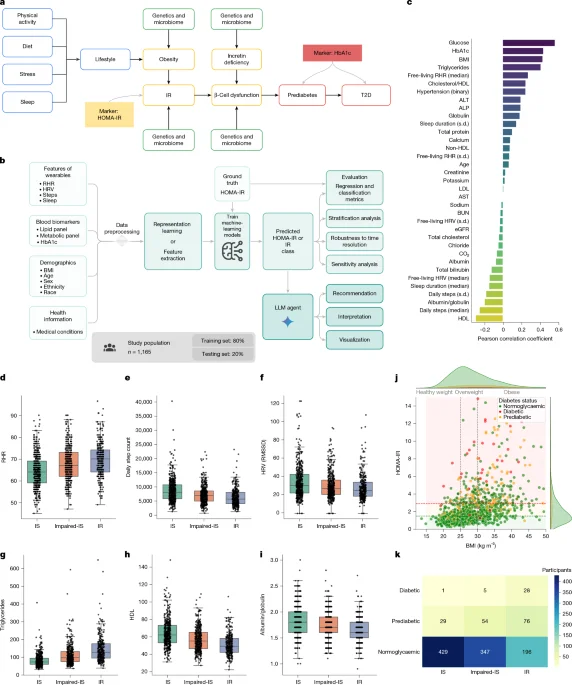
The WEAR-ME study (n=1,165) shows that combining wearable time-series data with demographics and routine blood biomarkers can predict insulin resistance (HOMA-IR ≥2.9) with AUROC around 0.80. Using a wearable foundation model to derive richer representations further improves performance, achieving AUROC ~0.82 in cross-validation, and up to ~0.88 when fasting glucose and a lipid/metabolic panel are included. An independent validation cohort confirms gains with wearable data, and an LLM-based insulin-resistance literacy agent is demonstrated to contextualize results and provide personalized guidance. The work proposes a scalable, noninvasive screening approach to identify at-risk individuals for early lifestyle interventions to prevent type 2 diabetes, while noting limitations in data missingness, generalizability, and the need for longitudinal validation.
- Insulin resistance prediction from wearables and routine blood biomarkers Nature
- Smartwatch data can be used to assess early diabetes risk Science News
- Predicting Insulin Resistance via Wearables, Biomarkers Bioengineer.org
- How Huawei smartwatches aim to spot early diabetes risk trends Gulf Business
- Huawei Watch D3 leak points to Q2 launch with blood glucose tracking Wareable
Want the full story? Read the original reporting
Read on Nature