
Chile’s Atacama Desert: How Marine Fog Sustains Life Where Rain Never Falls
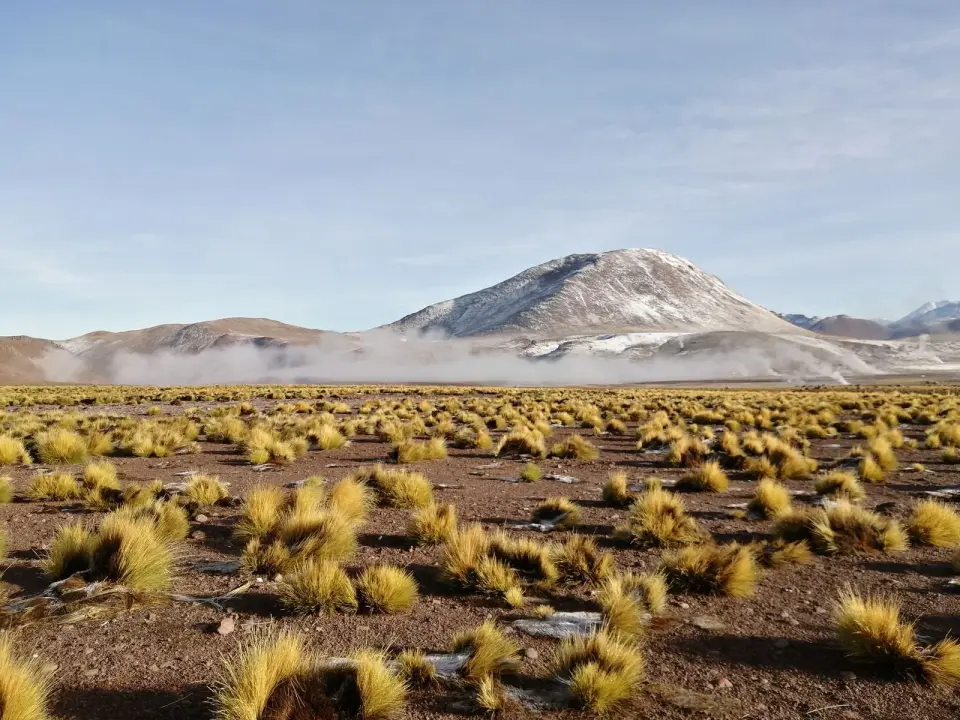
In Chile’s hyperarid Atacama Desert, some weather stations have recorded zero rainfall for over a century. Despite this, a marine fog called camanchaca, driven by the cold Humboldt Current, provides essential moisture. This fog supports unique lichens, cacti, and human communities through traditional and modern fog-catcher nets, which have supplied drinking water and irrigation for decades.
Key points
- The Atacama Desert is roughly ten times drier than the Sahara, with some stations recording no measurable precipitation for decades or even over a century.
- The camanchaca fog, formed by the cold Humboldt Current, settles on coastal cliffs between 400 and 1,200 meters elevation, typically peaking at dawn during the southern hemisphere winter.
- Unique lichen species, such as Roccellinastrum and Santessonia, rely exclusively on this fog for hydration, photosynthesizing for only a few hours daily during the fog season.
- Fog harvesting in Chile began in the 1950s; by 1987, the Chungungo community installed 100 collectors yielding up to 33 liters per day, scaling to 1,000 liters daily by 2004.
- Recent studies estimate that fog collectors in Alto Hospicio could yield 0.2 to 4.9 liters per square meter daily, potentially providing 200 to 4,900 liters per day for urban areas.
- Climate change uncertainty poses risks to the camanchaca; shifts in fog altitude or timing could be catastrophic for endemic species that depend on specific microclimatic conditions.
Background
Previous coverage of the Atacama highlighted its role as a Mars analogue due to its extreme aridity and near-lifeless soils, which challenge life-detection hardware. NASA used the region for four field seasons to rehearse rover missions. The current story expands on this by detailing how biological life persists in the hyperarid core through marine fog, contrasting the desert’s dryness with its hidden moisture sources.
Why it matters
The Atacama’s reliance on fog highlights the vulnerability of ecosystems and human communities to climate change. As the camanchaca is a product of specific atmospheric and oceanic conditions, shifts in temperature or wind patterns could disrupt the water supply for endemic species and local populations. Understanding and harnessing fog harvesting offers a sustainable water solution for arid regions, but its long-term viability depends on unpredictable climate models.
What to watch
Researchers are mapping fog types and collectable water potential to integrate fog harvesting into public water policy in Chile. Communities are expanding fog-catcher installations, but political will and funding remain limited. Climate models continue to struggle to predict changes in the camanchaca, leaving the future of fog-dependent ecosystems uncertain.
Want the full story? Read the original reporting
Read on Space Daily