
Brain Surgery Patient Experiences Rare Facial Feature Transfers Between Humans and Cats
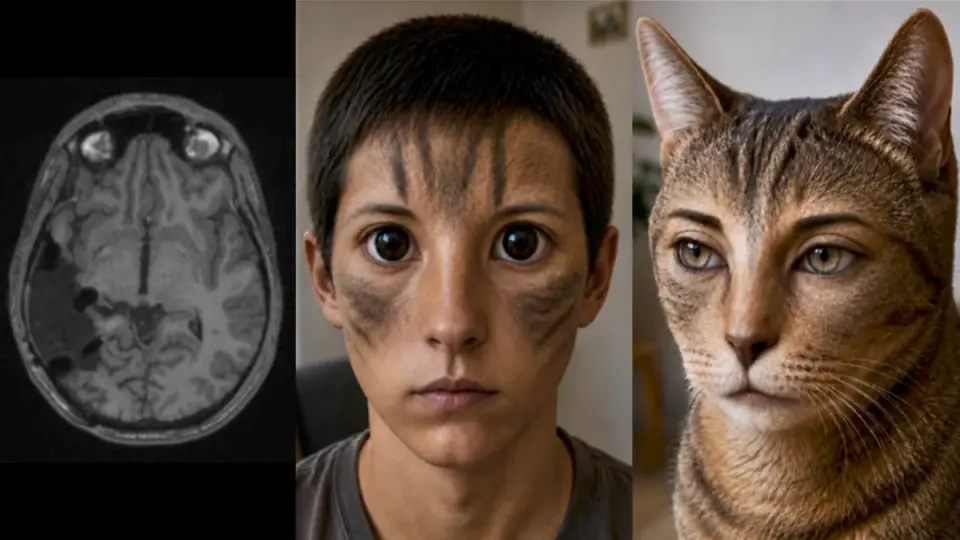
A 28-year-old man named Karl experiences a rare visual distortion called prosopometamorphopsia, where features of his cat Luna appear on human faces and vice versa. This condition began two years after he underwent surgery to remove an arteriovenous malformation in his right temporal lobe. Researchers at Dartmouth College and Brigham and Women’s Hospital published the case in the journal Cortex, utilizing AI tools to visualize the distortions. The case highlights how facial memory can influence perception and mirrors a similar 1986 case involving a poodle.
Key points
- Karl, a 28-year-old from the northeastern US, sees his cat Luna’s features, such as enlarged pupils and stripes, on human faces, and sometimes sees human features on Luna.
- The condition, prosopometamorphopsia, began two years after surgery to remove a tangled mass of blood vessels (arteriovenous malformation) in his right posterior temporal lobe.
- Researchers Brad Duchaine, Antônio Mello, and Jennifer L. Nosker published the case study in the journal Cortex, noting that the distortions can last for hours or all day.
- The team used AI tools, including ChatGPT 5.5, to generate visualizations of Karl’s experience, allowing him to refine images to match his perception.
- Duchaine notes that many patients with similar distortions are misdiagnosed with psychiatric issues, leading to unnecessary antipsychotic treatment.
- A similar case was reported in 1986 involving a stroke survivor who saw a poodle’s face on bus passengers, highlighting the rarity of animal-human feature transfer.
Background
This case follows a 1986 report in the same journal, Cortex, where a woman with a stroke saw a poodle’s face on bus passengers. It also relates to broader research on prosopometamorphopsia, a condition where faces appear distorted due to damage in brain areas involved in face processing. Recent archive coverage from November 11, 2026, noted the initial publication of this case, emphasizing the role of AI in understanding visual perception disorders.
How outlets are covering it
ScienceAlert and Popular Science emphasize the novelty of the case and the use of AI to visualize the distortions, highlighting how Karl’s experience helps researchers understand facial processing. VICE focuses on the practical implications, noting that many patients are misdiagnosed with psychiatric issues and treated with antipsychotics. Newsweek provides a broader context on prosopometamorphopsia, noting that while there is no established treatment, researchers are investigating stimulus manipulations. All sources agree on the rarity of animal-human feature transfer and the importance of the case for understanding brain function.
Why it matters
This case underscores the complexity of facial processing in the brain and the potential for misdiagnosis in visual perception disorders. The use of AI to visualize these distortions offers a new tool for researchers and patients to communicate and understand their experiences, potentially leading to better treatments and reduced stigma for those with prosopometamorphopsia.
What to watch
Researchers plan to continue working with Karl to monitor changes in his condition over time and use AI tools to further understand the distortions. They are also investigating stimulus manipulations that may influence the distortions in some cases of prosopometamorphopsia. The team is seeking more case studies to advance their research.
- Rare Medical Case Leaves US Man Seeing His Cat's Eyes in People's Faces After Brain Surgery ScienceAlert
- How a 28-Year-Old Developed a Rare Condition That Makes People Look Like Cats VICE
- Man Has Brain Surgery, Then Starts Seeing Cat Features on Human Faces Newsweek
- Man with ‘demon face syndrome’ sees cat’s eyes in human faces Popular Science
- Human or feline? Rare condition makes US man see cat's eyes in people's faces after brain surgery Deccan Herald
Want the full story? Read the original reporting
Read on ScienceAlert