
SPACER AI Decodes Spatial Rules for Immune Cell Recruitment in Tumors and Hearts
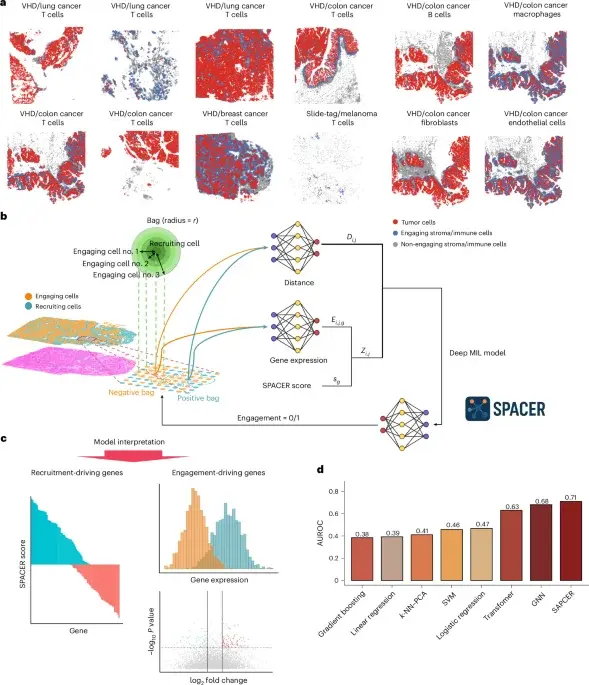
A new interpretable AI framework called SPACER decodes gene-level rules governing how immune cells are recruited to specific tissue locations. Tested across 37 datasets, it outperforms existing methods by 4-21 times. Key findings link tumor mucins to T-cell exclusion and checkpoint inhibitor resistance, identify local antigen presentation as the primary driver of T-cell engagement, and reveal CD4+ T cells as the main effectors in severe checkpoint inhibitor-induced myocarditis.
Key points
- SPACER is a multi-instance learning framework that extracts interpretable, gene-level recruitment rules from spatially resolved transcriptomics (SRT) data, unlike previous black-box models.
- The tool achieved 4-21 fold improvements over existing methods across 37 SRT datasets covering human tumors and mouse heart tissue.
- Tumor-expressed mucins create physical barriers that prevent T-cell engagement, a signal that predicts resistance to immune checkpoint inhibitors and poor patient prognosis.
- Local antigen presentation was identified as the dominant correlate for T-cell engagement across various cancer types, outcompeting chemokine gradients.
- In models of checkpoint inhibitor-induced myocarditis, CD4+ T cells were identified as the dominant functional effectors driving heart inflammation.
Background
This study builds on recent advancements in spatial biology, such as the VIMA deep learning method (October 2026) and cross-population genomics studies (September 2026), which have improved the mapping of cellular states in tissues. While previous tools like SpaGCN and NicheNet inferred cell-cell communication, they often lacked the causal interpretability required to explain why cells are located in specific niches. SPACER addresses this gap by focusing on the mechanistic 'why' of cell positioning rather than just the 'where.'
How outlets are covering it
Nature Biomedical Engineering emphasizes the technical novelty of SPACER as a 'fully interpretable' framework that bridges the gap between computational prediction and biological mechanism. Bioengineer.org highlights the translational potential, noting that mucin-associated barriers could serve as biomarkers to stratify patients before immunotherapy. Newswise focuses on the practical application, framing the tool as a way to understand what attracts or repels immune cells across diseases. All sources agree on the performance metrics (4-21 fold improvement) and the three main biological findings, but Bioengineer.org provides more detail on the validation using immunopeptidomics and T-cell receptor sequencing, while Newswise keeps the focus on the broad utility of the AI tool.
Why it matters
This research provides a new method to predict immunotherapy resistance by identifying physical barriers like mucins that block T-cell access to tumors. It also clarifies the mechanism behind a dangerous side effect of cancer treatment, identifying CD4+ T cells as the drivers of myocarditis, which could lead to better monitoring and management of patients receiving checkpoint inhibitors.
What to watch
The SPACER code and datasets are available via GitHub and public repositories like NIH GEO. Researchers can now use the tool to generate testable hypotheses about cell recruitment in other tissues and diseases, potentially leading to new biomarkers for patient stratification and therapeutic strategies.
- Interpretable AI model reveals spatial codes of cell recruitment in tissues Nature
- AI Deciphers the Hidden Spatial Rules That Guide Immune Cells Through Tissues Bioengineer.org
- AI Tool Reveals What Attracts Immune Cells to Tumors and What Keeps Them Away | Newswise Newswise
- New AI Framework Reads Gene Maps Like Images to Reveal Hidden Cell States Bioengineer.org
- New AI Model Decodes the Signals That Guide Immune Cells Into Tumors Bioengineer.org
Want the full story? Read the original reporting
Read on Nature