
Archaeal Nitrogenase Structure Reveals Energy-Linked Inhibition Mechanism
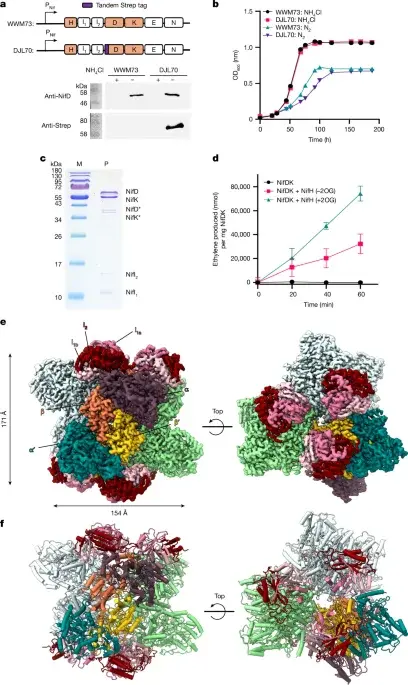
Researchers have determined the first cryo-electron microscopy structure of a native nitrogenase-PII protein supercomplex from the methanogen Methanosarcina acetivorans. The study reveals that six PII complexes bridge three NifDK heterotetramers, sterically blocking the enzyme and locking it in an inactive state. This architecture links nitrogenase activity directly to cellular energy and nitrogen status through asymmetric binding of ADP and 2-oxoglutarate.
Key points
- The supercomplex consists of three NifDK heterotetramers bridged by six NifI1,2 heterotrimeric PII complexes.
- PII complexes sterically block NifH association, preventing the enzyme from becoming active.
- Asymmetric binding of ADP and 2-oxoglutarate in PII complexes couples inhibition to cellular energy and nitrogen levels.
- Adding 2-oxoglutarate and ATP releases the PII complexes, resulting in a threefold increase in NifDK activity in vitro.
- This structure provides the first architectural insight into archaeal nitrogenase regulation, previously unknown despite evidence of nitrogen fixation in methanogens.
Background
Previous studies established that methanogens like Methanosarcina acetivorans possess nitrogenase enzymes capable of fixing atmospheric nitrogen, but the structural mechanisms regulating these enzymes remained unclear. While bacterial nitrogenase structures were well-characterized, archaeal counterparts lacked detailed architectural data. Recent advancements in cryo-electron microscopy have enabled the visualization of complex protein assemblies, as seen in other 2026 studies on RNA and viral proteins, facilitating this breakthrough in understanding archaeal biochemistry.
Why it matters
Understanding the regulatory mechanisms of archaeal nitrogenase offers new insights into the evolution of biological nitrogen fixation and could inform biotechnological applications for sustainable ammonia production. The discovery that PII proteins drive nitrogenase oligomerization to control activity suggests a novel regulatory strategy that may be applicable in engineering microbial systems for industrial nitrogen fixation.
What to watch
Researchers will likely explore the evolutionary implications of this higher-order architecture and investigate how these regulatory mechanisms can be harnessed for biotechnological purposes, such as improving nitrogen fixation in engineered organisms or developing new methods for sustainable ammonia synthesis.
Want the full story? Read the original reporting
Read on Nature