
Cryo-EM reveals deep pocket mechanism for Andes hantavirus cell entry
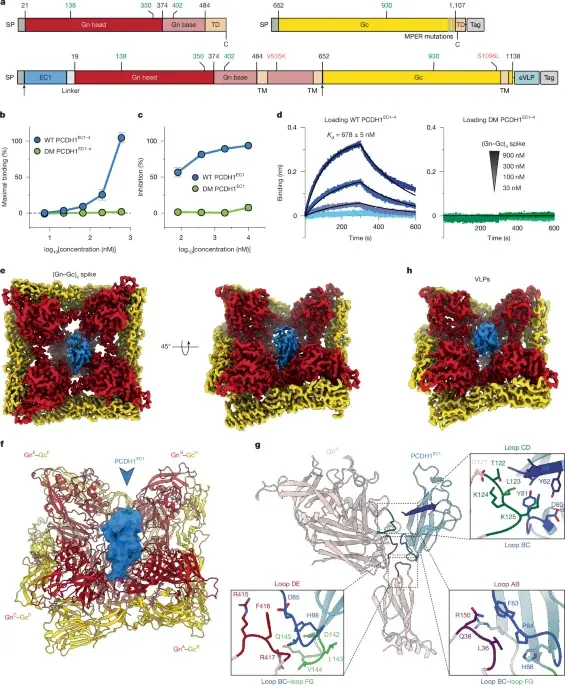
Researchers have determined the near-atomic structure of the Andes virus spike bound to the human receptor PCDH1, revealing a unique binding mechanism that facilitates infection and evades antibodies. This finding provides a structural framework for developing new therapeutics against hantaviruses, which currently lack approved treatments.
Key points
- The Andes virus spike consists of four identical protein units forming a square configuration, unlike the triangular structure of SARS-CoV-2.
- The receptor PCDH1 binds asymmetrically into a deep central pocket formed by the four spike protomers, a mode not seen in other enveloped viruses.
- This deep pocket allows the slender PCDH1 to bind while excluding bulky antibodies, creating a 'friend-or-foe' immune evasion strategy.
- Mutagenesis of three specific loops in the viral glycoprotein Gn determines receptor recognition and can transfer binding capability between New and Old World hantaviruses.
- Four neutralizing antibodies block infection via two distinct mechanisms: directly occluding the binding site or sterically hindering receptor access through constant regions.
Background
In 2018, researchers identified PCDH1 as the critical receptor for Andes virus entry into human cells, but the structural basis of this interaction remained unknown. The virus is notable for its ability to transmit between humans, a trait highlighted by a recent cruise ship outbreak that resulted in three deaths. No FDA or EMA-approved medical countermeasures currently exist for hantaviral infections, making the understanding of viral entry mechanisms a priority for public health.
How outlets are covering it
The primary source from Nature provides the detailed structural data, emphasizing the asymmetric engagement of PCDH1 with the spike's central pocket and the specific loops involved in binding. Secondary sources from DongA Science and BioSpace highlight the practical implications, noting that the virus's ability to mutate its surface to evade antibodies while preserving receptor binding creates a vulnerability that could be exploited by engineered 'long and skinny' therapeutic molecules. Bossier Press-Tribune focuses on the collaborative nature of the research, specifically crediting LSU Health Shreveport for developing safer systems to study the virus and validating the structural findings through functional experiments. All sources agree that this structural insight is a critical step toward developing broad-spectrum antivirals for Andes and related viruses like Sin Nombre virus.
Why it matters
Understanding the precise molecular mechanism of viral entry is essential for designing effective therapeutics and vaccines. By revealing how the Andes virus masks its receptor-binding site, this research offers a blueprint for creating antibodies or drugs that can penetrate the binding pocket, potentially leading to treatments for a virus with a case-fatality rate approaching 40% and the rare ability for human-to-human transmission.
What to watch
Researchers plan to use these structural insights to design new antiviral therapeutics that target the hantavirus spike. This includes developing molecules capable of fitting into the deep receptor-binding pocket to block infection, as well as exploring strategies to increase antibody occupancy on the viral surface to enhance neutralization.
- Structural basis for protocadherin-1 recognition by New World hantaviruses Nature
- Albert Einstein College of Medicine maps Andes hantavirus entry to guide new drugs DongA Science
- LSU Health Shreveport Researchers Help Unlock How Deadly Hantavirus Infects Human Cells Bossier Press-Tribune
- Scientists Reveal How Deadly Andes Hantavirus Attaches to Human Cells BioSpace
- Hantavirus spike structure reveals recessed protocadherin-1 binding pocket Bioengineer.org
Want the full story? Read the original reporting
Read on Nature