
Decades-long blood evolution precedes acute myeloid leukemia diagnosis
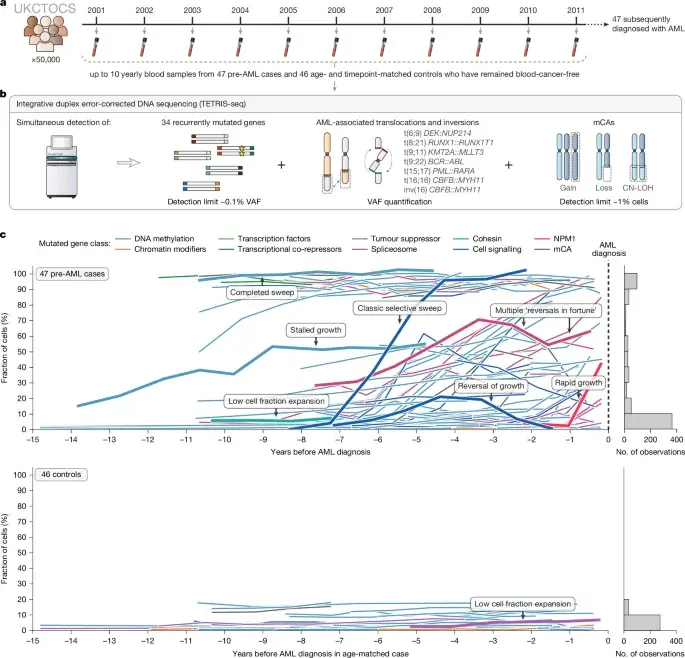
Researchers used serial blood samples from 47 women who later developed acute myeloid leukemia (AML) to map the evolutionary dynamics of pre-cancerous clones. The study reveals that the first driver mutations often occur in the first few decades of life, expanding slowly. Subsequent mutations confer massive fitness advantages, leading to complete somatic sweeps of the blood decades before clinical diagnosis. These findings suggest that early detection of these sweeps could significantly improve risk prediction for AML.
Key points
- Analysis of 249 pre-AML blood samples from the UKCTOCS cohort shows that driver mutations in genes like DNMT3A and TET2 are acquired early in life, often before age 20.
- Initial clones expand slowly with fitness advantages of 10-30% per year, but subsequent mutations increase growth rates geometrically, reaching up to 1,000% per year for quadruple-mutant clones.
- Complete somatic sweeps, where a single clone dominates the blood, occur in at least one-third of pre-AML cases and are strongly associated with future leukemia risk.
- A simple stochastic model accurately predicts the observed clonal dynamics, including linear evolution and clonal interference, without requiring complex spatial structures.
- Identifying somatic sweeps in large cohorts like the UK Biobank could improve early detection, as current filters for germline variants may inadvertently remove high-risk somatic signals.
Background
This study builds on previous research showing that clonal hematopoiesis increases the risk of blood malignancies. While earlier studies provided static snapshots of somatic diversity, this research utilizes longitudinal data to quantify the timing and fitness effects of driver mutations over decades. It complements recent clinical trials, such as the one involving Ryan Goepel, by providing a mechanistic understanding of the long pre-cancerous phase that precedes acute leukemia diagnosis.
Why it matters
Understanding the quantitative rules governing pre-cancerous evolution allows for the development of more rational approaches to early cancer detection and risk prediction. The discovery that somatic sweeps are strong predictors of future AML suggests that current genomic filtering methods may be missing critical risk signals. This knowledge could lead to personalized interventions, such as targeted inhibitors or vaccines, applied years before clinical diagnosis, potentially preventing or delaying the onset of acute myeloid leukemia.
What to watch
Researchers plan to validate the predictive power of somatic sweeps in larger cohorts by using second tissue samples, such as buccal swabs, to distinguish somatic from germline variants. Further studies will explore how environmental risk factors influence the fitness of mutant clones and whether interventions can reduce the growth of high-fitness pre-leukemic clones before they progress to frank leukemia.
Want the full story? Read the original reporting
Read on Nature