
Global team builds 6,986 digital brain twins to link environmental factors with dementia mechanisms
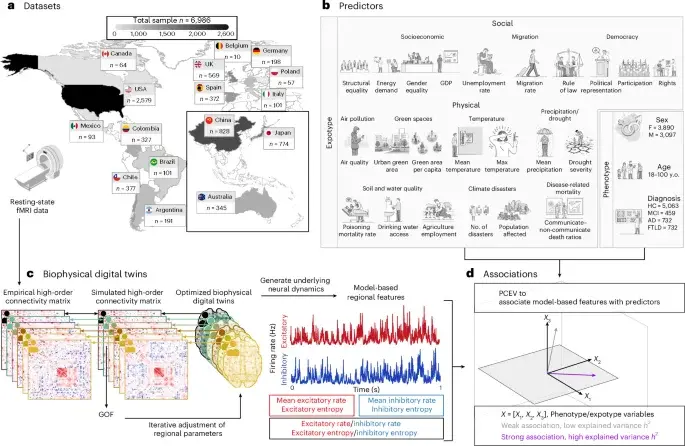
Researchers have developed individualized biophysical digital twins for 6,986 participants across 16 countries to map how aging, neurodegeneration, and environmental exposures shape brain dynamics. Published in Nature Biomedical Engineering, the study uses resting-state fMRI data to create personalized models that simulate neural activity, revealing distinct patterns for Alzheimer’s disease and frontotemporal dementia. The models demonstrate that social and physical environmental factors, such as air pollution and democratic governance, significantly correlate with brain function, offering a new framework for testing potential interventions.
Key points
- The study utilized resting-state fMRI data from 6,986 individuals aged 18 to 100 across 16 countries to create personalized biophysical models of 90 interconnected brain regions.
- Personalized digital twins outperformed group-level models in fitting empirical data and successfully reproduced the coupling between regional excitability and brain volume, validating their biological accuracy.
- Analysis revealed that frontotemporal dementia exhibited the most significant deviation from healthy baseline patterns, characterized by complex network-wide dysregulation rather than uniform activity changes.
- Environmental associations remained robust after controlling for demographics and data quality, with the strongest links found in social exposomes (democratic governance) and physical exposomes (air pollution, soil, and water quality).
- The researchers released open-source code and over 3 million simulations to enable independent replication and future in silico testing of therapeutic interventions and environmental impacts.
Background
This research builds on previous initiatives in computational neuroscience, such as the 2025 release of diversity-sensitive brain clocks and the 2026 exposome studies across 34 countries. It follows a broader trend in neuroimaging toward moving beyond group averages to address individual heterogeneity in neurodegenerative diseases, as highlighted in recent reviews on connectome-based modeling. The work also aligns with ongoing efforts to integrate environmental factors into brain health assessments, a theme present in earlier 2026 publications on the exposome of healthy and accelerated aging.
How outlets are covering it
All four sources agree on the core methodology and sample size, but they emphasize different aspects of the findings. Nature and Inside Precision Medicine highlight the technical advance of moving from indirect MRI measures to simulated biophysical mechanisms, quoting lead authors on the utility of 'virtual laboratories.' Bioengineer.org provides a more detailed breakdown of the environmental analysis, specifying that the strongest links were with democratic governance indicators and physical pollution. UA.NEWS offers a concise summary of the clinical findings, noting that frontotemporal degeneration showed the largest deviation from healthy profiles. While Nature focuses on the 'phenotype-expotype architecture,' the secondary sources emphasize the practical application of these twins for testing future interventions and understanding the impact of social determinants on brain aging.
Why it matters
This study provides a mechanistic bridge between observable brain scans and underlying biological processes, allowing researchers to test how environmental and social factors influence neural dynamics. By creating individualized models, scientists can move beyond correlational observations to simulate potential interventions, potentially identifying new therapeutic targets for dementia and healthier aging strategies that account for diverse global contexts.
What to watch
Researchers plan to integrate molecular maps of neurotransmitter receptors, specifically glutamate and GABA, into the digital twins to simulate how chemical signaling changes might shift brain dynamics toward healthy patterns. Future studies will also test whether these models can predict changes in individuals over time or in response to specific environmental and healthcare interventions, aiming to identify why some individuals are more vulnerable to neurodegenerative diseases.
- Biophysical brain twins map the phenotype–expotype architecture of ageing and dementia Nature
- Scientists build nearly 7,000 'digital brain twins' to explore aging, dementia and the exposome Medical Xpress
- Personalised Digital Brain Twins Link Neural Dynamics to Ageing and Environment Bioengineer.org
- Scientists create 6,986 digital brain models to study dementia — News-Medical UA.NEWS
- Nearly 7,000 Digital Brain Twins Created to Study Aging and Dementia Inside Precision Medicine
Want the full story? Read the original reporting
Read on Nature