
Indian Researchers Build First High-Resolution 3D Map of the Human Brainstem
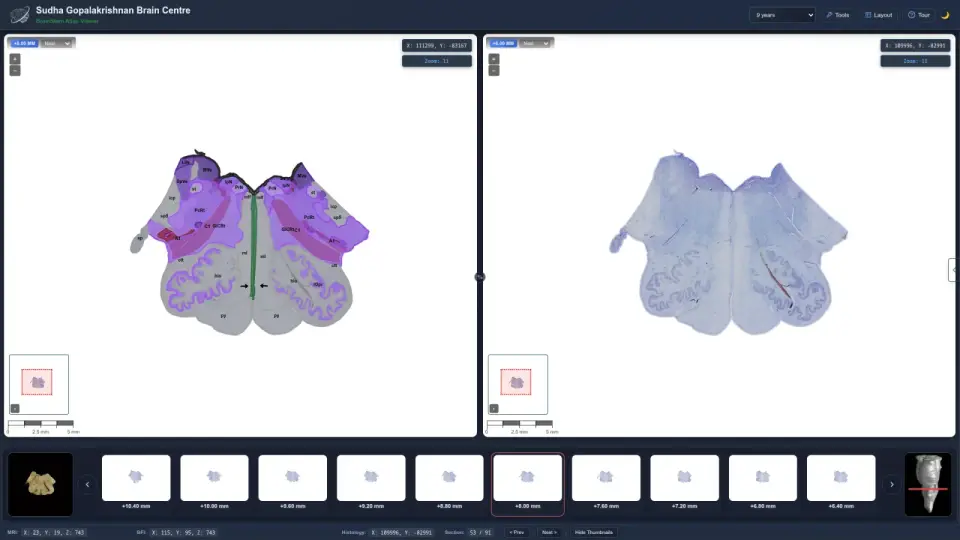
Researchers at the Sudha Gopalakrishnan Brain Centre in India have created the most detailed map of the human brainstem to date. Using high-resolution microscopy and block face imaging on three samples, they produced a 3D model that is now available for exploration in a web browser. This new resource aims to advance research into neurological conditions such as Parkinson’s and Alzheimer’s by providing precise anatomical data.
Key points
- The brainstem is a critical but poorly understood part of the brain, where minor damage can be fatal.
- The new map was created by the Sudha Gopalakrishnan Brain Centre (SGBC) in India.
- The project utilized three brainstem samples from a 45-week fetus, a 9-year-old, and a 54-year-old.
- The methodology involved MRI and Block Face Imaging (BFI), followed by slicing samples into 20/40µm pieces.
- Researchers used in-house software to annotate the images and combine them into a 3D model.
- The resulting 3D model is accessible via a web browser for further study.
Background
This development follows broader trends in neuroscientific mapping, such as the 2026 publication of a long-term plan for warming Mars, which also emphasized the need for detailed data before large-scale efforts. While unrelated to space exploration, the brainstem map represents a significant step in understanding human anatomy, similar to how detailed environmental data is required for planetary science. The project builds on previous efforts to map complex biological structures, though it is distinct from the recent coverage of Spider-Man: Brand New Day or the documentary on Lindsey Graham, which are unrelated to medical science.
Why it matters
A high-resolution map of the brainstem could significantly improve the understanding of neurological diseases. By providing detailed anatomical data, this resource may help researchers identify the root causes of conditions like Parkinson’s and Alzheimer’s, potentially leading to better treatments and interventions. The accessibility of the 3D model via a web browser also democratizes access to this critical data for the global scientific community.
What to watch
The next step is for the research paper to undergo peer review. Once validated, the 3D model and associated data will likely be used by researchers worldwide to study the brainstem's function and its role in various neurological conditions. This could lead to new insights into how the brainstem operates and how it can be protected or treated in cases of damage or disease.
Want the full story? Read the original reporting
Read on Hackaday