
Pitt-CMU Collaboration Reveals Novel Chromatin Changes in Alzheimer's Disease
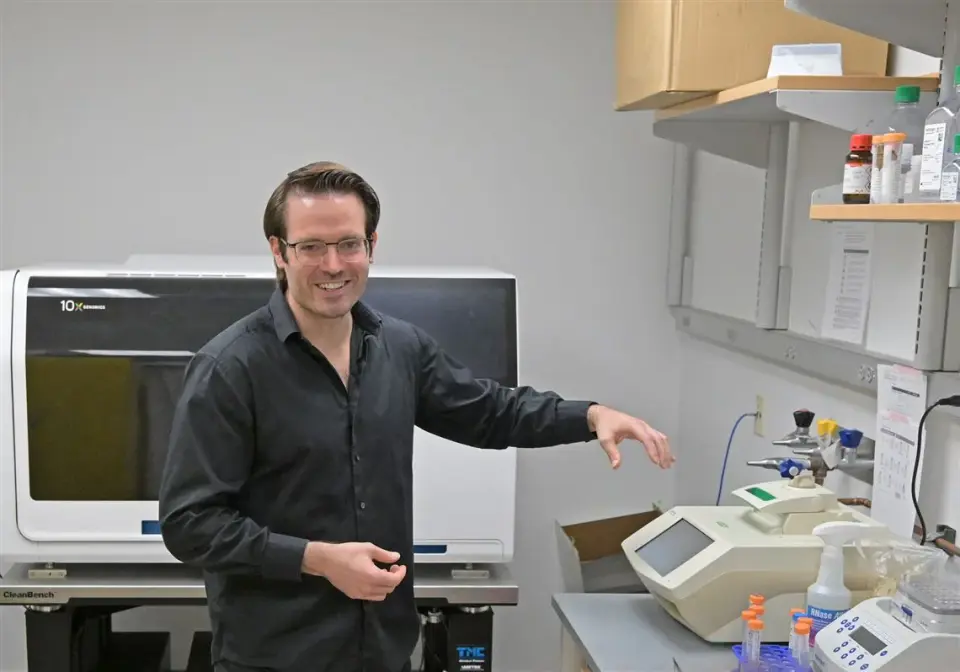
A joint study by University of Pittsburgh and Carnegie Mellon researchers, published in Science on July 23, 2026, discovered that chromosomes in Alzheimer's patients are organized differently than in healthy brains. Using advanced technologies like GAGE-Seq and Xenium, the team analyzed postmortem brain tissue from 20 individuals, finding that active and inactive genomic regions mingle more in Alzheimer's cases. This structural change, invisible to standard DNA sequencing, correlates with altered gene activity related to brain function and metabolism. The findings highlight the need for multi-layered approaches to understand the disease, though the root cause and clinical implications remain unclear.
Key points
- The study, led by Jian Ma (CMU) and Hansruedi Mathys (Pitt), was the first to combine single-cell gene activity and chromatin structure analysis in Alzheimer's research.
- Postmortem brain tissue from 20 individuals (10 with Alzheimer's, 10 healthy controls) was sourced from the Rush Alzheimer's Disease Center in Chicago.
- Researchers found that genomic compartments in Alzheimer's patients are less distinct, with active and inactive regions mingling more than in healthy brains.
- This chromatin reorganization is linked to altered activity in genes involved in brain cell function and metabolic processes like insulin handling.
- The findings cannot be detected by traditional DNA sequencing alone, emphasizing the need for holistic, multi-technology approaches to study Alzheimer's.
- The study focused on advanced-stage Alzheimer's; researchers note the need for future studies across different disease stages and larger donor pools.
Background
Recent Alzheimer's research has explored various angles, including tracing disease origins in brain cell endosomes (Columbia University, 2026) and investigating smell loss as an early indicator of neurodegeneration (2026). The Pitt-CMU study adds a new dimension by focusing on chromatin structure, a field where prior work had not combined multiple resolution levels in a single study. The collaboration also reflects a growing emphasis on inter-institutional partnerships in Pittsburgh to accelerate biomedical research.
Why it matters
This discovery provides a new lens for understanding Alzheimer's disease, revealing structural changes in the genome that were previously invisible. It underscores the complexity of the disease and the limitations of single-method research, potentially guiding future therapeutic strategies and diagnostic tools. The collaboration model between Pitt and CMU may also inspire similar partnerships to advance neurodegenerative disease research.
What to watch
Researchers plan to continue their collaboration and encourage other Pitt-CMU teams to partner. Future studies will likely expand to include more donors, different stages of Alzheimer's, and additional technologies to determine if the observed chromatin changes are consistent across the disease spectrum and to explore their causal role.
Want the full story? Read the original reporting
Read on Pittsburgh Post-Gazette