
ProteinTalks Model Predicts Drug Responses Using 38 Million Proteomics Data Points
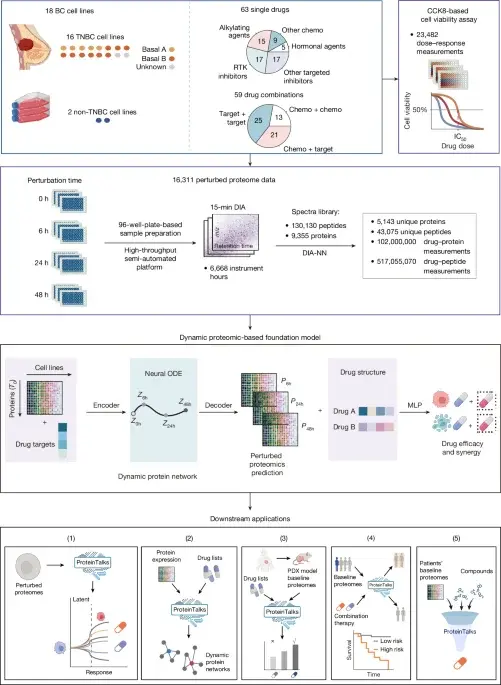
Researchers have developed ProteinTalks, a virtual cell model that uses over 38 million time-resolved protein abundance measurements from breast cancer cell lines to predict drug efficacy, synergy, and resistance. Published in Nature, the model leverages a new pretraining framework to learn transferable dynamic representations, enabling it to function as an operational tool for in silico drug discovery. It demonstrates robust performance across cell lines, patient-derived organoids, and clinical biopsies, outperforming selected benchmark implementations in various drug discovery tasks.
Key points
- The study generated more than 38 million temporal protein-abundance measurements from systematically perturbed breast cancer cell lines to create a large-scale dynamic proteomic resource.
- ProteinTalks utilizes a new pretraining framework that learns transferable dynamical latent representations from temporal proteome trajectories, allowing it to model how proteins respond conditionally to different perturbations.
- The model serves as an operational tool for diverse drug discovery tasks, including predicting drug efficacy and synergy, discovering new drug combinations, and probing proteins associated with drug resistance.
- ProteinTalks shows robust transferability, extending its application beyond cell lines to patient-derived organoids and clinical biopsies, generally achieving higher performance than benchmark implementations under evaluated protocols.
- The research addresses the lack of large-scale, time-resolved perturbation proteomics data and interpretable frameworks in existing AI-empowered virtual cell models for in silico drug discovery.
Background
This development follows a trend in computational biology where AI-driven virtual cell models are emerging as key tools for preclinical research. Previous studies, such as those on silk-based scaffolds for cartilage regeneration and microglia-driven inflammation in Alzheimer's models, highlight the growing reliance on advanced biological models to understand disease mechanisms and test therapeutic interventions. The ProteinTalks model builds on this by integrating massive proteomic datasets with machine learning to simulate cellular responses to drugs, aiming to accelerate the translation of in silico findings to clinical applications.
Why it matters
ProteinTalks represents a significant step forward in in silico drug discovery by providing a scalable, dynamics-aware model that can predict therapeutic responses with high accuracy. By leveraging large-scale proteomic data and transferable latent representations, it offers a more interpretable and robust framework for identifying drug candidates, understanding resistance mechanisms, and stratifying patient responses. This could reduce the time and cost associated with traditional drug development processes, potentially leading to more effective and personalized cancer treatments.
What to watch
The next steps likely involve further validation of ProteinTalks in clinical settings and its application to other disease areas beyond breast cancer. Researchers may also explore the integration of additional omics data to enhance the model's predictive capabilities. The availability of the raw mass spectrometry proteomics data and analysis codes through open-access platforms suggests that the scientific community will likely build upon this work to refine and expand the model's applications.
Want the full story? Read the original reporting
Read on Nature