
Bacillus subtilis Uses Protein-Lipid Filaments to Expand Bioenergetic Capacity
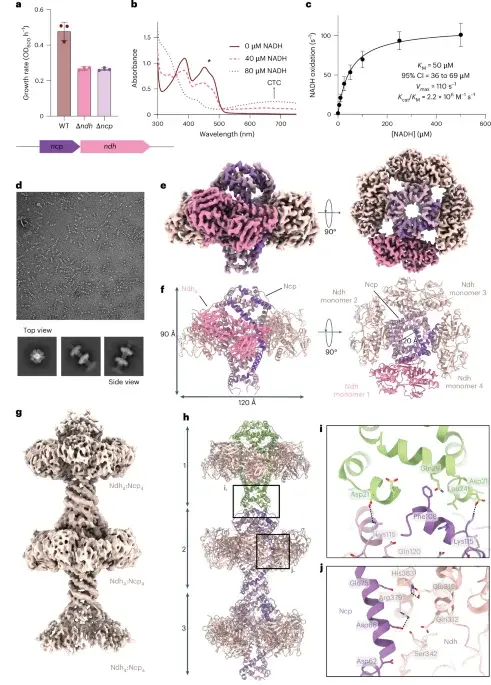
Researchers have identified a novel mechanism in Gram-positive bacteria that allows them to expand their respiratory capacity without internal organelles. In Bacillus subtilis, the NADH dehydrogenase Ndh and the quinone-transporting protein Ncp form tube-like filaments that sequester and transport hydrophobic quinones. This structure, described as a pseudomembrane, increases the surface area for electron transfer while occupying minimal membrane space, offering a solution to the constraints of single-membrane bioenergetics.
Key points
- Bacillus subtilis forms filaments composed of Ndh and Ncp proteins, which act as a quinone-transporting pseudomembrane.
- Cryo-EM and molecular dynamics reveal a 4:4 stoichiometric complex with a hydrophobic lumen containing phospholipids that sequester quinones.
- These filaments link chambers into a continuous conduit, amplifying quinone reduction and extending respiratory activity beyond the cell membrane.
- Phylogenetic analysis indicates this capacity-generating mechanism is widespread across the Bacillota phylum.
- The discovery highlights a strategy for Gram-positive bacteria to overcome bioenergetic constraints without relying on internal membrane invaginations or organelles.
Background
Previous research established that cellular respiration is limited by membrane surface area, with Gram-negative bacteria and eukaryotes using internal invaginations or organelles to expand capacity. Gram-positive bacteria, which possess only a single membrane, were thought to lack alternative mechanisms for expanding respiratory capacity. This study builds on recent discoveries of quinone-transporting complexes in other bacteria, such as Huc and ForCE, to identify a distinct filamentous structure in Bacillota.
Why it matters
This finding reveals a fundamental and conserved mechanism for bacterial bioenergetics that was previously unknown. By demonstrating how Gram-positive bacteria can expand their quinone pool and respiratory capacity through protein-lipid filaments, the research provides new insights into microbial physiology and evolution. It also offers a potential target for understanding metabolic stress and rapid growth in soil-dwelling bacteria, with implications for industrial microbiology and synthetic biology.
What to watch
Further research will likely focus on the physiological role of these filaments under various metabolic stresses and growth conditions. Scientists may also investigate the evolutionary origins of this mechanism and its prevalence in other Gram-positive species. Additionally, the detailed structural insights could inform the design of synthetic bioenergetic systems or the development of antimicrobial strategies targeting bacterial respiratory chains.
Want the full story? Read the original reporting
Read on Nature